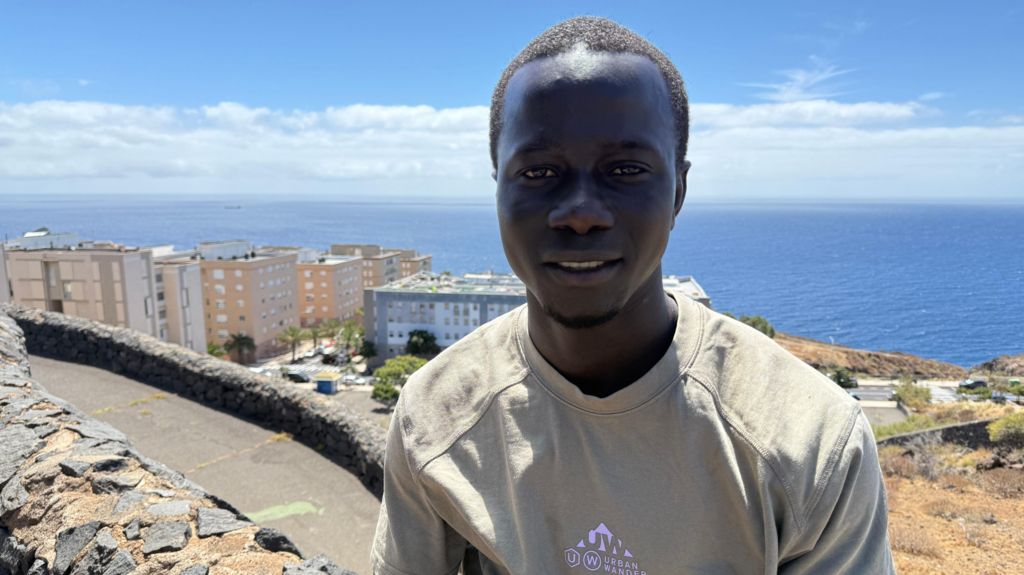
At 19 years old, Bakary Jaiju made an unthinkable choice: leave behind his young wife and infant child in the Gambia, board an overcrowded wooden dinghy, and cross the deadly Atlantic Ocean to Europe in search of a future he could never build at home. For seven terrifying days at sea, the gravity of his gamble sank in with every passing hour. Food and fresh water dwindled to almost nothing, and sleep became a luxury no one dared afford—one wrong move, and a sleeper would tumble into the churning open water.
“I decided to go, whether I survive or I die, because I want my family to be in a good condition,” Jaiju recalled from his new home in Tenerife, where he finally landed late last year after surviving the crossing. He counts himself among the extraordinarily lucky. In the months since his arrival, hundreds of other migrants have perished attempting the same treacherous journey, their stories ending before they ever reach Europe’s shores.
This week, the perilous plight of these migrants and the harrowing survival stories of those who make it will take center stage, as Pope Leo XIV kicks off a visit to Spain’s Canary Islands starting Thursday. The Pope’s focus on migration stands in deliberate contrast to the rising rhetoric of a migration “crisis” and “ideological invasion” that has gained traction across much of Europe.
Recent data from the United Nations High Commissioner for Refugees confirms that overall migrant sea arrivals to Spain have dropped sharply this year, a decline largely attributed to increased EU-funded interception operations off the coast of West Africa. Even so, thousands of desperate people continue to attempt the crossing, and hundreds continue to lose their lives to the Atlantic. During his trip to Gran Canaria and Tenerife, the Pope will push for expanded “safe and legal pathways” for migration, while calling for a deeply humane approach and a “respectful welcome” for those who have already risked everything to reach European borders. He will also honor those who never made it, dropping a wreath of flowers into the ocean off Gran Canaria to commemorate entire boatloads of migrants that vanished without a trace.
For Jaiju, survival was only the first hurdle. The 160-person boat that carried him—including dozens of women and children—managed to evade the heightened naval patrols off the coasts of Mauritania and Senegal, only to run out of fuel hundreds of miles from shore. They were eventually spotted and rescued off the small Spanish island of El Hierro. After that, Jaiju spent three freezing, grueling months in a migrant reception camp on Tenerife, before he connected with a local integration project that helps him learn Spanish and navigate the process of securing legal residency.
The project is the brainchild of Padre Pepe, an outgoing local parish priest who eschews a traditional clerical collar for jeans and checked shirts. He noticed a growing gap in support: local authorities only provided care for underage migrants until they turned 18, after which young people were left completely on their own. “But the streets will eat you up, young people are like carrion there,” Padre Pepe explained. Today, his Good Samaritan Foundation provides housing and vocational training for roughly 170 young migrant men, and the priest argues that local labor markets are more than capable of absorbing these workers. “The labour market could absorb all these people, there is huge demand,” he said. Questioning the increasingly hardline attitudes toward migration across the continent, he added: “It’s hard for me to understand why the human heart is so hard. If we do it well, integrate people well, there is nothing bad in it at all. Quite the contrary.”
Jaiju’s path to legal status has been smoothed by a controversial one-time policy from Spain’s ruling Socialist government led by Prime Minister Pedro Sánchez. The administration is currently allowing hundreds of thousands of undocumented migrants who arrived before December 2025 to apply for residence and work permits to regularize their status. Padre Pepe’s team is working around the clock to help as many eligible migrants as possible submit their paperwork before the application deadline closes.
The policy has drawn fierce condemnation from Spanish opposition groups. The conservative Popular Party has labeled the move “irresponsible” and out of step with EU immigration frameworks, while far-right party Vox has decried it as enabling an “invasion” that will overwhelm the country’s public health system, housing market, and security infrastructure. For the Socialist government, however, the move balances humanitarian principle with practical economic reality: like much of the rest of Europe, Spain faces an aging, shrinking native population and a growing gap in available workers.
That demand is already visible on the ground in the Canary Islands. At the Domingo Alonso Group, a car dealership and service center in Las Palmas de Gran Canaria, managers struggled for months to fill open positions for bodywork painters and panel beaters, unable to recruit local workers. The company partnered with a local government scheme to hire young migrants after they age out of state care, and today the firm employs roughly 30 migrant workers. Initially, the move drew intense backlash online, with critics accusing migrants of “stealing” local jobs, said human resources manager Diana del Molino Rodriguez. “It was a really hard thing to do because immigration was not something seen as positive. Nobody was looking at migrants like persons,” she explained. Today, the program is a success: one of their workers, 19-year-old Tiene Lama from Ivory Coast, earns enough to send hundreds of euros home to his family each month. Dozens of local businesses, including major hotel chains that rely on the islands’ booming tourism industry, have now joined the scheme.
As Pope Leo works to shift the narrative around migration toward greater compassion, a new EU migration pact is set to take effect this week that will further tighten Europe’s external border controls. The new framework is designed to make it easier to detain and deport migrants who arrive irregularly by sea. For desperate young people like Jaiju, who are already willing to risk death for a better future, policy experts say the new restrictions will do little to deter crossings. Human rights organizations warn the new rules will create new barriers for asylum seekers seeking to have their claims heard.
The sharpest criticism of the new pact comes from local officials in the Canary Islands, where the policy will be implemented directly. “We have no-one to work in the hotels, drive our buses or work in construction; we don’t have masons or mechanics,” said Francis Candil, the Canary Islands’ deputy minister for welfare. “What we need is a real migration policy that means people from African countries don’t have to risk their lives but can come to Europe and have options for work. Instead, we have Europe trying to protect itself behind walls – and to expel people.”