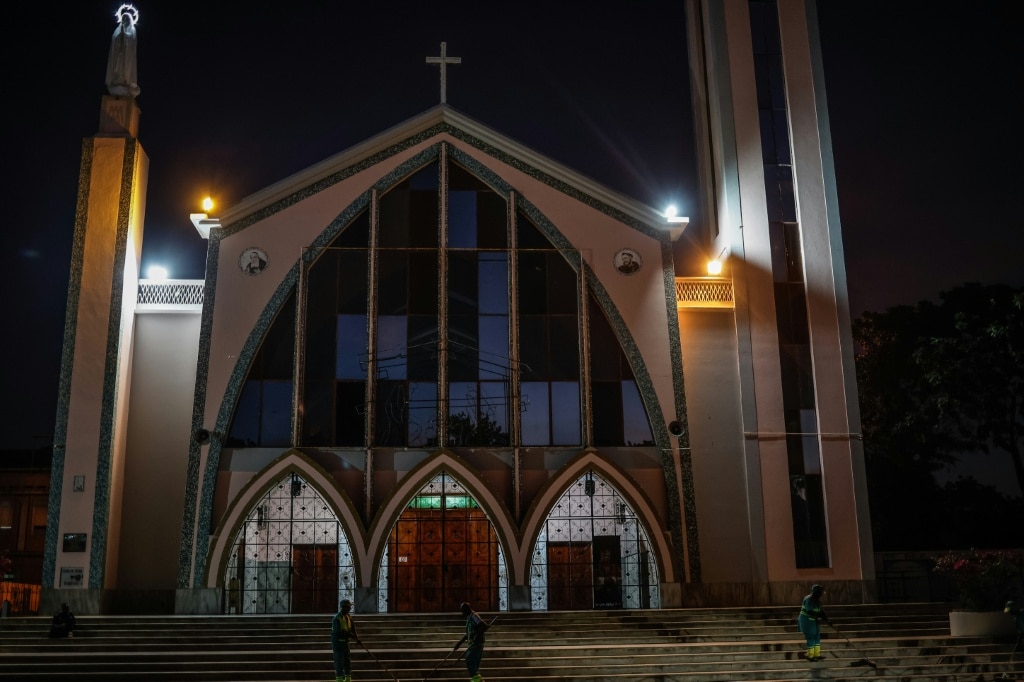
Pope Leo XIV has launched the third stop of his historic 11-day, four-nation African pilgrimage, arriving in Angola Saturday after wrapping up a high-profile three-day visit to Cameroon, where he delivered sharp social and political critiques amid a worsening war of words with former U.S. President Donald Trump over the ongoing Middle East conflict.
The American pontiff, who was elected to the papacy in May 2025 after the passing of Pope Francis, marked the end of his Cameroon leg with a massive open-air mass at Yaoundé’s airport that drew more than 200,000 adoring worshippers, who greeted him with traditional songs and festive dances. Speaking in French during his homily, Pope Leo thanked the Cameroonian people for their warm welcome, before issuing a pointed call for the nation to find the courage to break from harmful long-standing habits and outdated power structures. His remarks came against the backdrop of 42 years of authoritarian rule by 93-year-old President Paul Biya, who has held power since 1982.
Following the mass, Pope Leo departed midday for Angola’s capital Luanda, where he is scheduled to meet with President Joao Lourenco and deliver a policy address before wrapping up his visit on Tuesday. Only two other popes have traveled to the resource-rich southern African nation: John Paul II in 1992 and Benedict XVI in 2009, with roughly 44% of Angola’s population identifying as Catholic. Organizers and local officials expect tens of thousands of worshippers to travel across the country to catch a glimpse of the head of the global Catholic Church, which counts 1.4 billion followers worldwide.
For many Angolans, the papal visit carries deep personal and national meaning. “It’s as if God were very close to us,” Helena Maria Miguel, a 40-year-old human resources manager based in Luanda, told reporters ahead of the pope’s arrival.
Pope Leo’s consistent calls for global peace are expected to resonate particularly strongly in Angola, a nation that only emerged from a brutal 27-year civil war in 2002. The conflict broke out immediately after Angola gained independence from Portugal in 1975, leaving deep socioeconomic scars that persist decades later. Despite the country’s vast fossil fuel reserves, an estimated one-third of Angolans still live below the poverty line, with the national economy overly reliant on volatile global oil prices and long plagued by systemic corruption that has even reached the inner circle of former president Jose Eduardo dos Santos.
Many local residents hope the pope’s visit will shine a light on the unmet needs of Angola’s young population. “There is a lot of suffering, a lot of poverty in Angola. I hope the pope will see with his own eyes the needs of the youth here,” said 33-year-old engineer Antonio Masaidi.
The visit comes as Pope Leo has adopted a far more assertive public tone after facing repeated sharp criticism from Donald Trump, breaking from the more low-key, measured approach he took immediately after his election. Up until the public feud erupted, the new pope had positioned himself as more discreet than his predecessor, Pope Francis, who led the church from 2013 to 2025. Throughout the African tour, the pontiff has repeatedly called out global corruption, the exploitative plunder of Africa’s natural resources by foreign and domestic actors, and the unregulated risks of artificial intelligence, even as his public clash with Trump continues to unfold. After Trump’s Vice President JD Vance, a Catholic, publicly called on the Vatican to stay out of political affairs and “stick to matters of morality”, Pope Leo fired back Thursday, arguing the world is “being ravaged by a handful of tyrants” and doubling down on criticism of actors who misuse religious doctrine to justify armed conflict. During his time in Cameroon, he doubled down on these critiques, demanding local leaders root out graft and condemning “those who, in the name of profit, continue to seize the African continent to exploit and plunder it”.
On Sunday, Pope Leo will lead a second massive open-air mass in Kilamba, a suburb of Luanda, where local authorities have built new infrastructure including a large public food court to accommodate the expected crowds of worshippers. In the afternoon, he will travel by helicopter to the riverside village of Muxima, roughly 130 kilometers southeast of the capital, which is home to a 16th-century church that has grown into one of southern Africa’s most important Catholic pilgrimage sites. The village, where enslaved Africans were once baptized before being forcibly shipped out of the continent, is currently the site of a multi-million-dollar government development project to build a new basilica and transform the area into a major international religious tourism destination.
“It is a historic moment of grace, a moment of profound emotion, with tears in our eyes and gratitude in our hearts,” Father Mpindi Lubanzadio Alberto, rector of the Muxima shrine, told the Catholic outlet ACI Africa ahead of the visit. On April 20, the pope will travel more than 800 kilometers from Luanda to Saurimo, where he will visit a local retirement home and lead another mass before departing Angola the following morning. After wrapping up his time in Angola, Pope Leo will travel to Equatorial Guinea for the fourth and final stop of his 18,000-kilometer journey, which launched in Algeria earlier this month.