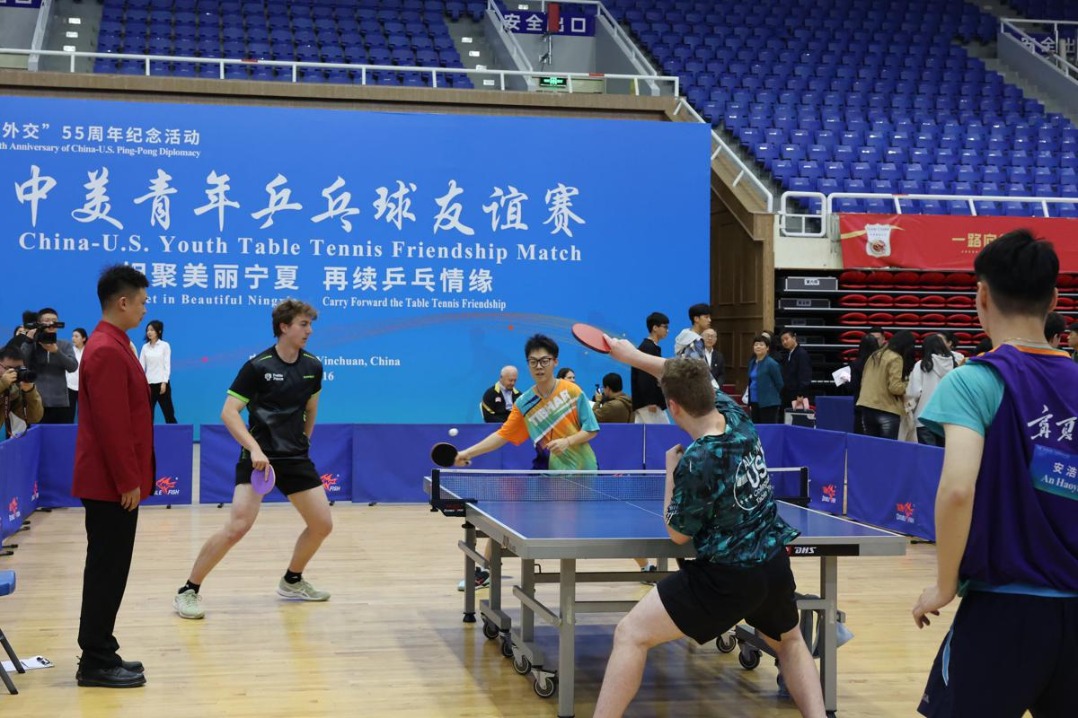
Fifty-five years after a historic table tennis exchange broke decades of ice between China and the United States, young players from both nations gathered in Yinchuan, the capital city of northwest China’s Ningxia Hui Autonomous Region, on Thursday to honor the legacy of what is now widely known as “ping-pong diplomacy”.
Organized around the shared passion for table tennis that first connected the two peoples half a century ago, the commemorative event brought together young collegiate table tennis athletes from Northwestern United States and eight elite young players from China. Rather than sticking to rigid, country-versus-country competition formats, organizers reimagined the tournament to reflect the core values of the original diplomatic breakthrough: connection and mutual understanding.
All players were split into two mixed transnational squads, named “Peace” and “Friendship”. In a symbolic twist that embodied the event’s spirit of cooperation alongside friendly competition, athletes paired with cross-national partners for doubles matches, and faced off against peers from the other country in singles rounds. This structure encouraged collaboration even as it highlighted the players’ sharp competitive skills.
Throughout the day, participants displayed remarkable technical proficiency and exemplary sportsmanship, drawing warm, sustained applause from the local audience that turned out to watch the historic commemoration. Moving away from traditional hierarchical medal ceremonies that prioritize winning above all else, every athlete at the event received a custom commemorative medal in recognition of their role in advancing people-to-people exchange.
Beyond the confines of the competition court, the gathering functioned as an informal platform for deep cultural exchange. Players discussed table tennis technique, swapped recommendations for favorite films, and shared personal stories, small interactions that helped bridge lingering cultural gaps and build new personal connections between the younger generations of both nations. Organizers noted that the event echoes the original 1971 ping-pong diplomacy, which proved that people-to-people exchange can lay the groundwork for greater mutual understanding between nations, even when official relations face challenges.