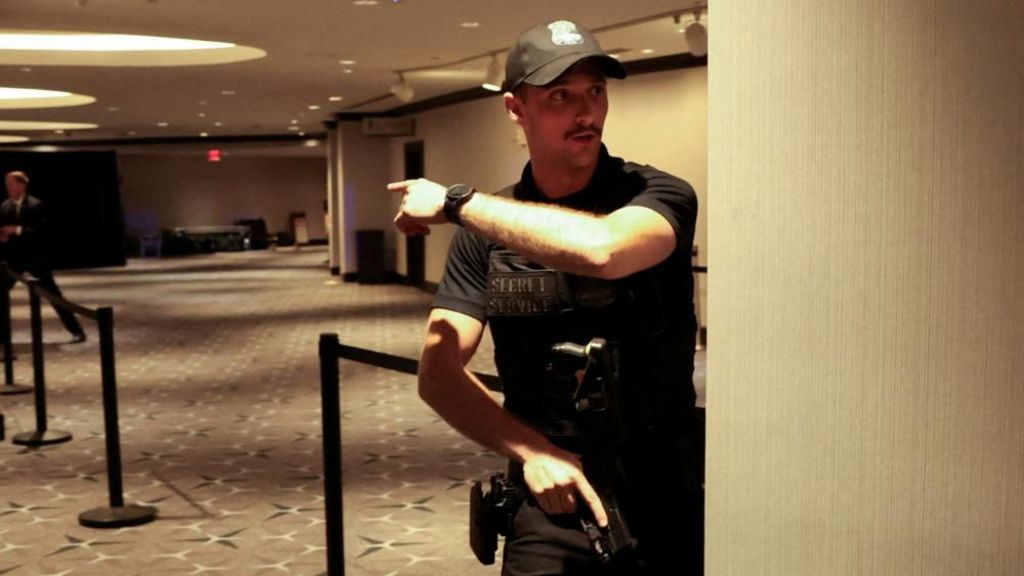
On a Saturday night at the annual White House Correspondents’ Association dinner, a gathering of journalists, politicians, and public figures at the Washington Hilton was upended by sudden gunfire, turning what is normally a lighthearted annual tradition into a scene of chaos and fear that echoed the all-too-familiar trauma of political violence that has gripped modern America.
For many attendees, the moment of panic carried deeply personal echoes of past attacks. Erika Kirk, the widow of conservative activist Charlie Kirk who was killed in a shooting just seven months prior, was left sobbing amid the evacuation. House Majority Leader Steve Scalise, who survived a near-fatal shooting at a 2017 Republican congressional baseball practice, was immediately escorted out by security personnel. Health and Human Services Secretary Robert F. Kennedy Jr., who lost both his father and uncle to political assassinations, was also removed from the venue for his safety. Even many of the journalists present had covered or witnessed the 2024 rally shooting in Butler, Pennsylvania, where an attacker shot former President and then-candidate Donald Trump, grazing his ear before being killed by a Secret Service sniper.
Saturday’s shooting marks the third direct assassination attempt targeting Trump, who is now serving as U.S. president. The first occurred at the Butler rally, the second at his Palm Beach golf resort in 2024, and a separate incident last year saw the Secret Service kill an armed man attempting to breach Trump’s Mar-a-Lago property while the president was out of state. For the United States, the incident has cemented a grim reality: political violence has become a persistent, omnipresent threat that can strike any gathering, no matter how high-profile or protected, at any time.
In the immediate aftermath of the shooting, the familiar cycle of response to political violence played out rapidly. Speaking from the scene Saturday night, Trump called for national unity and a toning down of divisive political rhetoric, a moment that even some of his critics acknowledged struck the right tone. A Wall Street Journal editorial noted that Trump’s post-shooting comments hit the right notes of gratitude and mutual respect. But by Sunday evening, that call for unity quickly dissolved into familiar partisan friction during a primetime interview on CBS’s *60 Minutes*. In the sit-down, Trump blamed Democrats for cultivating a cultural atmosphere that he claimed enabled the attack, and went on to deride interviewer Norah O’Donnell as “a disgrace” and “horrible” after she pressed him on the alleged gunman’s published manifesto. On the left, unfounded conspiracy theories quickly circulated online claiming the attack had been staged to boost Trump’s political standing, fueled by fears of coming crackdowns on political activism and free speech.
Within days, the Trump administration and its congressional Republican allies had moved to tie the shooting directly to one of the president’s long-standing policy priorities: constructing a large, fortified new ballroom on the site of the White House’s former East Wing. In a social media post Sunday, Trump explicitly framed Saturday’s attack as direct justification for the project, writing that the incident was “exactly the reason” the new ballroom was needed. In a formal letter to the historic preservation group that has filed a lawsuit blocking the project, Assistant Attorney General Brett Shumate argued that the current venue arrangements put the president, his family, and his staff at grave risk, writing that the preservation group’s legal challenge directly endangers those lives. Top congressional Republicans have already pledged to introduce new legislation that would explicitly authorize the construction, with House Speaker Mike Johnson telling Fox News Monday that the fortified ballroom would provide a safe, secure venue for events like the White House Correspondents’ Dinner itself.
But experts and observers note that a new, fortified White House ballroom alone cannot resolve the core security gaps exposed by Saturday’s shooting. Key unanswered questions remain: how was the suspected gunman able to bring weapons into a venue hosting the sitting president and dozens of top government officials? Was the Secret Service’s established security perimeter sufficient for the event? Should all guests in all areas of the hotel, not just the dinner ballroom, have been screened for weapons ahead of time? In response to these open questions, White House Chief of Staff Susie Wiles has scheduled an early-week meeting with top Secret Service officials to review existing protocols and security practices for all major presidential events, including the upcoming 250th U.S. centennial celebrations scheduled for this summer.
The shooting has also reshaped Trump’s approach to public campaigning ahead of the looming midterm elections. Following the 2024 Butler rally shooting, Trump drastically scaled back his large outdoor public rallies, a signature staple of his political career. Since taking office, he has favored small, closed-door events at secure military bases and smaller indoor venues, moving all large public appearances to enclosed arenas that allow the Secret Service to more rigorously screen all attendees. But with midterms approaching, political strategists note that Trump will face mounting pressure to return to the campaign trail to energize his base, which historically sees lower turnout in non-presidential election years when Trump is not on the ballot. While a more cautious, closed-off approach to public appearances may reduce the president’s personal security risk, it could carry a significant political cost for his party in the upcoming elections.