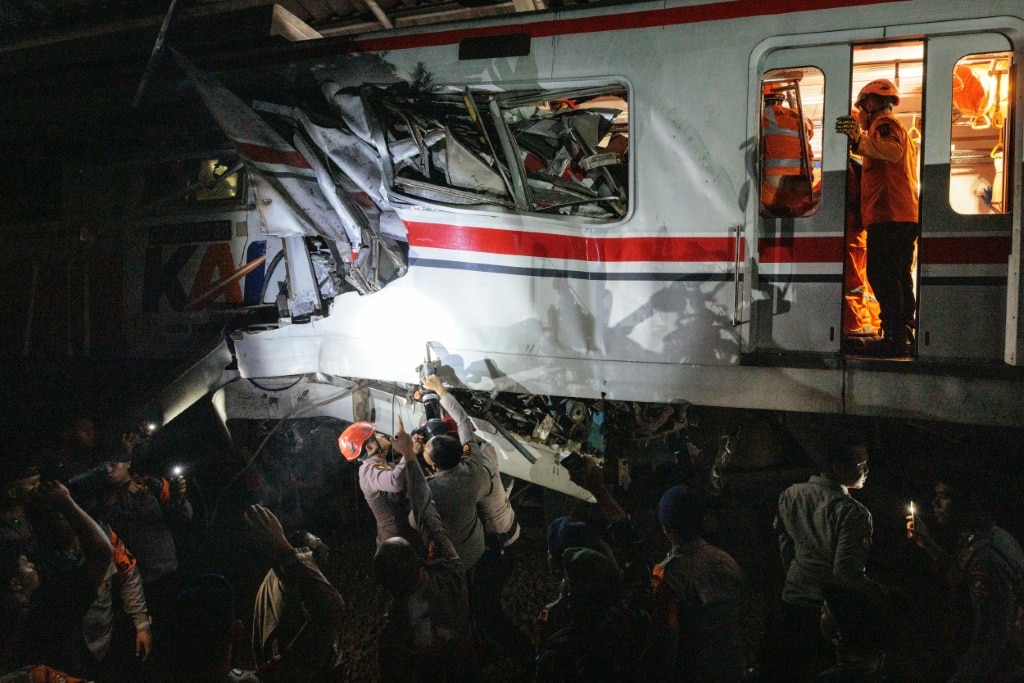
Rescue teams have launched an urgent search and evacuation operation after a fatal overnight collision between two trains on the outskirts of Indonesia’s capital Jakarta, which has already claimed seven lives and left more than 80 others injured, with multiple passengers still trapped inside mangled carriages.
State-owned rail operator Kereta Api Indonesia (KAI) spokesperson Anna Purba confirmed the initial casualty count to local media early Tuesday: seven fatalities and 81 injured people, with two trapped individuals confirmed alive in the wreckage as rescue work continued.
Survivors have described the sudden, terrifying chaos of the incident, which occurred when a long-distance intercity train struck a stationary commuter train that had been halted on the tracks near Bekasi Timur Station, roughly 25 kilometers from central Jakarta. Sausan Sarifah, a 29-year-old commuter who was admitted to RSUD Bekasi hospital with a broken arm and deep thigh laceration, recalled the harrowing moments immediately after impact. She had been traveling home from work when her train stopped at the station, and passengers had already received announcements to prepare to disembark when the collision occurred. “It all happened so fast, in a split second,” Sarifah said from her hospital bed. “There was no time to get out, and everyone ended up piled up inside the train, crushed on top of one another. I thought I was going to die. Thank God I was on top, so I could be evacuated quickly.”
According to KAI spokesperson Franoto Wibowo, the chain of events that led to the collision began when a taxi clipped the commuter train at a nearby level crossing, forcing the train to stop abruptly on the active main line where it was subsequently hit by the oncoming long-distance service. Jakarta police chief Asep Edi Suheri added that the long-distance train collided directly with the last carriage of the commuter train, which was designated as a women-only car. All confirmed fatalities and injuries are from the commuter train; all roughly 240 passengers aboard the long-distance train were evacuated without major harm, Purba confirmed.
Witnesses at the crash site described chaotic scenes in the immediate aftermath of the incident: rescue personnel shouted urgently for emergency equipment such as oxygen tanks, ambulances formed a long, flashing queue along the access road, and stretchers carrying injured survivors were carried out of the wreckage as hundreds of shocked onlookers gathered. The Jakarta search and rescue agency noted in an official statement that the high-force impact caused “significant damage to several train carriages”, leaving multiple passengers pinned inside the twisted metal. Rescuers from the military, local fire department, national search and rescue agency, and Indonesian Red Cross have all been deployed to the site, using specialized extrication equipment to extract trapped survivors.
As of Tuesday morning, evacuation work was still ongoing, and officials warned that the death toll could climb. Deputy house speaker Sufmi Dasco Ahmad, who was at the crash site, told reporters: “Judging from the evacuation process that is still under way, it is possible that the number of victims may continue to rise.”
Local hospitals are also operating at a rush to treat the influx of injured patients, with medical teams conducting triage to prioritize the most severe cases. Eva Chairista, a 39-year-old woman who traveled to RSUD Bekasi after learning her 27-year-old sister-in-law Fira was injured, described a frenzied scene as families waited for updates on their loved ones. “The doctor told us to be patient, there are many whose condition is worse than my sister-in-law’s,” she said.
This collision is the latest serious transport accident in Indonesia, a vast archipelagic nation where chronic underinvestment and poor maintenance have left much of the public transport fleet, including trains, buses and passenger aircraft, aged and unsafe. The previous major train crash in Indonesia, which occurred in West Java province in January 2024, killed four crew members and injured roughly two dozen people. One of the deadliest level crossing accidents in the country’s recent history occurred in Jakarta in 2015, when a commuter train collided with a minibus, killing 16 people.