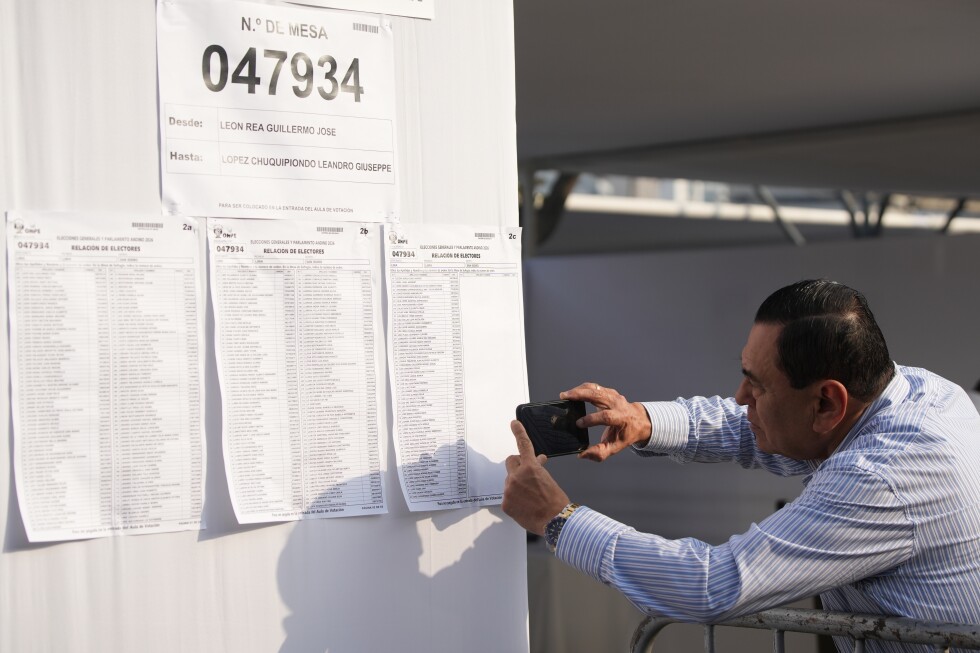
As Peruvians head to the polls on Sunday for a high-stakes presidential election, the Andean nation finds itself grappling with deep-seated public anger, a spiraling crime crisis, and a historic political reshuffle that will shape its governance for years to come. This election will mark the selection of Peru’s ninth president in just one decade, a statistic that underscores the chronic political instability that has long plagued the country. A field of 35 candidates — ranging from a seasoned former cabinet minister to a popular comedian and the heir to one of Peru’s most famous political dynasties — are competing for the nation’s highest office, in the largest candidate pool the country has ever seen.
The entire campaign has been defined by one overwhelming public concern: a dramatic surge in violent crime and entrenched political corruption that has left most voters convinced that every candidate lacks integrity and is unprepared to tackle the country’s most pressing challenges. Official government data paints a stark picture of the security breakdown: homicide rates have doubled since the start of the decade, while extortion cases have jumped fivefold. In 2025 alone, more than 200 public transportation drivers were murdered across the country, a statistic that has spread fear across every layer of society. A 2025 national survey from Peru’s National Institute of Statistics and Informatics found that 84% of urban respondents worry they will fall victim to a violent crime within the next year.
This widespread anxiety has translated into raw voter disillusionment, shared by Peruvians from all walks of life. Juan Gómez, a 53-year-old construction worker supporting five children, summed up the prevailing mood as he carried groceries home: “You can’t trust anyone anymore, nothing’s going to change. Criminals come on motorcycles, put a gun to your head… you look around and there’s no police officer. What are you going to do? You just let them rob you.” Retiree Raúl Zevallos, 63, echoed that fear, describing the constant risk of daily travel: “You get on the bus, and you have to sit far from the driver; you don’t know if you’ll make it home alive. Criminals drive by on motorcycles, shoot, kill the driver, and you could die, too.”
In response to public demands for action, most candidates have rolled out hard-line security proposals to win over frustrated voters. Planks on the campaign trail include constructing large-scale “megaprisons,” requiring incarcerated people to work to earn access to meals, and even reviving the death penalty for the most serious violent offenses.
The best-known candidate in the race is Keiko Fujimori, a conservative former congresswoman and daughter of late Peruvian President Alberto Fujimori, who is making her fourth bid for the presidency. Fujimori has campaigned on a promise of an iron fist crackdown on organized crime, but her record has drawn scrutiny: in recent years, her party backed legislation that legal experts argue has made it far harder to prosecute criminal offenders, eliminating preliminary detention for certain offenses and raising the legal bar to seize illegally gained assets. If elected, Fujimori has pledged to allow criminal case judges to serve anonymously and mandate that prisoners work to earn their food rations.
Another top conservative contender is Rafael López Aliaga, the former mayor of Lima, Peru’s capital. López Aliaga has proposed building new high-security prisons in the country’s remote Amazon region, also backs anonymous judge protections, and has promised to expel all undocumented migrants living in Peru. A more unconventional candidate is Carlos Álvarez, a comedian who has pivoted to politics, who has pledged to bring in security policy expertise from the leaders of El Salvador, Denmark, and Singapore if elected.
Beyond the presidential race, this election carries historic implications for Peru’s governing structure: for the first time in more than 30 years, voters are also selecting a new bicameral Congress, after lawmakers pushed through constitutional reforms in 2024 that shift significant power to a newly created upper Senate chamber. This reversal of a decades-old unicameral system comes despite 80% of voters rejecting a bicameral model in a 2018 public referendum.
Under the new framework, the sitting president will lack the power to dissolve the Senate, while the upper chamber will gain the ability to remove a sitting president from office through impeachment. The threshold for impeachment has also been lowered dramatically: impeachment will now pass with just 40 votes out of the 60-member Senate, compared to the previous requirement of 87 votes out of 130 unicameral legislators. Political analysts widely credit the frequent use of the impeachment power by the old unicameral Congress for the chaotic “revolving door” of presidents that has seen Peru turn over eight leaders in 10 years.
The new Senate will also take on sweeping powers beyond impeachment, including the authority to appoint and discipline top government officials, ranging from the national ombudsman and constitutional court justices to central bank board members. It will also hold the power to review and amend legislation passed by the lower congressional chamber. Alejandro Boyco, a researcher at the Institute of Peruvian Studies, warned that the concentration of power in the small 60-person Senate creates new corruption risks. “They’ve concentrated too much power in a 60-people chamber,” Boyco said. “They are not going to be immune to being corrupt.”
Voting is mandatory for all Peruvian citizens between the ages of 18 and 70, with more than 27 million registered voters nationwide. Around 1.2 million registered voters are living abroad, mostly in the United States and Argentina, and will cast ballots outside the country. While an outright win requires a candidate to capture more than 50% of the vote, political analysts widely agree that a June runoff election is all but guaranteed, given the deep divisions among the electorate and the historically large field of candidates competing for support.