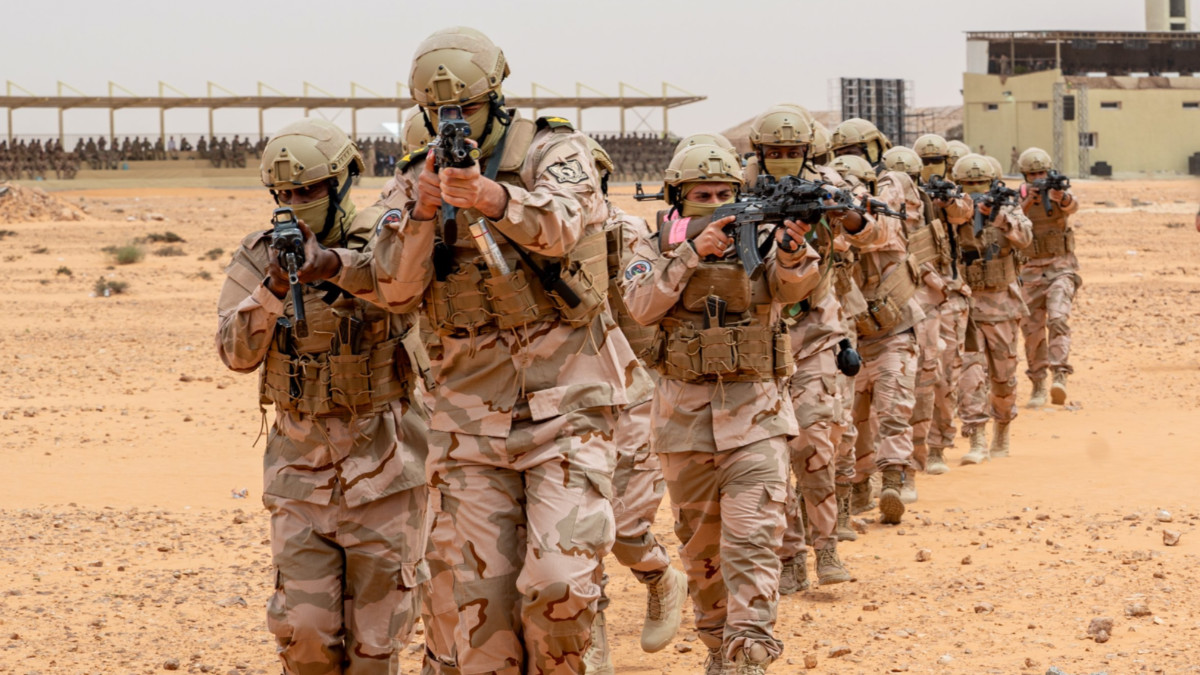
New unreported arms shipments from Pakistan to the eastern Libyan administration led by military strongman Khalifa Haftar have been carried out earlier this year, with financing and facilitation from Saudi Arabia, multiple Western and Arab officials with direct knowledge of the matter have confirmed to Middle East Eye.
One official who was present at Benghazi’s main airport during the offloading process confirmed that at least five Pakistani cargo jets carrying military hardware arrived and were unloaded in March. A second senior official verified the shipments occurred, but declined to share details on the specific types of weapons transferred. This delivery marks the first confirmed execution of a massive $4 billion arms framework between Pakistan and Haftar’s government, a deal that was first reported by Reuters after a December visit to Benghazi by Pakistan’s Chief of Army Staff, Field Marshal Asim Munir.
Haftar, 82, accompanied by his son Saddam Haftar — widely viewed as his likely political successor — made a rare official trip to Islamabad in early February, where the pair held meetings with Munir and Pakistani Prime Minister Shehbaz Sharif. The Arab official confirmed that the full terms of the March weapons shipments were finalized during this high-level visit.
This delivery comes at a moment of growing uncertainty for Pakistan’s broader arms export agenda across Africa, just after another major Pakistani arms deal with Sudan’s transitional government collapsed earlier this month when Saudi Arabia withdrew its pledged financing for the purchase.
According to regional and Western diplomatic sources, the new deal is part of a deliberate Saudi push to expand its influence in eastern Libya and displace the long-standing dominance the United Arab Emirates has held over Haftar and his political bloc. One senior Arab official called the deal an explicit outreach strategy, stating: “This deal was done to pull Haftar away from the UAE. Saudi Arabia is using honey, and saying ‘we can sponsor you’.” A Libyan source familiar with Haftar’s inner circle expressed skepticism about the success of this gambit, noting that the Haftar family retains extensive business holdings and assets in the Emirates.
Beyond shifting influence dynamics in Libya, the deal also ties to Saudi regional priorities in the ongoing Sudan conflict. Western and Arab officials confirm Riyadh is pressing Haftar to block illegal cross-border weapons flows from southeastern Libya to the Rapid Support Forces (RSF), the paramilitary group fighting Sudan’s military government. The deal is also structured to buy Haftar’s cooperation with ongoing efforts to integrate his eastern military forces with the military wing of the internationally recognized Tripoli-based government under Prime Minister Abdul Hamid Dbeibeh. In March, forces from both sides participated in joint training exercises during the U.S.-led Flintlock military drill, and a joint military coordination committee has already been established to advance integration. As one Western official put it: “There is a sense that Saudi Arabia is buying Haftar’s cooperation with new supplies. The integration of Libya’s military is against the UAE’s interest vis-a-vis Sudan.”
The Saudi-UAE rift that underpins this new initiative has deepened rapidly over the past year, despite the two countries’ long history as Gulf allies. Both nations joined forces to intervene in Yemen’s civil war and backed Haftar’s failed 2019 offensive to seize full control of Tripoli, but their alignment collapsed after the outbreak of Sudan’s 2023 civil war. Tensions flared after Saudi Crown Prince Mohammed bin Salman lobbied former U.S. President Donald Trump to oppose the UAE’s open support for the RSF. Rifts escalated further in December, when Saudi Arabia launched airstrikes against UAE-aligned militia groups in Yemen.
While the two sides have attempted to contain open conflict, with bin Salman sending a February letter to UAE National Security Advisor Tahnoon bin Zayed that outlined Riyadh’s grievances and called for mediation, recent regional shifts have only deepened divisions. The outbreak of the ongoing Israel-Iran conflict sparked speculation that Gulf powers would put aside differences to present a unified front, but the war has instead widened the gap between the two: Saudi Arabia has sought to balance U.S. requests for military access with public calls for a negotiated end to tensions, while the UAE has taken a hardline hawkish stance against Iran and has publicly expressed frustration with U.S.-led direct talks with Tehran — talks that Pakistan has helped facilitate.
Libya has remained split into two competing administrative blocs since 2014, and a United Nations arms embargo imposed on the country has been routinely violated by outside powers seeking to advance their own regional interests. Middle East Eye reached out to the Saudi and Pakistani embassies in Washington D.C. for official comment on the arms shipment, but received no response prior to publication.