博客

  • 2,000 volunteers join a painstaking effort to restore massive skeleton of prehistoric predator

    2,000 volunteers join a painstaking effort to restore massive skeleton of prehistoric predator

    Deep inside a glass-walled laboratory at Warsaw’s iconic Copernicus Science Centre, an extraordinary public science experiment is unfolding. Unlike traditional paleontological digs that happen far from public view, this project invites everyday people to stand shoulder-to-shoulder with scientists and bring a 240-million-year-old giant back into the light.

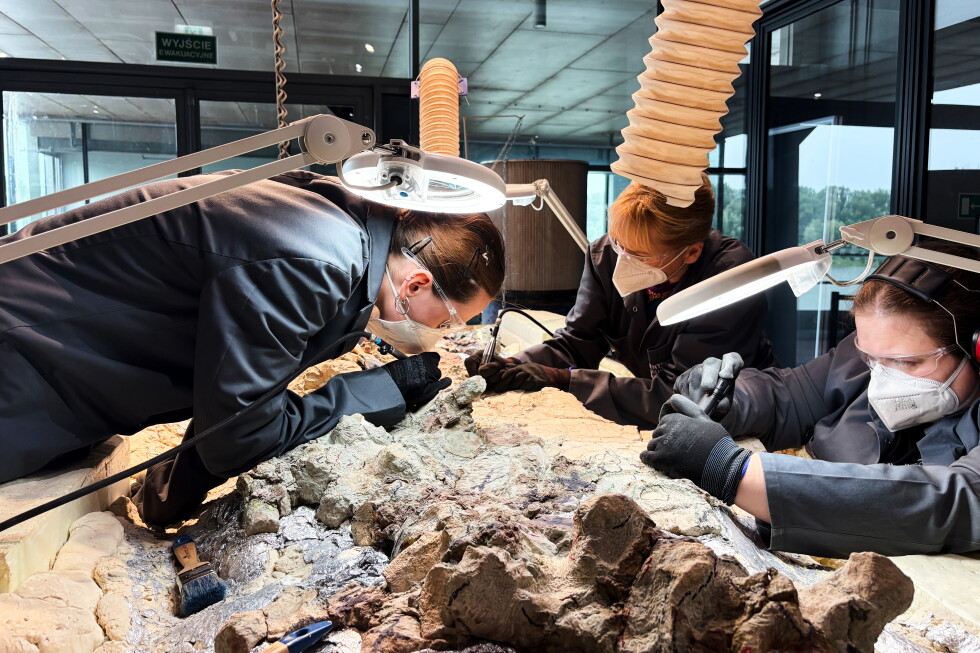
    Armed with pneumatic chisels, soft-bristled brushes, and protective goggles, hundreds of volunteers from across Poland are slowly and carefully chipping away at solid rock that has encased the massive bones of a *Mastodonsaurus* — one of the largest amphibians to ever walk (or swim) the Earth. On the opposite side of the clear glass barrier, crowds of curious visitors watch every step of the painstaking work in real time: wide-eyed children press their palms to the glass to point at the emerging fragments, while adults marvel at the sheer scale of the creature that once dominated Triassic waterways.

    What makes this restoration project unprecedented is its reliance on non-professional labor. More than 2,000 volunteers from all walks of life — including office managers, hospital cleaners, professional tattoo artists, and retired teachers — have signed on to help, none requiring prior experience in paleontology or geology. Before they start their two-hour supervised chiseling shifts, every volunteer completes a hands-on training session and receives custom protective gear to keep them safe and ensure the ancient bones remain undamaged.

    The work itself requires extraordinary precision. Volunteers separate bone from surrounding rock one millimeter at a time, using a specialized pneumatic chisel with a thin needle tip that gently breaks away rock without damaging the fragile fossil. Ultraviolet lighting is used to clearly mark the boundary between fossilized bone and surrounding stone, eliminating the risk of accidental breaks that could destroy irreplaceable scientific data.

    For many volunteers, the experience has been life-changing. “I imagine that those bones were lying underground for 240 million years and I am the first human on earth to touch them,” said Tatyana Kozyk, who coordinates the volunteer teams. “I’m still trying to wrap my head around this experience.” Dorota Serafin, a 51-year-old Warsaw manager who has volunteered multiple times, described the work as both deeply calming and philosophically profound. “Working with the skeleton of an ancient animal is an experience that is at the same time relaxing and philosophical, even mystical,” she said, adding that she plans to bring her entire family to see the finished display when it opens to the public.

    The *Mastodonsaurus* itself was a fearsome aquatic ambush predator that ruled freshwater ecosystems during the Middle Triassic period, a time when the first dinosaurs were just beginning to emerge but had not yet become the dominant terrestrial vertebrates on Earth. Growing up to six meters (20 feet) in length, the creature had a broad flat skull, massive elongated jaws lined with sharp conical teeth, and a body shape that vaguely resembles modern crocodiles — though it belongs to an entirely separate branch of the vertebrate evolutionary tree. It fed primarily on fish and smaller amphibians, lying motionless in shallow water before launching surprise attacks on unsuspecting prey.

    The massive skeleton was first discovered in southern Poland in 2023 by paleontologist Tomasz Sulej, a professor at the Polish Academy of Sciences’ Institute of Paleobiology, and his colleague Wojciech Pawlak, a geologist from Warsaw University. It was the pair’s idea to open the restoration process to public volunteers, turning a purely scientific project into an unprecedented public outreach opportunity.

    When complete, the 1,300-kilogram (2,865-pound) skeleton will be the largest *Mastodonsaurus* specimen ever put on public display anywhere in the world. Sulej notes that while smaller *Mastodonsaurus* skeletons — most measuring between 2 and 3 meters long — have been found in Germany and Russia, this new specimen is far larger than any previously discovered, and promises to rewrite scientific understanding of the species.

    “The structure of the body is different from what we knew so far,” Sulej explained. “This is information that is completely new to the scientific world.” The finished skeleton is scheduled to go on public display at the Copernicus Science Centre in late 2024, most likely in October or November.

    Beyond its scientific value, the project offers a unique perspective on extinction, resilience, and the future of life on Earth. The *Mastodonsaurus* emerged after the Permian-Triassic extinction event — the most severe mass extinction in our planet’s history, which wiped out roughly 96% of all marine species and 70% of terrestrial vertebrate species — and paved the way for the rise of the dinosaurs millions of years later. As humanity grapples with the accelerating impacts of human-caused climate change, Sulej says the story of the *Mastodonsaurus* offers a message of cautious hope.

    “The Mastodonsaurus lived after the great extinction, which shows one thing, that nature always manages,” Sulej said. “It’s not true that humans can destroy life on this planet. Nature and life always find ways to survive.”


  • Tunnel collapse in India kills 12 workers

    Tunnel collapse in India kills 12 workers

    A catastrophic construction accident has left at least 12 workers dead and 13 others trapped deep underground after a methane-fueled gas explosion triggered a partial collapse of an under-construction hydropower tunnel in India’s Himalayan northeastern state of Sikkim, official authorities have confirmed. As of Wednesday, multi-agency rescue operations have entered their third day, with teams focusing their efforts on a 200-meter target zone inside the tunnel where remaining trapped workers are believed to be located.

    The incident unfolded on Monday around 1.5 kilometers (0.9 miles) inside the tunnel, which is being developed as part of a major hydropower project by state-owned utility National Hydroelectric Power Corporation (NHPC). Designed to divert water from the nearby Teesta River to feed the hydropower plant’s turbines, the project is a key infrastructure initiative for the mountainous state.

    In an official statement following the accident, NHPC confirmed the blast was caused by a sudden outburst of methane gas naturally trapped within surrounding rock formations. The explosion generated thick toxic fumes that have complicated rescue efforts, a conclusion echoed by the Sikkim state government, which formally attributes the incident to methane gas combustion. A senior government official explained that methane naturally accumulates in underground rock formations; when tunneling work releases the gas into the confined space of the tunnel, even a small spark or other ignition source can trigger a catastrophic explosion or ignition.

    At the time of the blast, 27 workers were spread across different work sections inside the tunnel. Only two workers managed to escape immediately after the explosion, leaving 25 trapped. “Of the 25 people who were trapped, we have recovered 12 bodies so far, and teams are working to locate the 13 other men,” Sonam D Bhutia, Superintendent of Police of Sikkim, told the BBC in an interview Wednesday morning. So far, authorities have confirmed the identities of seven of the deceased: one victim was a resident of Sikkim, while the remaining six identified victims are migrant workers from neighboring Indian states of West Bengal, Uttarakhand and Assam. Official confirmation of the exact cause of death for each victim will be released following full post-mortem examinations, according to authorities.

    National Disaster Response Force (NDRF) officer Mohsen Shahedi told Indian news agency ANI that search and rescue teams are currently concentrating their operations on a specific 200-meter stretch of the tunnel, where modeling and on-site data suggest the remaining trapped workers are most likely located. In response to the disaster, Sikkim Chief Minister Prem Singh Tamang has ordered the formation of a specialized independent investigation team to probe the root causes of the incident. “We have engaged a team of experts to find out what exactly happened and how. We will take action on the basis of the findings,” Tamang told reporters following the disaster.

  • India opposition leader released after protest detention

    India opposition leader released after protest detention

    Three days of nationwide protests demanding sweeping reforms to India’s crisis-plagued education system have escalated into one of the most significant challenges to Prime Minister Narendra Modi’s newly elected third-term government, with opposition leader Rahul Gandhi released from custody Wednesday after being detained for a sit-in demonstration outside Modi’s New Delhi residence.

    The unrest, organized by the rapidly growing social media-fueled movement Cockroach Janta Party (CJP), began over a string of high-profile controversies that have shattered public confidence in India’s national examination system. The most recent scandals include a major leak of a national medical entrance exam that forced more than two million candidates to retake the test, and a separate dispute over flawed online grading of high school exams taken by nearly two million students across the country. Protesters are calling for the resignation of Education Minister Dharmendra Pradhan alongside systemic overhauls to examination governance.

    Gandhi, leader of India’s main national opposition bloc, was detained Tuesday after staging a peaceful sit-in outside Modi’s official residence. In his remarks before detention, Gandhi accused the ruling government of deliberately ignoring student demands and condemned a heavy-handed police crackdown on peaceful demonstrations that took place in the capital the previous day. He was released from custody overnight as protests continued to spread across major urban centers.

    The capital saw the worst unrest Monday, when demonstrations turned violent after police deployed tear gas and baton charges to clear crowds, with protesters responding by hurling stones at security personnel. It was the largest mass protest in New Delhi in five years. Official police figures confirm 60 civilian protesters and 118 police personnel were injured in the clashes. Solidarity demonstrations have since been held in other major Indian cities including Mumbai and Bengaluru, drawing hundreds of participants each.

    As of Wednesday, hundreds of protesters remained camped out at New Delhi’s iconic Jantar Mantar protest ground, with the CJP vowing to continue its campaign until their demands are met. In a defiant social media statement Wednesday, the movement wrote, “Cockroaches are alive,” and reiterated its accusation that Pradhan is “incompetent” to lead the nation’s education portfolio. Launched only in May 2024, the CJP has already amassed millions of followers across social media platforms, emerging as a major grassroots counterweight to Modi’s Hindu nationalist administration after its third consecutive election victory earlier this year.

    Facing mounting public pressure over his handling of the examination controversies, Pradhan broke his silence on the unrest late Tuesday, releasing a statement on social media acknowledging public anger and promising the government remains committed to change. “We owe them (students) answers, reforms and accountability,” Pradhan wrote. “That is exactly what our government remains committed to delivering,” he added, marking his first public comments on the unrest since Monday’s street clashes.

  • Iran’s demands over the Strait of Hormuz would set a dangerous precedent, Rubio tells ASEAN leaders

    Iran’s demands over the Strait of Hormuz would set a dangerous precedent, Rubio tells ASEAN leaders

    MANILA, Philippines — U.S. Secretary of State Marco Rubio issued a stark warning during diplomatic gatherings in the Philippine capital on Wednesday, arguing that Iran’s recent claims to control traffic and impose tolls on the Strait of Hormuz pose a critical threat to global economic stability and the long-standing principle of free navigation — risks that would extend as far as Southeast Asia.

    Rubio opened his annual meeting with foreign ministers from the Association of Southeast Asian Nations (ASEAN), a bloc whose member states have already raised growing alarm over the spillover effects of escalating conflict in the Middle East on their own economic and security interests. Addressing concerns that Washington’s focus on the Middle East war would divert attention from Indo-Pacific priorities, Rubio explicitly reassured ASEAN leaders of unwavering U.S. commitment to the region.

    “If we allow a precedent to take hold in the Middle East where a sovereign nation can unilaterally seize control of an international waterway, demand tolls from passing vessels, and attack ships that refuse to comply, that dangerous pattern will be replicated in other regions across the globe, including right here in Southeast Asia,” Rubio told the assembled ministers.

    Beyond the ASEAN meeting, Rubio also took part in a gathering of foreign ministers from the Quadrilateral Security Dialogue (Quad), the four-nation strategic partnership grouping the United States, Australia, India and Japan. During that meeting, the bloc aligned on core shared priorities including technological governance, humanitarian aid coordination, emergency disaster response, maritime security and countering transnational security threats.

    Following closed-door discussions, the Quad issued a joint statement reaffirming their commitment to ongoing maritime security initiatives designed to counter China’s expanding geopolitical influence in the Indo-Pacific. “We are united in our conviction that peace and stability in the Indo-Pacific maritime domain underpin the security and prosperity of the region,” the statement read. Rubio later confirmed the bloc’s ongoing relevance in a post to the social platform X, writing “The Quad remains a priority, and we will meet again later this year.”

    The Trump administration has consistently criticized what it frames as increasingly aggressive actions by China in the South China Sea, moves that disadvantage smaller territorial claimants including the Philippines — Washington’s longest-standing treaty ally in Asia. Territorial disputes in the waterway, which also involve Taiwan and ASEAN members Vietnam, Malaysia and Brunei, are a central topic on the agenda for the three days of diplomatic talks that opened in Manila on Tuesday.

    Rubio also held a bilateral meeting with Indian External Affairs Minister Subrahmanyam Jaishankar, where the two diplomats reviewed regional developments, the ongoing conflict between the U.S. and Iran, and progress on a bilateral trade agreement that would roll back existing U.S. tariffs on Indian goods, according to State Department spokesperson Tommy Pigott. “The Secretary and Minister Jaishankar agreed on the importance of finalizing the interim trade deal, which is almost complete,” Pigott told reporters.

    As of Wednesday evening, Rubio was scheduled to hold a separate, closed-door meeting with Chinese Foreign Minister Wang Yi on the sidelines of the talks, which are being hosted at a heavily secured convention center along Manila Bay.

  • Cops make wild find hidden beneath shed in Penfield Gardens

    Cops make wild find hidden beneath shed in Penfield Gardens

    In a startling and unusual drug bust, law enforcement in South Australia has uncovered a clandestine cannabis growing operation hidden deep beneath a rural shed, leading to charges against two individuals in their 30s who are now set to appear in court.

    The unconventional discovery unfolded when officers executed a search warrant on a private property located in Penfield Gardens, a semi-rural community roughly 40 kilometers north of Adelaide. What started as a routine targeted search quickly took an unexpected turn when investigators uncovered a purpose-built secret underground bunker, carefully concealed beneath the property’s existing outbuilding shed.

    Inside the hidden underground facility, police documented a sophisticated hydroponic growing setup that housed 26 mature cannabis plants, alongside a large stash of processed cannabis. In total, authorities seized approximately 24 kilograms of dried cannabis, which is estimated to have a high street value for illegal distribution.

    Following the seizure, a 38-year-old man from the nearby town of Hewett was taken into custody. He faces four distinct charges: trafficking a large quantity of a controlled drug, cultivating a commercial quantity of a controlled cannabis plant, possession of unauthorized drug manufacturing equipment, and illegal diversion of electricity to power the hidden growing operation. The man has been released on bail and is scheduled to make his first court appearance at the Elizabeth Magistrates Court on September 2.

    In a connected investigation, police executed a second search warrant at a separate property in Korunye, where a 38-year-old woman was identified as a co-conspirator. She has been reported for the same four criminal offenses and will appear in court at a later date, which is yet to be finalized.

    In addition to the drug seizure, law enforcement also impounded a range of high-value assets linked to the alleged operation from the Penfield Gardens site. These assets include a Ram Laramie pickup truck, a utility trailer, a recreational caravan, a personal watercraft Seadoo, and an excavator, indicating that the operation was a large-scale, well-funded criminal enterprise.

    South Australian police have confirmed that investigations into the illegal network are still ongoing, and additional charges or arrests may be forthcoming as the case progresses.

  • ‘It makes me different’: Meet the women breaking world records in lumberjack sports

    ‘It makes me different’: Meet the women breaking world records in lumberjack sports

    For more than six decades, the small Wisconsin city of Hayward has played host to the Lumberjack World Championships, a global gathering of elite athletes competing in traditional timber skills ranging from logrolling and speed climbing to axe chopping and sawing. This year’s edition, held over the past weekend, delivered more than just stunning displays of skill – it marked a major milestone for women in the sport, as three female competitors broke long-standing world records, highlighting the rapid growth and rising competitiveness of women’s lumberjack athletics.

    For 24-year-old Karolina Urbanova, the journey to Hayward’s record books began in an unlikely place: her tiny Czech village, where a new neighbor introduced her to lumberjack sports as a teenager. At the time, the sport was so niche in Europe that fewer than five women regularly participated, and Urbanova faced confusion from city acquaintances when she told them she chopped wood daily for training. Spotted for her natural talent alongside her mother and sister, the Czech athlete began training weekly in a local barn, testing different axes, refining techniques, and learning from veteran competitors as she worked her way through European and international events.

    That consistent training paid off in spectacular fashion this weekend, when Urbanova shattered two world records in chopping disciplines. In the Women’s Standing Block Chop, a event that requires athletes to chop through a vertical 9-inch white pine block as fast as possible, she finished in 19.38 seconds, beating the previous record of 21.17 seconds. She followed that performance with a second record in the Women’s Underhand Chop, where competitors stand on a horizontal wood block and chop between their feet. Urbanova cut through an 11-inch white pine in 21.28 seconds, knocking nearly three full seconds off the old record of 24.26 seconds.

    Urbanova’s historic performance was matched by Hayward local Meredith Ingbretson, who broke the Women’s Boom Run world record. Ingbretson, who was introduced to logrolling at age three and has competed for 28 years, crossed the eight linked cedar logs in 13.78 seconds, beating the previous record of 13.98 seconds. The achievement came after a year of intense focus, where Ingbretson cut out alcohol and adjusted her lifestyle to hit her long-held goal of setting a world record. For Hayward, a city founded on the 19th-century timber industry, lumberjack sports are a core part of community life – Ingbretson notes nearly every local resident has taken at least one summer of logrolling lessons, and her whole family is involved in the sport.

    The surge in record-breaking performances from women comes as no surprise to event leaders, who have watched female participation more than triple over the past 30 years. Samantha LaSalle, event director of the Lumberjack World Championships and a competitor since she was five years old, explained that while women have competed since the inaugural 1960 championships, they were originally restricted to only logrolling events. It took decades of advocacy from female athletes to open up chopping and sawing disciplines to women, with the Women’s Standing Block Chop – the event Urbanova won this year – only added to the competition schedule in 2022.

    “Women kept saying, ‘We can do the same events men have done for decades,’” LaSalle said. “As more of them trained and competed at a high level, it was clear we had to give them that same opportunity. Now we see times drop every single year, which just proves how much the level of competition is rising.”

    Beyond expanding competitive opportunities, the sport has grown thanks to its tight-knit, welcoming community, according to both Urbanova and Ingbretson. Unlike many elite sports, prize money rarely covers travel and training costs – this year’s Wisconsin championships only awarded $1,000 to each category winner – so the community relies on home stays and shared training to help athletes from around the world compete. Urbanova stayed with a local host family during this year’s event, while Ingbretson and her husband stayed with hosts during a competition in Tasmania, and her family hosts international athletes in Hayward annually.

    “That’s what makes this sport special,” Ingbretson said. “You can travel anywhere, and competitors will let you stay, train with you, and help you improve. It’s such an open, welcoming community, and it’s incredible to be part of it.”

    Ingbretson, who works as a community education director at a local high school and manages a fitness center, added that she has been overwhelmed with congratulations from the community, especially from young female athletes just starting out in the sport. Growth in college timber programs and social media exposure has helped bring hundreds of new young women into the sport in recent years, and more women are continuing to compete even after starting families – this year, three mothers competed in logrolling events, a shift Ingbretson called incredibly inspiring.

    Now, both record-holders are already looking ahead to future competitions. Ingbretson has set her sights on winning an all-around title, which requires consistent excellence across multiple disciplines – a goal that demands intense dedication and training. Urbanova, meanwhile, says she is still learning and improving as an athlete, and is proud to see the rising level of competition among young female competitors who are eager to beat her records.

    “I still feel like I’m growing and getting better, but the level of women’s competition is really high now,” Urbanova said. “It’s hard to keep up, but that pushes me to get better. I just feel really proud of what I’ve done so far.”

  • Beluga whales rescued from closed Canadian marine park arrive in US

    Beluga whales rescued from closed Canadian marine park arrive in US

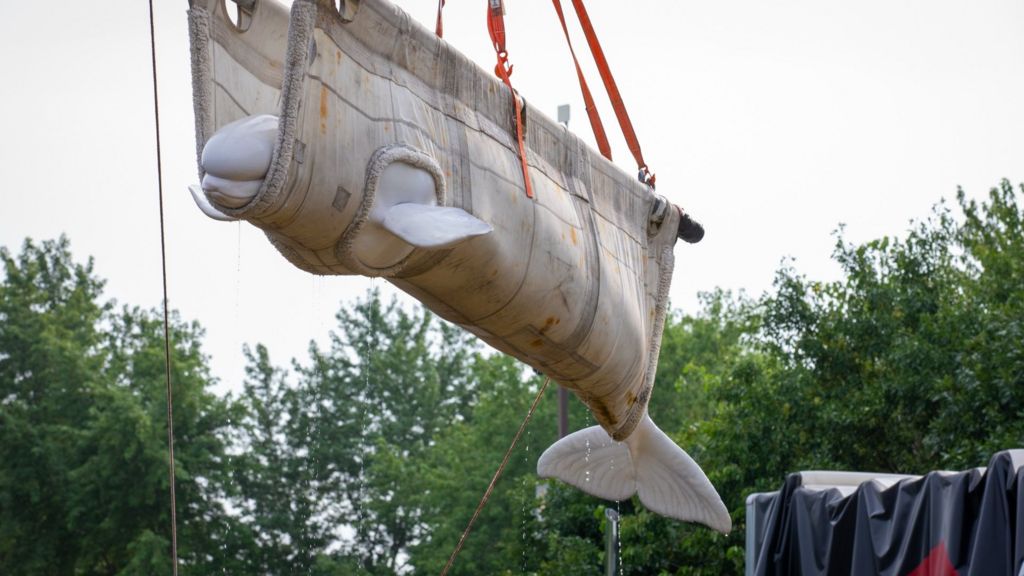
    After months of planning and coordination between marine conservation groups, six beluga whales that were left without proper care when a Canadian marine park ceased operations have successfully completed their journey to new sanctuaries in the United States.

    The closure of the Canadian facility left the captive belugas in a precarious position: the park’s operators could no longer meet the animals’ complex dietary, medical and habitat needs, prompting an urgent cross-border rescue effort. Conservation teams worked for weeks to plan the safe transport, taking extra precautions to minimize stress for the marine mammals during the move.

    Upon their arrival, the belugas were greeted by a team of marine biologists and veterinarians who conducted immediate health assessments. The new facilities, which prioritize animal welfare and conservation education, offer larger, more naturalistic enclosures designed to support the belugas’ physical and social needs.

    This rescue effort highlights growing global conversations about the ethics of keeping marine mammals in entertainment-focused facilities, and the work of conservation organizations to rehome captive marine life when operations shut down. For the six belugas, the arrival in the U.S. marks the start of a new chapter in environments built around their well-being.

  • India’s domestic workers go online as instant services boom

    India’s domestic workers go online as instant services boom

    India’s vast informal domestic work sector, which employs roughly 30 million people, is undergoing a tech-driven transformation as a new wave of startups move the industry online, mirroring the disruptive growth of ride-hailing platforms. The shift promises better pay and flexible working arrangements for workers, though it has also sparked criticism from labor advocates who warn that the new digital model carries new risks of exploitation.

    At training facilities like Snabbit’s hub in Bengaluru, southern India’s leading technology center, groups of aspiring domestic workers practice time-bound tasks ranging from folding linens to chopping vegetables, preparing to join the app-based service economy. Before going live, all workers complete police background checks and soft skills training covering professional etiquette and customer service standards. Once active on the platform, workers receive job bookings digitally, navigate to assigned homes, and log their working hours directly through their smartphones. Performance is tracked via customer ratings, with algorithm-generated incentives for high scores and penalties for consistent low ratings.

    For many workers, the digital model has delivered a dramatic improvement in earnings. Heena Bibi, a 34-year-old mother of four who joined Snabbit, told reporters she earns roughly 45,000 Indian rupees ($472) per month — three times the income she earned through traditional informal arrangements with multiple private clients. “I get three-four jobs on a normal day. If there’s any festival… more work comes,” she said, highlighting the flexible scheduling that allows workers to match work to their availability rather than being tied to a fixed set of long-term clients. The model has also proven popular with customers: 63-year-old homemaker Atiya Khusro explained that app-based services let her avoid adjusting her entire daily routine around the fixed schedule of a traditional full-time domestic helper, with on-demand support available whenever she needs it.

    One of the largest players in this growing market, Snabbit currently operates across 10 major Indian cities including Delhi and Mumbai, with 20,000 registered workers completing an average of 60,000 individual service jobs daily. Other platforms including Pronto and Urban Company have expanded the model to cover a wide range of on-demand home services: Pronto offers everything from hourly window cleaning to same-day post-party cleanups, while Urban Company provides on-demand access to everything from home repair services to at-home salon treatments.

    Snabbit founder and CEO Aayush Agarwal argues that the platform’s biggest selling point for workers is the flexibility it offers, particularly for women balancing care responsibilities. “Today a mother can send her kid off to school, work at Snabbit for four hours and come back before the kid comes back from school,” he said. Agarwal added that the goal of the platforms is to expand options for both workers and customers, rather than replacing the traditional informal domestic work system, framing the shift as similar to the digitization of the ride-hailing sector that made on-demand transport widely accessible.
    Bhoomika Saigal, Snabbit’s director of training and quality, noted that customer ratings are central to maintaining service standards. “If anybody is less than four (out of five), our training team ensures that we call her and understand what is the problem,” she explained, allowing the platform to address performance gaps and support worker improvement.

    Despite the benefits cited by workers and industry leaders, the new model has not won universal support. Some long-time domestic workers remain wary of the unvetted new clients they would be required to serve through the app. Renu Devi, a 38-year-old worker from Uttar Pradesh who has stuck with traditional arrangements, said the existing informal system feels more secure. “I am scared that I might have to go to a house where I don’t know if I will be safe,” she said. “At the moment, I know the people who I work for and I can trust them.”

    Labor advocates have raised broader structural concerns about the gig-based model, arguing that it simply replaces one form of exploitation with another. Sanjay Gaba, president of the All India Gig and Platform Workers Union, called the app-based system 100 percent unfair. “They don’t have any job security. They don’t have benefits like pension because they are not permanent employees,” he told AFP, pointing to the longstanding lack of regulation in India’s domestic work sector that leaves gig workers without basic labor protections. Even before the shift to digital platforms, domestic work in India has long been associated with stagnant low wages and widespread risks of abuse and exploitation, though low barriers to entry continue to draw millions of rural migrant workers to the sector in search of urban economic opportunity.

  • Troubled Indonesian nutrition agency loses second chief in 2 months

    Troubled Indonesian nutrition agency loses second chief in 2 months

    Just six weeks after taking the helm of Indonesia’s signature multi-billion-dollar free meals initiative, the program’s top leader has stepped down, throwing the already troubled flagship policy of President Prabowo Subianto into fresh doubt.

    Nanik S. Deyang, who was inaugurated as head of the National Nutrition Agency in early June, announced her resignation Wednesday, citing an urgent need for cardiac medical care overseas. Her departure comes only 45 days after she replaced Dadan Hindayana, who was removed from the post and arrested over corruption allegations tied directly to the program.

    Launched to deliver on a core campaign pledge from President Prabowo, the ambitious initiative was designed to tackle widespread malnutrition across Indonesia by providing free daily meals to nearly 90 million children and pregnant women. From its early rollout, however, the program has been plagued by controversy: beyond the high-profile corruption scandal that took down its first leader, it has faced sharp public and policy criticism over its ballooning $15 billion annual price tag, and multiple reported outbreaks of food poisoning among participating schoolchildren.

    In a public statement posted to her Facebook page Wednesday, Deyang confirmed her exit, noting that President Prabowo had accepted her resignation out of concern for her health. “I conveyed my deepest apologies to the president that I must step down as Head of the National Nutrition Agency for health reasons,” Deyang wrote. “The president was sympathetic and agreed to my request, though he asked that I continue to support the agency in an advisory capacity moving forward.”

    During her short 45-day tenure, Deyang oversaw a notable adjustment to the program’s budget, cutting the annual allocation from 268 trillion rupiah (equivalent to roughly $15 billion) to 229 trillion rupiah, around $12 billion. Agency officials have framed the budget adjustment not just as a cost-cutting measure, but as part of a broader push to refine distribution systems. A spokesperson for the agency noted that teams have completed a full review of program beneficiaries, with the current priority being to make distribution of free meals more efficient, effective, and targeted to the communities that need the support most.

    As of Thursday, the Indonesian government has not yet announced a replacement for Deyang, leaving the day-to-day leadership of the signature program in limbo as it works through its ongoing reforms. The repeated turnover at the top of the initiative has raised new questions among policy analysts about whether the government can deliver on Prabowo’s campaign promise while addressing the corruption, safety, and cost concerns that have dogged the program since its launch.

  • 24 hours in a Ukrainian hospital, buckling under the toll of war

    24 hours in a Ukrainian hospital, buckling under the toll of war

    Deep in Ukraine’s industrial heartland of Dnipro, 100 kilometers from the active front lines of Russia’s full-scale invasion, a major public hospital never stops moving. For more than two years, Dnipro Central Hospital has served as the primary trauma care hub for thousands of wounded soldiers and civilians streaming in from the embattled eastern and southern regions of the country, its corridors and operating rooms bearing unflinching witness to the human cost of war. A day in this facility is a relentless cycle of crisis, grief, quiet resilience and small moments of new life that keep medical staff going.

    It is just 9 a.m. when the surgical team completes its third amputation of the day. On the operating table lies a 27-year-old Ukrainian soldier, whose lower body was torn apart by shrapnel from a Russian drone attack. Lead surgeon’s scalpel hovers over the mangled flesh and shattered bone, a small cross drawn in the air before the first cut, as hospital director Sergiy Ryzhenko and his team watch in somber silence. One young medical worker slips out of the observation room, voice barely audible: “I’ll never get used to this.”

    Ryzhenko, who oversees between 50 and 100 operations every single day, says the nature of injuries flowing through his hospital has shifted dramatically since the invasion began in 2022. Common bullet wounds from the early phase of the war have been replaced by far more devastating damage from drones, missiles and Russian glide bombs. “The body is torn into pieces, chunks of flesh are ripped out, bones are shattered — everything happens in a way that makes saving them almost impossible,” he explains.

    By 10 a.m., morning rounds wrap up, and staff retreat to the break room for a quick bite. The sharp scent of antiseptic mixes with the aroma of garlic and coffee as medics snack on black bread and fresh cherries, trading dark gallows humor that has become their most vital coping mechanism. Nurse Ruslana Vorobyova recounts the unthinkable injuries she treats daily: 83% of patients arriving at the hospital are either unconscious or suffering catastrophic, limb-altering damage. “One guy’s intestines were sticking out. He was holding it in with his hands,” she says. “Another had his head smashed, everything was pouring out.”

    Working 24-hour consecutive shifts, staff grab what little rest they can on folding camp beds tucked into quiet corners, but even sleep offers no escape from the conflict. Even off shift, Vorobyova says, exhaustion can’t drown out the lingering trauma: “You come home exhausted, lie down to rest. And you still dream that you’re… You dream that there’s an explosion somewhere.” With Dnipro facing frequent Russian rocket and drone attacks, the fear of incoming strikes never fully fades for the team working here.

    A short walk across the hospital, on what staff call the “happy side,” obstetrician Olga Fandeieva has just helped deliver a healthy newborn. After the delivery, family members crowd into the small room, passing the tiny infant between them and snapping photos to mark the moment. Since the war began, Fandeieva has split her shifts between the trauma ward and the maternity wing, moving between scenes of catastrophic injury and new life every day. That contrast, she says, is what keeps her grounded.

    “When you look at young guys who’ve had their arms and legs cut off, and then in the morning you come here and you take these little paws in your hands – it’s a reset,” she explains. “You understand what you live for and what you work for.” Many of her colleagues make a point of visiting the maternity ward for a quiet break when the pressure of the trauma wing becomes too heavy. Others step out into the courtyard for a cigarette and a moment of fresh air, where on this afternoon two nurses sit chatting, and a young one-legged soldier with a singed beard laughs with a comrade, a small crack of light in the darkness.

    As the sun sets over Dnipro at 8 p.m., dark circles deepen under Vorobyova’s eyes. She pulls a heavy leather ledger from the windowsill of the nurses’ station, flipping to a page marked 1958 — the number of trauma surgeries the hospital has performed in just the first five months of this year. Since the invasion began in 2022, the facility has carried out almost 60,000 operations total. Today, multiple severe traumatic injuries are the norm, with some patients requiring as many as 20 separate surgeries in a single week to save their lives. The unique patterns of damage from modern drone attacks have even become a specialized field of study, with dozens of Western doctors traveling to Dnipro to learn from the team’s frontline experience.

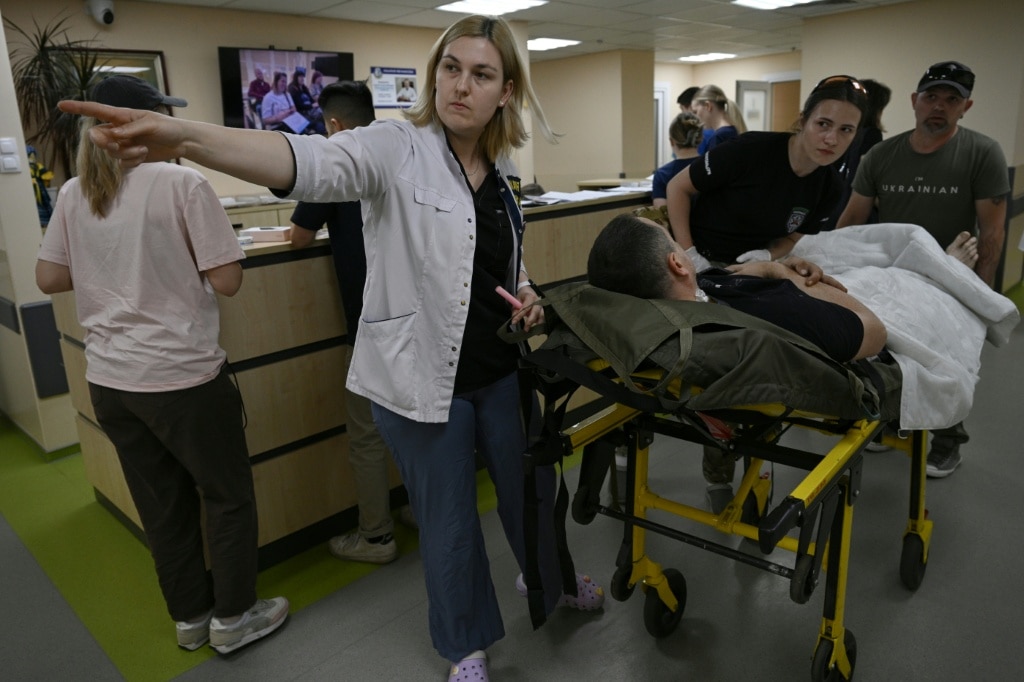
    As midnight approaches, overnight Russian air strikes begin. Paramedics in bulletproof vests wheel a heavily bandaged man into the emergency department, with drone fragments lodged in his throat, eyes and skull. Ryzhenko notes that facial injuries like this have become far more common amid drone attacks, and they are the most devastating to encounter. “You look, and there should be a person there, there should be a face. There is nothing,” he says.

    Half a dozen ambulances arrive before dawn, but staff call it a quiet night. Eventually, the neon lights over the emergency entrance are switched off, and the receptionist dozes off between incoming patients, soft snores echoing down the empty corridor. By 8 a.m., the new day shift has clocked in, and the hospital stirs to life once more. Vorobyova heads home to rest, surgeons pull on fresh sterile gowns, and Ryzhenko begins his morning corridor round all over again — the unending work of saving lives in a country at war.