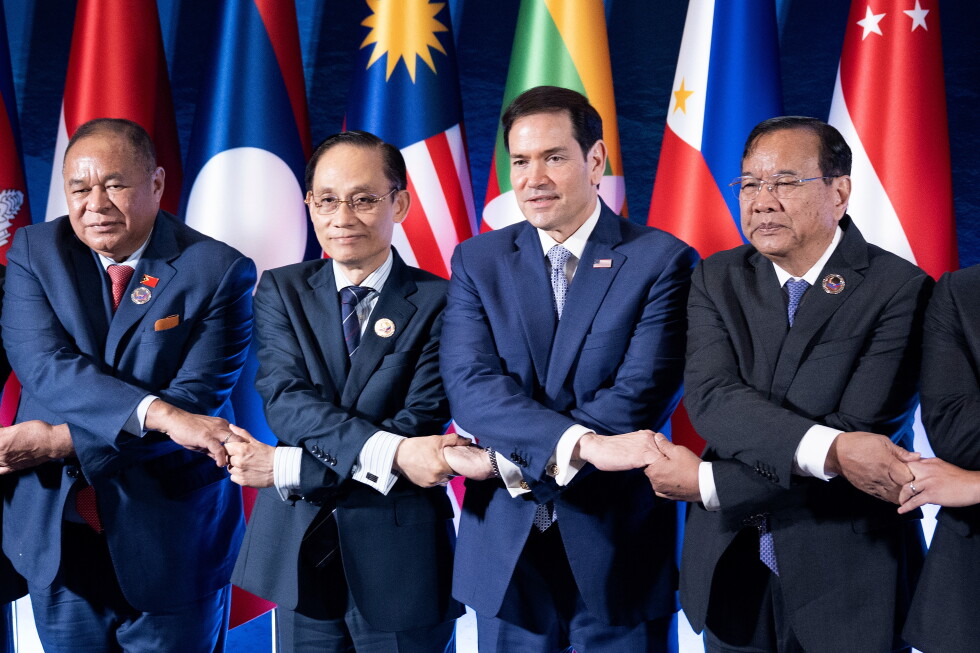
MANILA, Philippines — U.S. Secretary of State Marco Rubio issued a stark warning during diplomatic gatherings in the Philippine capital on Wednesday, arguing that Iran’s recent claims to control traffic and impose tolls on the Strait of Hormuz pose a critical threat to global economic stability and the long-standing principle of free navigation — risks that would extend as far as Southeast Asia.
Rubio opened his annual meeting with foreign ministers from the Association of Southeast Asian Nations (ASEAN), a bloc whose member states have already raised growing alarm over the spillover effects of escalating conflict in the Middle East on their own economic and security interests. Addressing concerns that Washington’s focus on the Middle East war would divert attention from Indo-Pacific priorities, Rubio explicitly reassured ASEAN leaders of unwavering U.S. commitment to the region.
“If we allow a precedent to take hold in the Middle East where a sovereign nation can unilaterally seize control of an international waterway, demand tolls from passing vessels, and attack ships that refuse to comply, that dangerous pattern will be replicated in other regions across the globe, including right here in Southeast Asia,” Rubio told the assembled ministers.
Beyond the ASEAN meeting, Rubio also took part in a gathering of foreign ministers from the Quadrilateral Security Dialogue (Quad), the four-nation strategic partnership grouping the United States, Australia, India and Japan. During that meeting, the bloc aligned on core shared priorities including technological governance, humanitarian aid coordination, emergency disaster response, maritime security and countering transnational security threats.
Following closed-door discussions, the Quad issued a joint statement reaffirming their commitment to ongoing maritime security initiatives designed to counter China’s expanding geopolitical influence in the Indo-Pacific. “We are united in our conviction that peace and stability in the Indo-Pacific maritime domain underpin the security and prosperity of the region,” the statement read. Rubio later confirmed the bloc’s ongoing relevance in a post to the social platform X, writing “The Quad remains a priority, and we will meet again later this year.”
The Trump administration has consistently criticized what it frames as increasingly aggressive actions by China in the South China Sea, moves that disadvantage smaller territorial claimants including the Philippines — Washington’s longest-standing treaty ally in Asia. Territorial disputes in the waterway, which also involve Taiwan and ASEAN members Vietnam, Malaysia and Brunei, are a central topic on the agenda for the three days of diplomatic talks that opened in Manila on Tuesday.
Rubio also held a bilateral meeting with Indian External Affairs Minister Subrahmanyam Jaishankar, where the two diplomats reviewed regional developments, the ongoing conflict between the U.S. and Iran, and progress on a bilateral trade agreement that would roll back existing U.S. tariffs on Indian goods, according to State Department spokesperson Tommy Pigott. “The Secretary and Minister Jaishankar agreed on the importance of finalizing the interim trade deal, which is almost complete,” Pigott told reporters.
As of Wednesday evening, Rubio was scheduled to hold a separate, closed-door meeting with Chinese Foreign Minister Wang Yi on the sidelines of the talks, which are being hosted at a heavily secured convention center along Manila Bay.