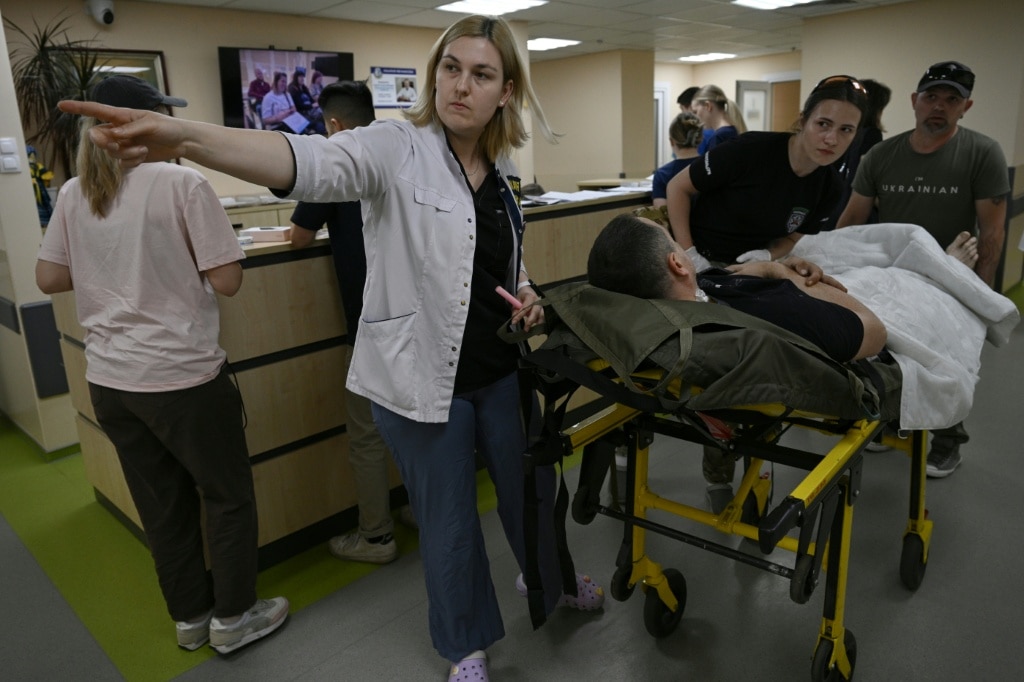
Deep in Ukraine’s industrial heartland of Dnipro, 100 kilometers from the active front lines of Russia’s full-scale invasion, a major public hospital never stops moving. For more than two years, Dnipro Central Hospital has served as the primary trauma care hub for thousands of wounded soldiers and civilians streaming in from the embattled eastern and southern regions of the country, its corridors and operating rooms bearing unflinching witness to the human cost of war. A day in this facility is a relentless cycle of crisis, grief, quiet resilience and small moments of new life that keep medical staff going.
It is just 9 a.m. when the surgical team completes its third amputation of the day. On the operating table lies a 27-year-old Ukrainian soldier, whose lower body was torn apart by shrapnel from a Russian drone attack. Lead surgeon’s scalpel hovers over the mangled flesh and shattered bone, a small cross drawn in the air before the first cut, as hospital director Sergiy Ryzhenko and his team watch in somber silence. One young medical worker slips out of the observation room, voice barely audible: “I’ll never get used to this.”
Ryzhenko, who oversees between 50 and 100 operations every single day, says the nature of injuries flowing through his hospital has shifted dramatically since the invasion began in 2022. Common bullet wounds from the early phase of the war have been replaced by far more devastating damage from drones, missiles and Russian glide bombs. “The body is torn into pieces, chunks of flesh are ripped out, bones are shattered — everything happens in a way that makes saving them almost impossible,” he explains.
By 10 a.m., morning rounds wrap up, and staff retreat to the break room for a quick bite. The sharp scent of antiseptic mixes with the aroma of garlic and coffee as medics snack on black bread and fresh cherries, trading dark gallows humor that has become their most vital coping mechanism. Nurse Ruslana Vorobyova recounts the unthinkable injuries she treats daily: 83% of patients arriving at the hospital are either unconscious or suffering catastrophic, limb-altering damage. “One guy’s intestines were sticking out. He was holding it in with his hands,” she says. “Another had his head smashed, everything was pouring out.”
Working 24-hour consecutive shifts, staff grab what little rest they can on folding camp beds tucked into quiet corners, but even sleep offers no escape from the conflict. Even off shift, Vorobyova says, exhaustion can’t drown out the lingering trauma: “You come home exhausted, lie down to rest. And you still dream that you’re… You dream that there’s an explosion somewhere.” With Dnipro facing frequent Russian rocket and drone attacks, the fear of incoming strikes never fully fades for the team working here.
A short walk across the hospital, on what staff call the “happy side,” obstetrician Olga Fandeieva has just helped deliver a healthy newborn. After the delivery, family members crowd into the small room, passing the tiny infant between them and snapping photos to mark the moment. Since the war began, Fandeieva has split her shifts between the trauma ward and the maternity wing, moving between scenes of catastrophic injury and new life every day. That contrast, she says, is what keeps her grounded.
“When you look at young guys who’ve had their arms and legs cut off, and then in the morning you come here and you take these little paws in your hands – it’s a reset,” she explains. “You understand what you live for and what you work for.” Many of her colleagues make a point of visiting the maternity ward for a quiet break when the pressure of the trauma wing becomes too heavy. Others step out into the courtyard for a cigarette and a moment of fresh air, where on this afternoon two nurses sit chatting, and a young one-legged soldier with a singed beard laughs with a comrade, a small crack of light in the darkness.
As the sun sets over Dnipro at 8 p.m., dark circles deepen under Vorobyova’s eyes. She pulls a heavy leather ledger from the windowsill of the nurses’ station, flipping to a page marked 1958 — the number of trauma surgeries the hospital has performed in just the first five months of this year. Since the invasion began in 2022, the facility has carried out almost 60,000 operations total. Today, multiple severe traumatic injuries are the norm, with some patients requiring as many as 20 separate surgeries in a single week to save their lives. The unique patterns of damage from modern drone attacks have even become a specialized field of study, with dozens of Western doctors traveling to Dnipro to learn from the team’s frontline experience.
As midnight approaches, overnight Russian air strikes begin. Paramedics in bulletproof vests wheel a heavily bandaged man into the emergency department, with drone fragments lodged in his throat, eyes and skull. Ryzhenko notes that facial injuries like this have become far more common amid drone attacks, and they are the most devastating to encounter. “You look, and there should be a person there, there should be a face. There is nothing,” he says.
Half a dozen ambulances arrive before dawn, but staff call it a quiet night. Eventually, the neon lights over the emergency entrance are switched off, and the receptionist dozes off between incoming patients, soft snores echoing down the empty corridor. By 8 a.m., the new day shift has clocked in, and the hospital stirs to life once more. Vorobyova heads home to rest, surgeons pull on fresh sterile gowns, and Ryzhenko begins his morning corridor round all over again — the unending work of saving lives in a country at war.