博客

  • Looking for a job in UAE? Key sectors and in-demand roles in 2025 revealed

    Looking for a job in UAE? Key sectors and in-demand roles in 2025 revealed

    The United Arab Emirates has established itself as the Gulf region’s most balanced labor market in 2025, according to Naukrigulf’s Year End Report. This equilibrium stems from simultaneous hiring for both scale and specialized skills, creating diverse opportunities across multiple sectors.

    Construction and real estate sectors led hiring demand, closely followed by IT, telecommunications, internet services, and the oil, gas, and energy industries. This multi-sector growth has created one of the region’s most evenly distributed job markets.

    The most sought-after positions included engineering, sales, and software/IT roles, with particular demand for project managers, sales executives, and customer service representatives. The report identified HVAC expertise, accounting proficiency, and customer support capabilities as critical skills that provide competitive advantages for job seekers.

    GCC-wide analysis revealed traditional industries continued to dominate regional recruitment, with construction and energy sectors accounting for over 4.6 million candidate searches throughout the year. Employers across the Gulf showed heightened demand for engineering talent (850,000+ searches), sales professionals (800,000+ searches), and project management experts (775,000+ searches), reflecting the region’s execution-focused growth strategy.

    Despite robust hiring activity, employees faced significant negotiation challenges. Approximately 46% of job seekers cited salary expectation mismatches as their primary obstacle, while 32% struggled with articulating their personal value proposition. Additional challenges included handling counteroffers (18%) and negotiating benefits packages (4%).

    UAE professionals demonstrated evolving priorities beyond compensation, with professional development opportunities emerging as the most valued non-monetary benefit. This was followed by vacation time, comprehensive health benefits, and flexible working arrangements, indicating a growing emphasis on long-term career growth and work-life balance.

    The findings are based on insights from more than 9 million hiring interactions on Naukrigulf’s platform throughout 2025, supplemented by jobseeker sentiment data collected through monthly Gulf Pulse surveys across all GCC nations.


  • Sanya hosts international dragon, lion dance competition

    Sanya hosts international dragon, lion dance competition

    The coastal city of Sanya in Hainan Province transformed into a vibrant stage for traditional Chinese cultural arts as it hosted the 2026 Sanya Cup International Dragon and Lion Dance Elite Competition from January 18-19. The event brought together approximately 300 elite athletes representing 24 international teams at the picturesque Dadonghai scenic area.

    Competitors showcased extraordinary skill and artistry across multiple disciplines, including traditional dragon dance performances alongside both southern and northern styles of lion dancing. The two-day spectacle demonstrated the global appeal and evolving nature of these ancient performance traditions, which have become symbolic of Chinese cultural heritage worldwide.

    The international gathering served not only as a competitive platform but also as a cultural exchange forum, with participants from across the globe converging in Sanya’s tropical setting. The event highlighted China’s ongoing efforts to promote and preserve its intangible cultural heritage while fostering international appreciation for these dynamic art forms.

    The competition’s location in Sanya, a popular tropical destination, provided a striking backdrop that enhanced the visual impact of the colorful performances. Organizers successfully created an event that balanced competitive excellence with cultural celebration, drawing attention to the continuing relevance and adaptation of traditional arts in contemporary global contexts.

  • Mosuo boaters sing amid ethereal winter fog at Yunnan’s Lugu Lake

    Mosuo boaters sing amid ethereal winter fog at Yunnan’s Lugu Lake

    In the highland region of Yunnan province, Lugu Lake awakens each winter morning shrouded in an ethereal mist. As dawn breaks over the surrounding mountains, a timeless cultural tradition emerges from the fog. Local Mosuo ethnic community members navigate the tranquil waters in traditional dugout canoes, their ancient mountain songs reverberating across the lake’s surface.

    The Mosuo boaters provide visitors with an immersive cultural experience, blending natural beauty with living tradition. The combination of the lake’s atmospheric winter fog and the haunting melodies creates a surreal spectacle that has become a signature attraction of the Lijiang area. This daily ritual represents more than tourism—it’s a preservation of Mosuo heritage and connection to their ancestral environment.

    Photographers like Chen Fei have captured these mesmerizing scenes, showing how the Mosuo people maintain their cultural practices while sharing them with outsiders. The images reveal the perfect harmony between human activity and natural beauty, with the dugout canoes gliding effortlessly through the misty waters as songs echo against the mountainous backdrop.

    The phenomenon has gained attention as both a tourist attraction and an example of cultural preservation. Visitors to the region can experience this atmospheric performance firsthand, gaining insight into the Mosuo way of life while witnessing one of Yunnan’s most breathtaking natural settings.

  • Folk-themed train takes international tourists to China’s far north

    Folk-themed train takes international tourists to China’s far north

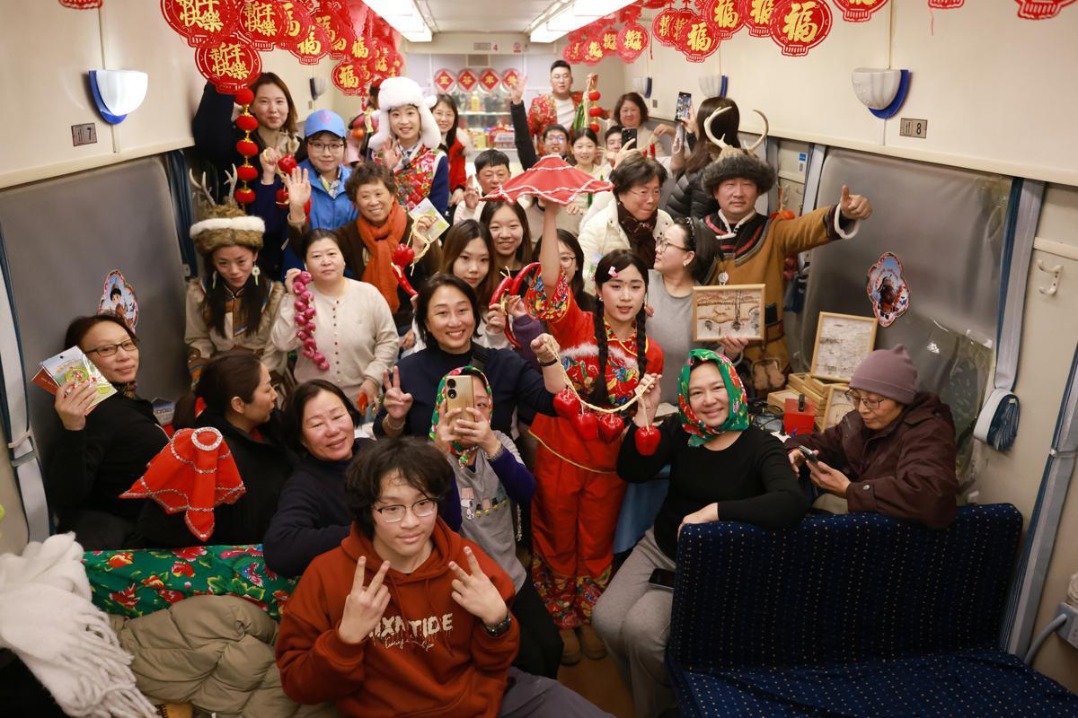
    A specialized cultural immersion experience unfolded aboard train K7041 as it departed Harbin Railway Station on Monday evening, transporting over 100 international tourists from Singapore, Malaysia, and various other nations toward Mohe—China’s northernmost urban center in Heilongjiang province.

    Operated by China Railway Harbin Group, this folk-themed journey transforms conventional rail travel into a mobile cultural showcase. Throughout the expedition, passengers engaged with the rich tapestry of Northeast China’s indigenous traditions through interactive demonstrations and participatory activities.

    The immersive experience featured authentic presentations of Ewenki birch bark pyrography, an ancient artistic practice utilizing heated tools to create intricate designs on tree bark. Travelers also enjoyed live performances of Oroqen folk music and observed delicate embroidery techniques passed down through generations.

    Beyond passive observation, the journey encouraged hands-on participation in traditional Northeast yangko dance—a vibrant folk dance style—alongside craft workshops including paper-cutting and dumpling making sessions. The cultural exploration extended to a traditional Manchu folk game, providing visitors with comprehensive insight into the region’s diverse ethnic heritage.

    This innovative travel concept represents China’s growing emphasis on experiential tourism that combines transportation with cultural education, offering international visitors an authentic encounter with remote regional traditions while showcasing the country’s ethnic diversity to global audiences.

  • Pakistan rescuers scour blaze site for dozens missing

    Pakistan rescuers scour blaze site for dozens missing

    Rescue teams in Karachi continue their painstaking search through the smoldering wreckage of Gul Plaza shopping complex four days after a catastrophic fire engulfed the building. The devastating blaze has claimed at least 29 confirmed fatalities, though authorities anticipate the death toll will rise significantly as recovery operations progress.

    Javed Nabi Khoso, Deputy Commissioner of Karachi South, disclosed that 39 individuals have been officially verified as missing, with nearly 50 additional persons remaining on unverified missing lists. The recovery process has drawn criticism from grieving families who have expressed frustration with the pace of the operation. AFP correspondents observed at least five sets of human remains being extracted from the debris on Wednesday.

    At Karachi’s Civil Hospital, health official Summaiya Syed reported that DNA samples from 51 families have been collected to facilitate identification of victims. “We will transfer the remains to families once DNA matches are confirmed,” Syed stated outside the hospital mortuary. Of the 29 victims transferred to the Edhi Foundation morgue, only seven have been positively identified and returned to relatives through DNA matching.

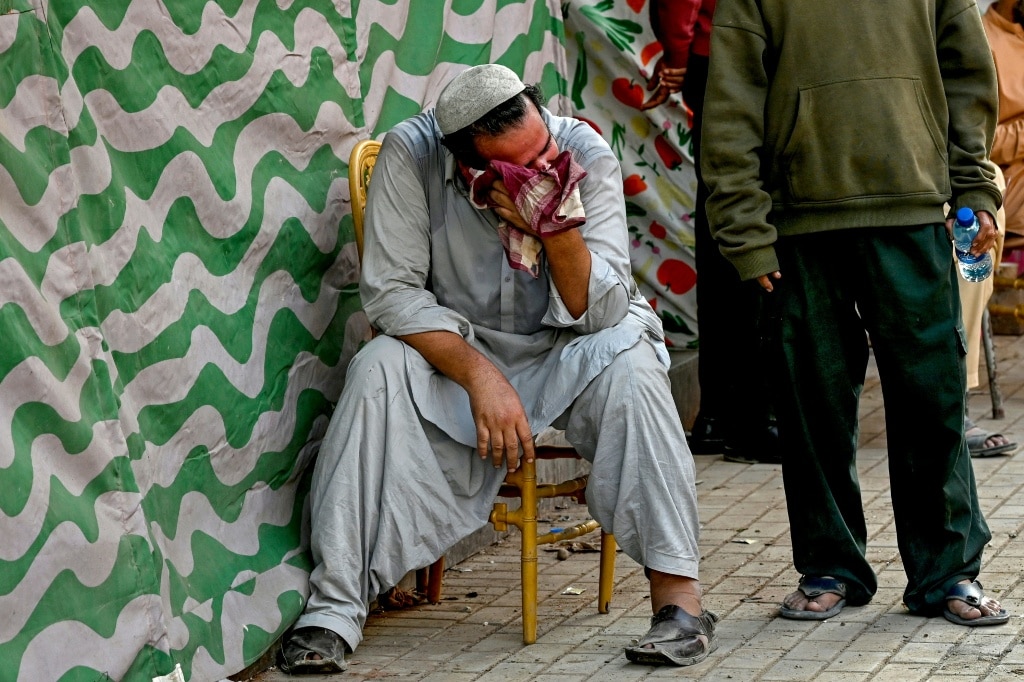
    The human tragedy has left families confronting unimaginable decisions. Muhammad Saleem, whose three relatives remain missing, explained his family’s resolution not to bring home any recovered remains. “They are bringing only remains wrapped inside clothes,” he expressed. “Our family members still believe they are alive. They will go mad if they see these remains.”

    Faraz Ali, 28, whose father and brother were inside the mall during the fire, articulated the anguish shared by many families: “I want the bodies to be recovered and handed over to their rightful families. That is all so that the families may receive something, some comfort, some peace. At least let us see them one last time, in whatever condition they are.”

    While fires occur frequently in Karachi’s commercial establishments due to substandard infrastructure, the scale of this tragedy stands as particularly severe. A government committee has initiated an investigation, though the cause of the inferno remains undetermined. The three-story Gul Plaza contained approximately 1,200 retail outlets, notably specializing in wedding merchandise and home decor.

  • Indonesian handprints are the oldest cave art found yet

    Indonesian handprints are the oldest cave art found yet

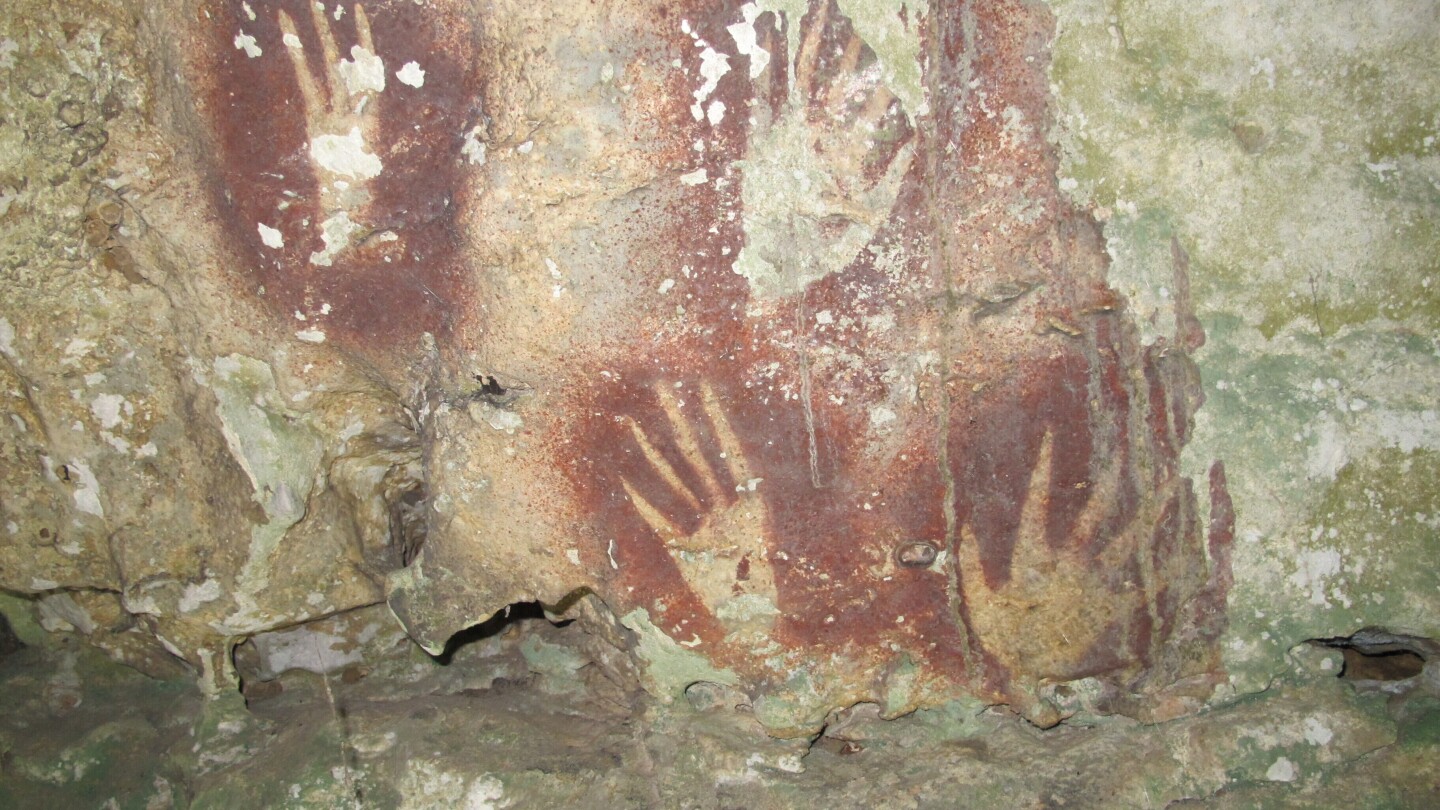
    A groundbreaking archaeological discovery in the caves of Sulawesi, Indonesia, has unveiled what researchers now identify as the world’s oldest known cave art. Meticulous analysis by a joint Indonesian-Australian research team has determined that distinctive hand stencils adorning the cave walls date back an astonishing 67,800 years, predating all previously studied rock art.

    The tan-colored artifacts were created through an sophisticated technique whereby prehistoric artists blew pigment over hands pressed against the cave surface, leaving behind precise negative outlines. Intriguingly, some stencils feature intentionally modified fingertips crafted to appear more pointed, suggesting symbolic or artistic intention beyond mere representation.

    This extraordinary find, detailed in Wednesday’s edition of Nature, positions Sulawesi as a cradle of ancient artistic culture. To establish the precise chronology, researchers employed advanced dating methods on mineral crusts that had formed over the artwork through millennia.

    Study author Maxime Aubert of Griffith University emphasized the significance of these stencils as evidence of a complex artistic tradition that potentially represented shared cultural practices among early human populations. While simpler markings on bones and stones exist from earlier periods, these Sulawesi creations represent the earliest emergence of figurative cave art.

    The discovery fuels ongoing scientific debate regarding which human species created these artworks. Potential creators include Denisovans—an ancient human group inhabiting the region—or early Homo sapiens migrants from Africa. The distinctive anatomical details preserved in the stencils strongly suggest human authorship.

    Separate figurative drawings found in the same cave system, depicting human forms, birds, and equine animals, were determined to be significantly younger at approximately 4,000 years old, indicating a long-standing artistic tradition.

    Researchers believe additional, potentially older artworks may await discovery throughout Indonesia’s island network. This finding not only pushes back the timeline of human artistic expression but opens new avenues for understanding how creative traditions spread across ancient human populations.

    As Aubert stated: ‘This discovery represents not an endpoint, but an invitation to continue our exploration of humanity’s artistic origins.’

  • Oldest cave painting of red claw hand could rewrite human creativity timeline

    Oldest cave painting of red claw hand could rewrite human creativity timeline

    A groundbreaking archaeological discovery on the Indonesian island of Sulawesi has revealed what scientists now identify as the world’s oldest known cave painting—a 67,800-year-old hand stencil that challenges long-held theories about human cognitive evolution. The remarkable find, documented in the journal Nature, predates the previous record-holder from Spain by approximately 1,100 years and fundamentally reshapes our understanding of when Homo sapiens developed symbolic imagination.

    The ancient artwork, located in Liang Metanduno cave on Muna Island, features a sophisticated red pigment outline of a hand that was intentionally modified to create a claw-like appearance. This deliberate artistic transformation represents an early leap in abstract thinking—the kind of cognitive processing that underpins language, religion, and scientific reasoning. Unlike simple impressions, this artwork demonstrates purposeful creative expression that researchers describe as ‘a very human thing to do.’

    Professor Adam Brumm of Australia’s Griffiths University, who co-led the research, emphasizes that this discovery dismantles the Eurocentric notion of a ‘creative explosion’ occurring exclusively in Ice Age Europe. ‘We’re seeing traits of modern human behavior, including narrative art in Indonesia, which makes that argument very hard to sustain,’ Brumm stated. The evidence now suggests that creativity was innate to our species from its African origins rather than suddenly emerging in European populations.

    The dating methodology employed uranium-series analysis of mineral crusts covering the artwork, providing a minimum age of 67,800 years. This technological advancement has consistently pushed back the timeline of sophisticated image-making in Sulawesi, where previous discoveries included 40,000-year-old hand stencils, a 44,000-year-old hunting scene, and a 51,200-year-old narrative painting.

    Crucially, the discovery’s location on the northern sea route between mainland Asia and the ancient Australia-New Guinea landmass (Sahul) has significant implications for human migration patterns. The confirmed presence of symbolically-capable humans in Sulawesi over 67,000 years ago lends credibility to controversial evidence suggesting human occupation in northern Australia by approximately 65,000 years ago—potentially resetting the timeline of Aboriginal Australian ancestry by 15,000 years.

    Indonesian researcher Adhi Agus Oktaviana of the national research and innovation agency (BRIN) notes that the artists were likely part of a broader population that eventually spread throughout the region and reached Australia. The finding supports an emerging consensus that symbolic behavior was established in Africa long before Homo sapiens migrated globally, with creative expression manifesting independently across multiple regions over tens of thousands of years.

  • Dozens of body parts are found after Pakistan’s shopping plaza fire

    Dozens of body parts are found after Pakistan’s shopping plaza fire

    KARACHI, Pakistan — The death toll from Saturday’s catastrophic shopping plaza fire is anticipated to increase significantly after rescue teams made a grim discovery Wednesday, uncovering human remains believed to belong to numerous victims who had sought refuge in a single shop during the blaze.

    For the first time since the fire erupted at Gul Plaza in Pakistan’s largest metropolitan area, search crews managed to access a retail establishment where multiple individuals had attempted to shelter from the inferno. The recovery operation revealed more than two dozen body parts, suggesting the final casualty count could substantially exceed initial estimates.

    Prior to this development, authorities had confirmed 29 fatalities from the incident, according to police surgeon Dr. Summaiya Syed. The city’s primary medical facility received the newly discovered remains on the fifth consecutive day of search efforts.

    Government administrator Javed Nabi Khoso provided preliminary assessments indicating the recovered remains might represent between 15 to 25 individuals. “This marks the first instance where such an extensive collection of remains has been located in a single area since the fire commenced,” Khoso stated.

    Senior rescue official Abid Jamal Sheikh corroborated these estimates, noting the remains could belong to more than a dozen people while emphasizing that official verification procedures remain ongoing.

    The investigation into the fire’s origin continues, with preliminary police reports suggesting an electrical short circuit may have ignited the blaze.

    Amid the ongoing recovery operations, dozens of mourners gathered Wednesday for the first funeral services, honoring shop owner Shahroz Iqbal who perished in the tragedy.

    This incident highlights Karachi’s persistent challenges with fire safety, characterized by inadequate safety protocols, lax enforcement measures, and unauthorized construction practices. The city witnessed a similar mall fire in November 2023 that resulted in 10 fatalities and 22 injuries. Pakistan’s deadliest industrial catastrophe occurred in 2012 when a garment factory fire claimed at least 260 lives.

  • Centuries of love letters go on display at the National Archives in London

    Centuries of love letters go on display at the National Archives in London

    LONDON — As Valentine’s Day approaches, Britain’s National Archives unveils a remarkable exhibition titled “Love Letters,” showcasing five centuries of heartfelt correspondence that transcends conventional romantic notions. The collection presents an extraordinary tapestry of human emotion through meticulously preserved documents ranging from royal missives to ordinary citizens’ expressions of affection.

    Curator Victoria Iglikowski-Broad describes the exhibition as revealing “legendary romances from British history” alongside voices from everyday life. “We’re trying to open up the potential of what a love letter can be,” she explained, noting that expressions of love emerge from unexpected sources and diverse formats. The collection spans medieval songs of heartbreak, twentieth-century classified ads seeking same-sex romance, and wartime correspondence between soldiers and their sweethearts.

    Among the most poignant exhibits is Robert Dudley’s final letter to Queen Elizabeth I, written days before his death in 1588. The document, found at the queen’s bedside upon her death fifteen years later, reveals the intimate connection between the “Virgin Queen” and her self-described “poor old servant.”

    The exhibition broadens the definition of love beyond romance to include familial bonds and friendship. Jane Austen’s handwritten will bequeathing nearly everything to her sister Cassandra appears alongside a 1956 plea from the father of gangster twins Reggie and Ronnie Kray, begging courts for leniency based on their good intentions.

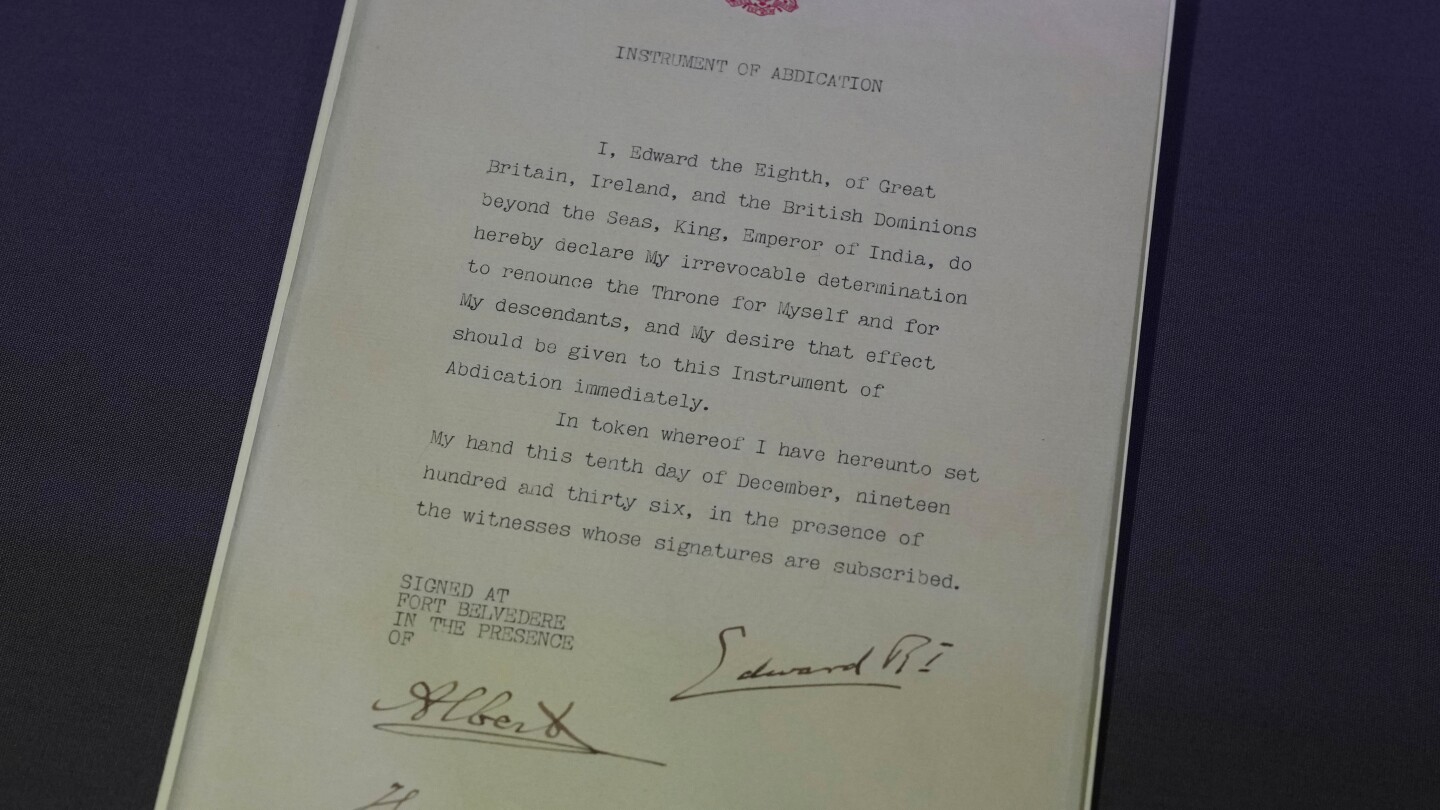
    Remarkable contrasts emerge throughout the collection. An 1851 petition from unemployed weaver Daniel Rush, begging authorities not to separate him from his wife through workhouse assignments, appears beside King Edward VIII’s 1936 Instrument of Abdication, through which he relinquished the throne to marry “the woman I love,” Wallis Simpson.

    “These two items share a common human feeling that sacrifice is worth it for love,” observed Iglikowski-Broad.

    The exhibition also explores love’s tragic dimensions. A previously unseen 1944 letter from British intelligence officer John Cairncross (later revealed as a Soviet spy) reflects on lost romance with former girlfriend Gloria Barraclough. Historical tragedies include Catherine Howard’s 1541 letter to Thomas Culpeper—written with “restrained panic” before both were executed for treason—and Queen Henrietta Maria’s rare intimate letter to King Charles I, discovered among possessions abandoned after a civil war defeat.

    Archives historian Neil Johnston noted the exceptional nature of the royal correspondence: “This is a little gem within the disaster of the English Civil War.”

    The “Love Letters” exhibition opens Saturday and continues through April 12 with free admission, offering visitors an unprecedented journey through centuries of emotional history.

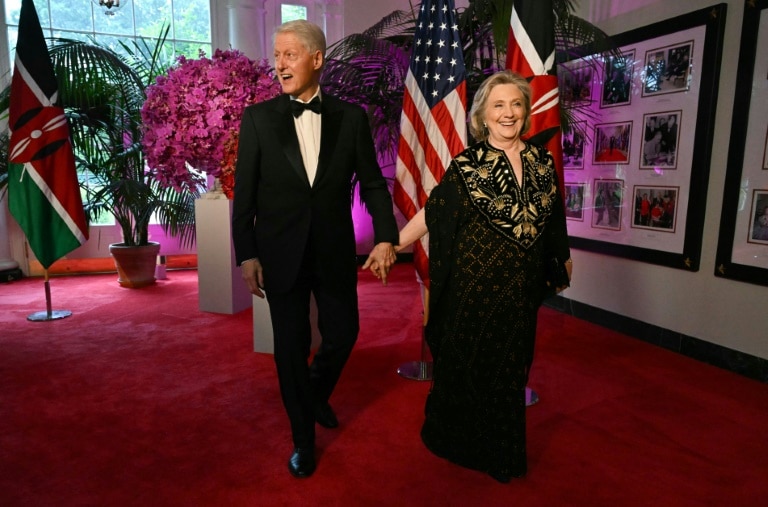
  • US Congress targets Clintons in Epstein contempt fight

    US Congress targets Clintons in Epstein contempt fight

    The U.S. House Oversight Committee has initiated a significant political confrontation by advancing contempt proceedings against former President Bill Clinton and former Secretary of State Hillary Clinton. The Republican-majority committee voted Wednesday to pursue charges after the Clintons declined to comply with subpoenas for in-person testimony regarding their connections to convicted sex offender Jeffrey Epstein.

    The committee’s action represents an escalation in the long-running investigation into how authorities handled previous Epstein investigations. The contempt resolutions now proceed to the full House of Representatives, where Republican leadership must decide whether to formally cite the Clintons for defiance of congressional authority and refer them to the Justice Department for potential criminal prosecution.

    This development highlights how the Epstein scandal continues to reverberate through Washington’s power structures, implicating prominent figures across the political spectrum. The investigation has become intensely polarized, with Democrats characterizing it as a politically motivated effort to target President Trump’s opponents while ignoring Trump’s own documented associations with Epstein.

    Committee Chairman James Comer rejected what he termed a ‘ridiculous offer’ from Bill Clinton’s representatives that would have limited questioning to a single lawmaker in New York without producing an official transcript. The Clintons maintain that the subpoenas lack legitimate legislative purpose and have instead provided sworn written statements detailing their limited interactions with Epstein.

    In their submitted declarations, Bill Clinton acknowledged using Epstein’s aircraft for humanitarian work in the early 2000s but denied visiting his private island. Hillary Clinton stated she had no meaningful interactions with Epstein whatsoever. The controversy has exposed divisions within the Democratic Party regarding how to respond to Republican investigative tactics while maintaining consistency with previous positions on accountability for Epstein’s crimes.

    The proceedings occur against the backdrop of ongoing criticism regarding the Trump administration’s delayed release of Epstein-related case files, which Democrats have characterized as a cover-up. Neither Trump nor the Clintons have been accused of criminal wrongdoing related to Epstein, but the investigation continues to expose the deep political fractures surrounding one of the most notorious criminal cases in recent memory.