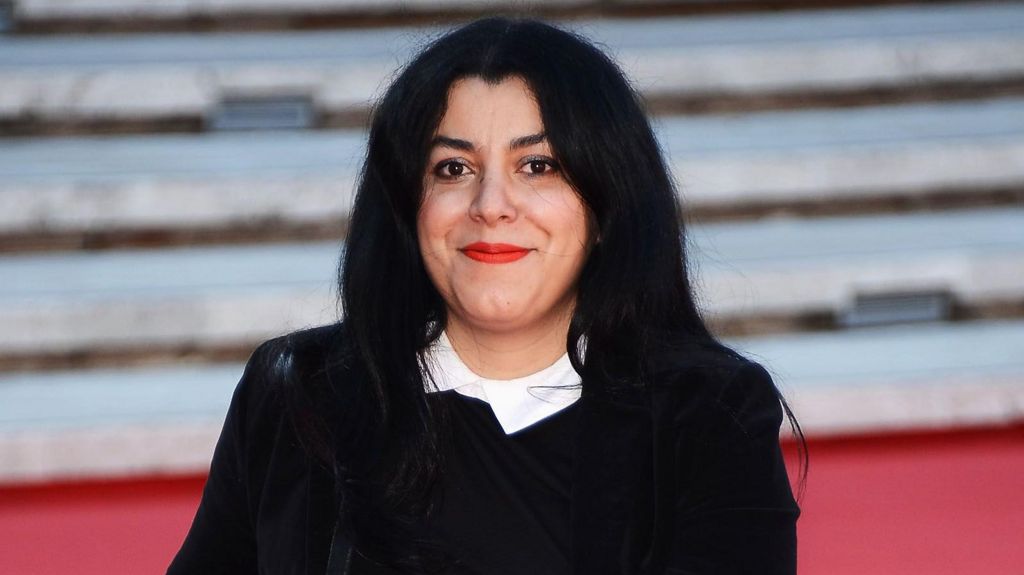
Marjane Satrapi, the trailblazing French-Iranian graphic novelist, filmmaker, and activist whose semi-autobiographical masterpiece *Persepolis* captivated readers and audiences across the globe, has died at the age of 56. France’s Élysée Palace, the official residence of the French president, has officially confirmed the passing.
Hailing Satrapi as a towering icon of French cultural life and an unwavering advocate for artistic freedom, the palace highlighted that her work carried a universally resonant message that earned her extraordinary international acclaim. A close source from her inner circle told French news agency AFP that Satrapi’s death came roughly 15 months after the passing of her beloved husband Mattias Ripa, a Swedish producer, actor, and screenwriter. The source described her death as a passing “of sadness” following the loss of her life partner.
Born and raised in Tehran during the upheaval of the 1979 Islamic Revolution, Satrapi drew deeply from her own life to craft *Persepolis*, which first hit bookshelves in 2000. The groundbreaking graphic novel traces the coming-of-age of a young girl navigating shifting social and political tides after the revolution, chronicling her early years of resistance to new Islamic regime rules before her parents sent her to exile in Europe for safety. Eight years after its publication, Satrapi co-directed the animated film adaptation of *Persepolis*, which earned an Academy Award nomination for Best Animated Feature. The film cast Chiara Mastroianni as the young Marjane and Catherine Deneuve as her mother, cementing the story’s place in global popular culture.
In a statement posted to X, Studio Canal UK paid tribute to Satrapi, remembering her as a brilliant and extraordinary artist. The studio noted that through her deeply intimate and politically sharp work, Satrapi delivered a timeless story of identity, freedom, exile, and resistance that still resonates deeply with audiences worldwide decades after its release.
Satrapi’s life trajectory reflected the disruptions and resilience that shaped her work. As a teenager, she moved to Austria to study for four years at the renowned Lycée Français de Vienne, before returning to Tehran after a severe case of bronchitis. Upon her return, she found a drastically altered city, a experience captured in the second installment of the *Persepolis* series. She went on to earn a master’s degree in visual communication from Tehran’s Islamic Azad University, and after a short early marriage that ended in divorce, her parents encouraged her to resettle in Europe permanently. She moved to France to continue her artistic training at the Haute École des Arts du Rhin in Strasbourg, and became a naturalized French citizen in 2006 after more than a decade of living in the country. Just last year, she made headlines when she declined France’s prestigious Legion of Honor, the country’s highest order of merit, citing what she called the “hypocrisy” of her adopted nation’s diplomatic dealings with her home country Iran.
A relentless, outspoken critic of the Iranian government, Satrapi remained actively engaged in pro-freedom protests supporting Iranian citizens for decades. In the wake of the 2022 “Woman, Life, Freedom” protests that erupted across Iran over mandatory hijab rules, Satrapi told outlet *Deadline* that her own parents had marched in the streets opposing the same mandate as early as 1983. She recalled her father, one of the few men to join that early demonstration, and reflected that the fight for women’s rights is a fight for the rights of all society. Over her decades of activism, Satrapi said she had faced repeated threats and smears from the Iranian regime, which labeled her a liar and a spy for her work. “It’s not that you don’t feel fear; you feel the fear, but then you decide whether you care about it or not,” she once said. “It’s not that I’m fearless or careless but there are kids in my country who are being shot and they are 17 years old, while I have lived for more than half a century.”
In 2023, Satrapi led a high-profile demonstration outside the Iranian Embassy in Paris in solidarity with five teenage girls from Tehran who were arrested after posting a TikTok video of themselves dancing to the hit song “Calm Down” by Rema and Selena Gomez. Of her activism, she said at the time: “We artists must be humble but doing nothing is worse, being indifferent is worse. I don’t think what I’m doing is huge or immense but I have a voice, I have a face and I’m known in France, I’m just doing what I have to do.”
Beyond her defining work *Persepolis*, Satrapi built a diverse body of creative work across graphic novels and film. Her other graphic novels include *Embroideries* and *Woman, Life, Freedom*. As a filmmaker, she directed a range of projects across genres: the 2011 feature *Poulet aux Prunes*, the 2012 documentary *La Bande des Jotas*, the 2014 dark horror comedy *The Voices* starring Ryan Reynolds as a schizophrenic factory worker undone by hallucinatory urges, and the 2019 biographical drama *Radioactive*, which told the story of pioneering Polish-French scientist Marie Curie.
In the months after Ripa’s 2024 death, Satrapi shared a series of emotional, heartfelt posts on her Instagram account writing, “For I Lost the love of my life,” marking her public grief over the loss of her partner.