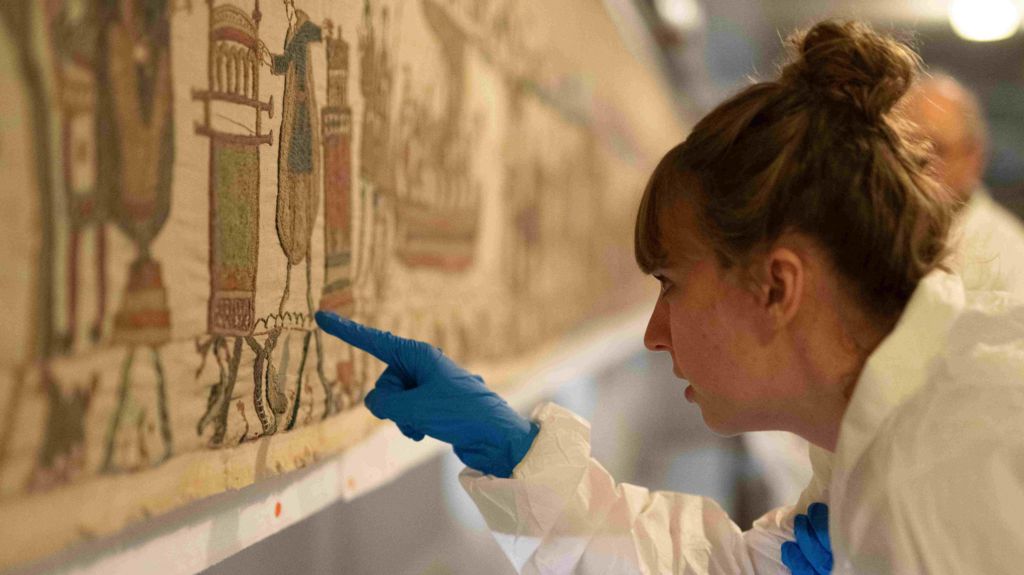
Nearly a millennium after it was stitched to recount one of the most transformative events in European history, the 950-year-old Bayeux Tapestry is preparing for only its third departure from its long-term home in the French town of Bayeux, for a nine-month unprecedented exhibition at London’s British Museum next month. As one of the most culturally significant medieval artifacts in existence, the embroidery’s cross-Channel journey has sparked heated debate across France’s art and heritage communities, with many critics warning the fragile 70-meter work is too precious and delicate to survive the 560-kilometer trip.
But French cultural authorities say years of rigorous planning and testing have eliminated all major risks, positioning the tapestry for a safe journey that will be as gentle as rocking a cradle. Delphine Christophe, head of heritage and architecture at France’s Ministry of Culture, says she has full confidence in the transport plan: “I am extremely serene. Nothing has been left to chance.”
The complex transport system, designed to eliminate vibration and shock damage, relies on a multi-layered protective setup. After being carefully removed from its permanent Bayeux display last September by a team of 90 specialists and mounted to a custom collapsible folding stand at an undisclosed secure location, the tapestry will be moved to London in a climate-controlled aluminum inner crate that regulates temperature and humidity. This crate will then be placed inside a rigid outer shell, fitted with 12 metal shock-absorbing springs above and below the inner container. The entire assembly will be transported by heavy goods vehicle, which will then cross the Channel via the Eurotunnel shuttle.
Cecilia Gauvin, a leading art conservation expert, explained the innovative mechanics of the protective system: “The idea is that the vertical shocks which will occur are transformed into horizontal shocks, causing the inner crate to rock to and fro like a baby in a cradle.” Two full dry runs with a full-size facsimile of the tapestry, completed in February and April, found the system absorbs 96% of all road and rail vibrations, reducing movement to the same level that artworks experience during routine display in a museum. Kerstin Kracht, a vibration reduction specialist, noted that even static museum displays are subject to minor vibrations from visitor foot traffic, so the tapestry will experience no more stress during transit than it would standing still in Bayeux. While teams found UK roads have slightly more uneven surfaces and potholes than French routes, the difference was not large enough to disrupt the carefully calibrated safety calculations.
The exact date of the journey remains undisclosed for security reasons, with transport scheduled to take place sometime in July. Once it arrives at the British Museum, the tapestry will be unpacked with the same level of careful manpower used to store it in Bayeux, and displayed flat rather than vertically for the duration of the nine-month exhibition.
Despite the extensive testing and planning, skepticism remains among some French heritage specialists. Didier Rykner, a prominent French arts journalist and heritage commentator, has questioned both the safety and the motivation for the journey, pointing to unforeseen risks: “What happens if there is a problem in the tunnel and the lorry gets stuck there? These technical reports they have produced are meaningless – they’re just there to justify the political decision that’s already been taken.”
The historic loan, which has been requested by successive UK governments for decades, was first announced by French President Emmanuel Macron in 2025, with an explicit political goal: strengthening post-Brexit Franco-British relations at a time of growing global instability. As a reciprocal gesture, the UK will loan a collection of iconic medieval artifacts to Normandy museums, including the 12th-century Lewis chessmen and Anglo-Saxon treasures from the famous Sutton Hoo burial mound. The exhibition comes ahead of 2027, when Normandy will mark the 1,000th anniversary of the birth of William the Conqueror, the Norman leader whose 1066 conquest of England is the tapestry’s central subject.
For context, the Bayeux Tapestry is technically an embroidered linen work, not a woven tapestry, created in the years immediately following the 1066 Norman Conquest to illustrate the lead-up to the Battle of Hastings. It was housed in Bayeux Cathedral for centuries, only rediscovered in the 1700s, and has left Bayeux just twice before: once in 1803, when Napoleon brought it to Paris to use as propaganda for his planned invasion of Britain, and again during World War Two, when it was moved to Paris for safekeeping.