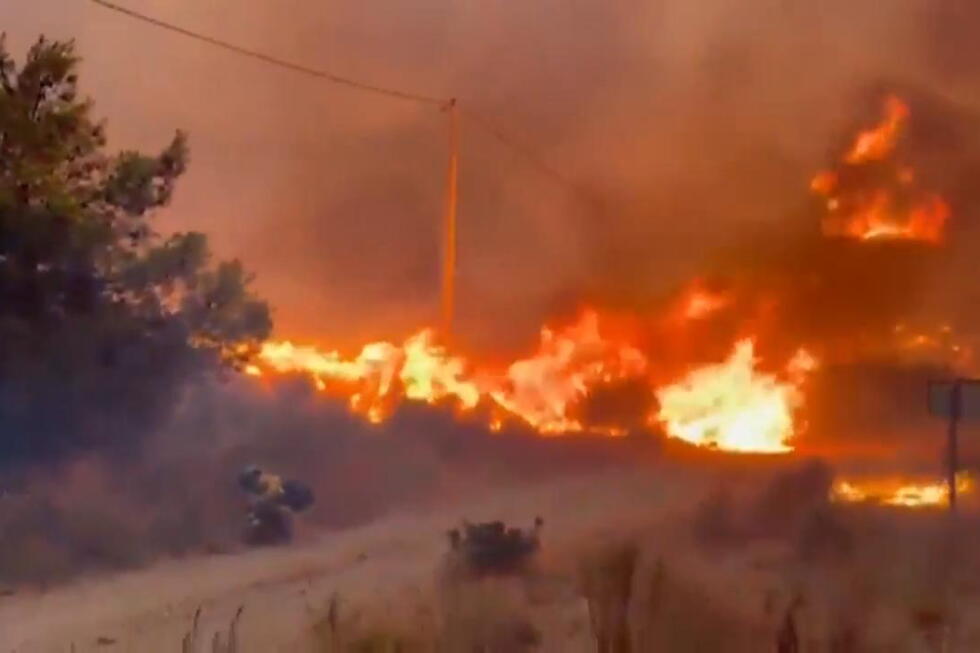
MADRID – In a devastating disaster that has underscored Europe’s growing wildfire risk amid accelerating climate change, a fast-spreading wildfire in southern Spain’s Almeria province has claimed at least 11 lives, making it one of the deadliest wildfires recorded in the country’s recent history. The blaze ignited as record-breaking high temperatures blanket most of the Iberian Peninsula, Spanish emergency authorities confirmed early Friday.
Local media reports indicate multiple victims were discovered trapped inside charred vehicles after the fire overran the area. Eight additional people have been treated for burn and smoke inhalation injuries, as a joint response team of 150 career firefighters and 220 military emergency unit personnel has been deployed to contain the blaze, which has spread across thousands of hectares of semi-arid brush and forest.
Regional emergency officials confirmed that four of the deceased are British nationals. Earlier reports had placed the death toll at 12, but officials issued a revised count Friday morning. Andalusia regional president Juan Manuel Moreno told Cadena Ser radio Friday that 19 people remain unaccounted for as search and rescue teams continue to comb through the burned area.
The fire started in a small hamlet in the semi-arid foothills of the Sierra de Los Filabres mountain range. While authorities have not yet officially confirmed the ignition cause, initial witness reports shared with emergency services point to a fallen power line that sparked the fire. The blaze quickly spread to a nearby forest, fanned by high winds and parched vegetation that allowed it to grow out of control in hours.
Emergency management officials have ordered the evacuation of roughly 1,000 local residents from at-risk communities, and multiple regional highways and local roads have been closed to prevent civilian exposure to the fire and smoke. The disaster prompted an immediate statement of condolence from Spanish Prime Minister Pedro Sánchez, who posted on the social platform X that he felt “Immense sadness and desolation in the face of the terrible consequences of the fire affecting the province of Almeria.”
This latest disaster comes as Spain confronts a growing pattern of extreme heat and wildfire activity, driven by long-term climate shifts. Over the past decade, the country has faced increasingly frequent and severe heatwaves, with peak temperatures regularly climbing above 40°C (104°F). The combination of persistent high heat, low rainfall, and strong gusty winds creates ideal conditions for small ignitions to expand into large, unmanageable blazes. Just two months prior, in June, a multi-day record heat event across Spain was linked to more than 1,000 excess heat-related deaths.
The current heatwave affecting Almeria is part of a broader pattern of extreme heat across Western Europe, which has now endured three major heat events in just six weeks. According to the European Union’s Copernicus Climate Change Service, Europe is warming faster than any other continent on Earth: since the 1980s, average temperatures here have risen twice as quickly as the global average. Data confirms 2025 was the third hottest year ever recorded globally, bringing a string of intense, long-lasting heatwaves across multiple European regions.
Climate scientists have repeatedly warned that human-caused climate change, driven by the burning of fossil fuels including gasoline, oil, and coal, is directly increasing the frequency and severity of extreme heat and drought across the Mediterranean basin. This shift has left many southern European countries far more vulnerable to large, deadly wildfires than in decades past, creating an urgent need for improved adaptation and fire management infrastructure.