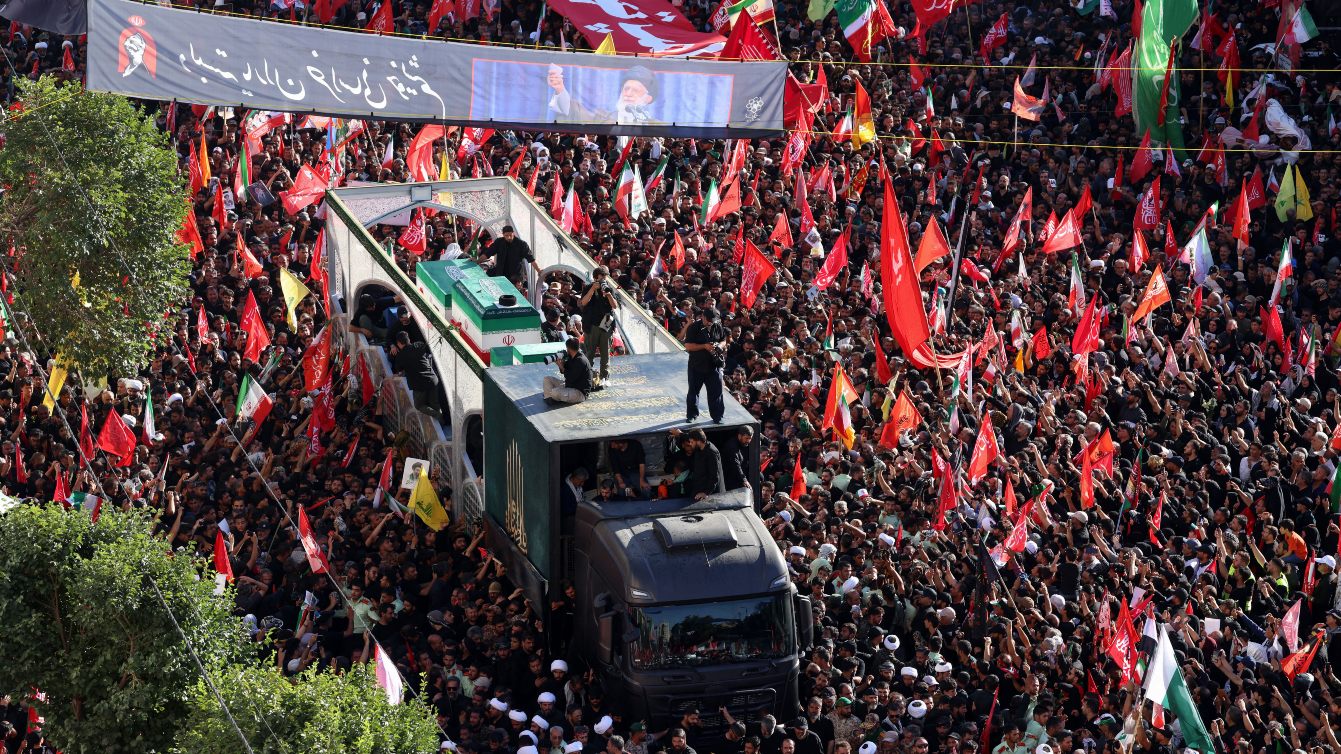
Six days after a joint US-Israeli air strike killed Iran’s former Supreme Leader Ayatollah Ali Khamenei at his Tehran compound on February 28, the 86-year-old leader was laid to rest in the holy Shia shrine of his hometown of Mashhad. The multi-city funeral procession drew an unprecedented turnout of participants, drawing global attention to the shifting dynamics of the ongoing conflict between the US-Israel alliance and Iran.
According to official Iranian media reports, an estimated 41 to 43 million Iranians took part in public ceremonies held across the country and neighboring Iraq. Iran’s state-owned broadcaster Press TV described the gathering as “the largest procession the world has ever witnessed.” State-led funeral rituals kicked off on Saturday, when tens of thousands of mourners packed Tehran’s Grand Mosalla religious complex to pay their final respects beside Khamenei’s flag-draped coffin. Commemorative events were staged across five major cities: Tehran and Qom in Iran, and Najaf and Karbala in Iraq, before the procession concluded with burial in Mashhad.
Many attendees openly expressed anger at the attack that killed Khamenei, alongside his daughter, son-in-law, and granddaughter. Mourners chanted anti-US slogans including “Death to America,” carried banners calling for the assassination of former US President Donald Trump, and raised red flags emblazoned with the word “Martyr” to honor Khamenei.
A towering figure in Iranian politics, Khamenei first took office as president during the 1980-1988 Iran-Iraq War, and succeeded Ayatollah Ruhollah Khomeini as Supreme Leader in 1989, leading the country for nearly 34 years. The strike that killed Khamenei marked the opening day of the ongoing US-Israeli military campaign against Iran, launched with the stated core goals of forcing Iran’s surrender and achieving regime change by removing the country’s top leadership. To date, the campaign has failed to meet these initial objectives,
Rather than fracturing Iranian society and destabilizing the government, the strike has consolidated domestic support for the Iranian government and allowed Tehran to strengthen its strategic position in the region. Iran has since seized full control of the critical Strait of Hormuz, a major chokepoint for global oil trade, and forced the United States to enter diplomatic negotiations. Domestically in the US, widespread opposition to the conflict has dragged down former President Trump’s approval ratings, with a recent public poll showing a majority of American voters view the war in Iran as “not worth it.”
Iran’s new Supreme Leader Mojtaba Khamenei has kept a low public profile since assuming office, but three of Khamenei’s sons, who had not been seen publicly since the outbreak of the war, were present at the funeral service. A wide range of international delegations also attended the ceremony to pay their respects, including senior diplomatic and government officials from Saudi Arabia, Pakistan, Russia, China, and Turkey. Representatives from regional armed groups allied to Iran also took part: Hamas and Islamic Jihad from the Gaza Strip, Hezbollah from Lebanon, and Ansar Allah (the Houthis) from Yemen.
The funeral takes place amid escalating tensions that threaten a fragile ceasefire between the two sides. The truce was formalized in a memorandum of understanding reached one month ago, but on Wednesday, Trump officially announced the end of the ceasefire and launched a verbal attack on Iranian leadership, calling them “scum.” Fighting has since resumed, leaving regional and global stability at heightened risk.