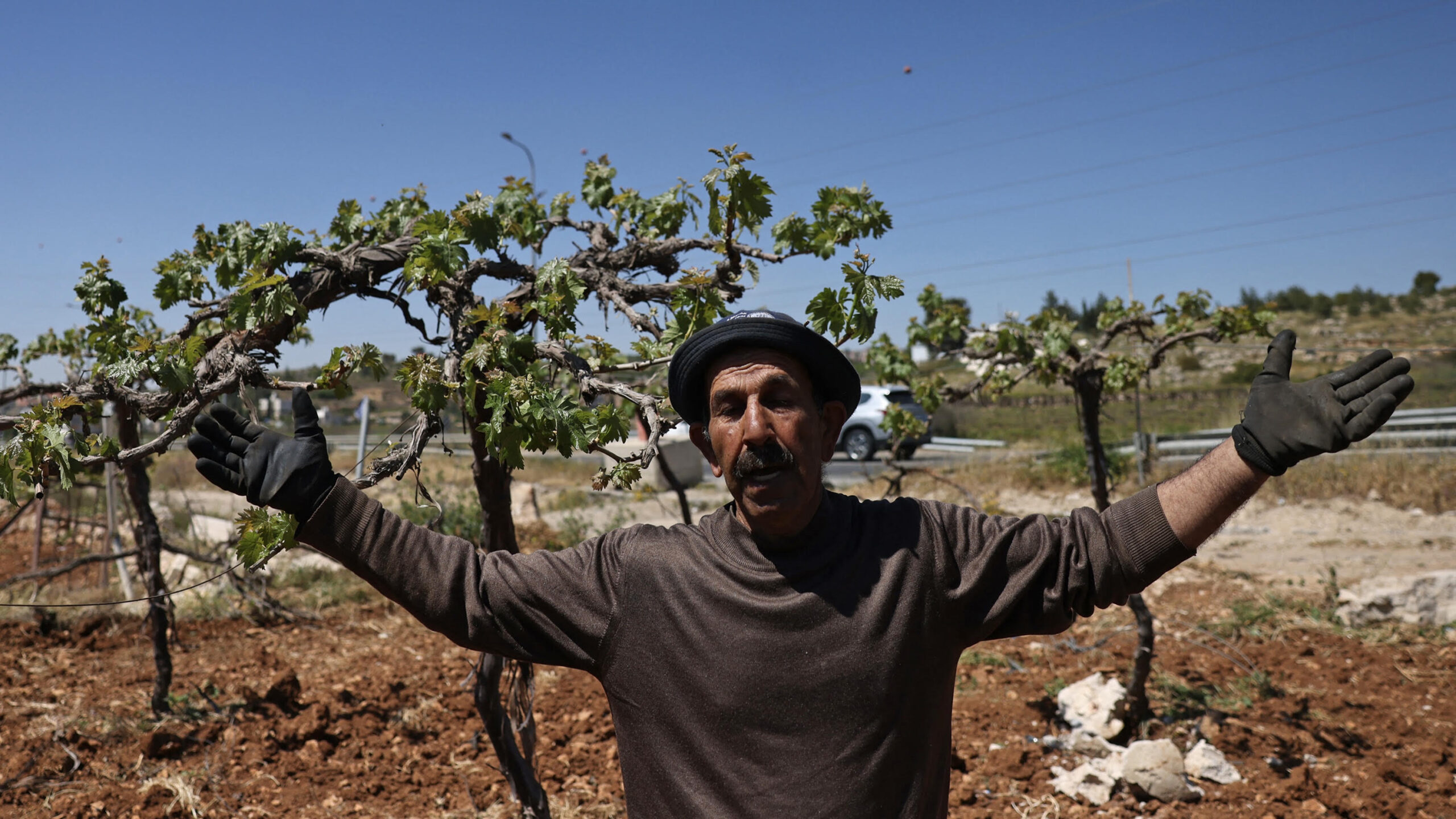
In a move that deepens long-standing tensions in the occupied West Bank, Israeli authorities have ordered the seizure of large swathes of privately owned Palestinian agricultural land to expand a major settler highway. The project, which focuses on widening Route 60 — one of the West Bank’s largest settler-controlled transportation arteries running east of Ramallah and south of Nablus — aims to add new lanes and strengthen connectivity between illegal Israeli Jewish settlements scattered across the occupied territory.
Multiple Palestinian communities across the region face the loss of their historic farmland, with the town of Al-Mazra’a Al-Sharqiya, located east of Ramallah, among the hardest hit. The highway expansion runs parallel to thousands of dunams of the town’s cultivated agricultural land, much of which has been held by local families for generations.
Unlike formal property seizure protocols that require direct notification to landowners, Palestinian farmers discovered crumpled confiscation orders discarded on their property rather than receiving them through official, direct channels. While the orders confirm the seizure of hundreds of dunams, the full extent of the land takeover remains unclear due to this haphazard notification process. Locals estimate the total confiscated land from Al-Mazra’a Al-Sharqiya could reach thousands of dunams, including thousands of ancient olive trees, some of which are more than 1,000 years old and form the backbone of the local economy.
For families like the Salems, the order threatens to erase a multi-generational legacy. Taysir Salem, a landowner in Al-Mazra’a Al-Sharqiya, told Middle East Eye that his family inherited 180 dunams (18 hectares) of land planted with trees by his grandfather, all of which is now marked for seizure. “Route 60 will be extended through our land, and at our expense, they will take it by force and bulldoze half of a hill that belongs to us,” Salem said. “All the neighbouring towns will also be subjected to land theft because of this road.”
Parallel to the official seizure order, Israeli settlers have launched a coordinated campaign of intimidation to bar Palestinian landowners from accessing their property. Last week alone, Salem said settlers arrived on tractors and expelled local farmers from their land at gunpoint, leaving residents in constant fear of further violence. “We are in great danger because they want to take the land by force,” he added.
All affected Palestinian landholders hold full, formal ownership documents proving their legal claim to the properties that have been their livelihoods for decades. Outraged by the seizure and what they call Israeli impunity, landowners are calling for urgent intervention from the international community. Salem criticized the United States’ long-standing refusal to confront Israeli expansion in the West Bank, noting that “The American government has the power to stop Israel from taking our land, but it won’t. If it were any other country, it would have stopped them, but it won’t force Israel.”
The Route 60 expansion is not an isolated incident. It aligns with a accelerating pattern of land seizure across the occupied West Bank that predates this latest order. Last June, Israel announced the confiscation of 464 dunams of land from the town of Sinjil, located north of Ramallah, which also sits along the path of the highway expansion. The current seizure will take land from at least five additional nearby Palestinian communities: Al-Sawiya, Al-Lubban ash-Sharqiya, Sinjil, and Turmusayya, in addition to Al-Mazra’a Al-Sharqiya.
Palestinian analysts and community leaders view the Route 60 expansion as a core strategy to entrench Israel’s illegal settlement project in the West Bank. The highway connects dozens of Israeli settlements and unauthorized outposts to one another and to mainland Israel, enabling further settlement expansion while simultaneously fragmenting contiguous Palestinian territory, cutting off Palestinian villages and towns from their surrounding agricultural lands, and fragmenting the geographic basis for any future independent Palestinian state.
Abdul Samad Abdul Aziz, spokesperson for the Al-Mazra’a Al-Sharqiya municipality, explained that farmers brought the discarded seizure notices to municipal offices just a few days ago. The orders allow a 60-day window for affected landowners to file appeals, but community leaders say the process is stacked against them. “The decision is dangerous for the town and the farmers, and it is unjust because it will cut off their livelihoods after stealing their land and trees. We don’t know what we will do,” Abdul Aziz said. “The residents will not be able to live without their land while settlers continue to attack farmers and shoot at them whenever they try to reach their land.”
Recent data from the Wall and Settlement Resistance Commission underscores the scale of ongoing land seizure in 2026. The group’s semi-annual report, released earlier this year, documents that Israeli authorities have seized more than 4,379 dunams of Palestinian land between January and the end of June 2026. Most of these seizures have been carried out through 40 separate military orders, under a range of official pretexts, to make way for four buffer zones around settlements, 16 new security roads, 12 military installations, and other Israeli state and settler infrastructure. The recent Route 60 land seizure fits directly into this broader trend of accelerated territorial takeover, Abdul Aziz said, leaving Palestinians with no option but to appeal to the global community for intervention to halt the expansion.
Concurrent with the Route 60 controversy, ongoing settler violence continues to roil other West Bank communities. In late April 2026, a confrontation broke out in the village of Masafer Yatta after settlers attempted to steal livestock from a local Palestinian family. When the family confronted the intruders, Israeli military forces intervened, assaulting multiple Palestinians and detaining six people, including one woman, according to on-the-ground reporting from Middle East Eye.