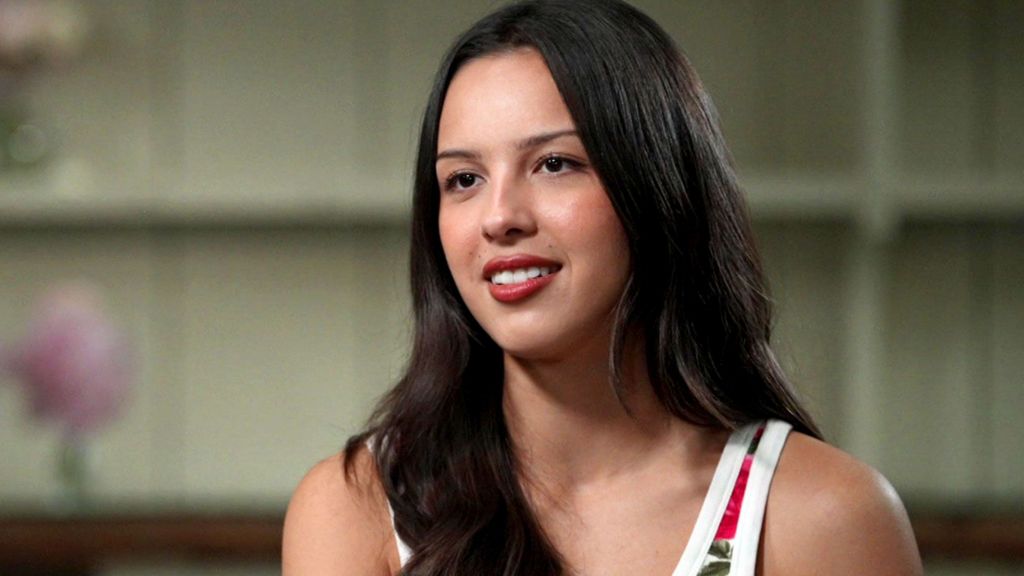
It was meant to be an open-air interview at Hampstead Heath, one of Olivia Rodrigo’s most beloved spots in London, but a sudden, torrential downpour derailed the original plan. Within minutes, the filming crew scrambled to pack up lights and cameras and relocated to the stately Victorian kitchen of nearby Kenwood House. By the time 23-year-old Rodrigo arrived, dodging wind and rain from her car to the new indoor set, every strand of her hair was still perfectly in place, and the production was just barely ready to go.
Even for an early morning call time, the global pop star had already put in a full shift of work. During her drive to the location, she was putting final finishing touches on her upcoming track *Maggots For Brains*, scheduled for release just 10 days later. “I love that song musically, there’s so much going on – layers of harmonies everywhere,” she explained in the interview. “Literally in the car, I was telling them to turn that backing vocal up just one decibel. I was being so picky about it, I know no one else would even notice if I’d left it as it was.”
Rodrigo has long been drawn to Hampstead Heath for the rare sense of normalcy it gives her: the sprawling open space lets her walk, relax, and blend into the crowd without being hounded for photos or autographs. “It’s just the best place to hang out,” she says. “No one ever acts weird around me, I think because it’s so spread out. One time I even saw a couple get engaged there – I was sitting on a bench, looked over, and all their friends were gathered, it was the sweetest thing.” That quiet, romantic moment lines up with Rodrigo’s own dream proposal: she hopes to one day get engaged in New York’s Central Park, with a custom bench placard that reads “Will you marry me?” “So spread the word… Hopefully my future husband will see this,” she laughs. She’s already picked out her wedding song, too – *I Melt with You* by Modern English, a track she says is perfect for walking back down the aisle after exchanging vows.
For anyone who has followed Rodrigo’s music career since her breakout 2021 debut *Sour*, and 2023’s *Guts*, it’s no surprise that her first two albums are rooted in the messy, searing pain of catastrophic heartbreak, laced with equal parts confusion, anguish, and unapologetic feminine rage. It wasn’t until 2024 that she wrote her first uncomplicated love song, *So American*, a punchy new wave track inspired by her whirlwind romance with English actor Louis Partridge. The relationship quickly became public: Rodrigo’s Instagram filled with candid shots from Wimbledon trips and rides across London on double-decker buses, and when she headlined Glastonbury Festival last summer with Partridge watching from side stage, she changed a core lyric from “I think I’m in love” to “’Cause I’m in love.”
When Rodrigo set out to write her third studio album, she expected the project to be a straightforward love letter to the joy of new romance, a sharp departure from the angsty heartbreak of her earlier work. “I really wanted to capture romantic joy and pleasure for the first time, because my last two albums were all heartbroken and really angsty,” she says. But the album’s final title – *You Seem Pretty Sad for a Girl So in Love* – hints that the perfect romance she set out to document did not end as planned. “It’s a love story that falls apart,” she confirms. “It’s a time capsule of a relationship that spanned a few years of my life.”
The album’s visual concept mirrors this arc: the front cover shows Rodrigo swinging through the air, carefree and giddy with new love, but flip it over, and she’s lying flat on the ground, hair messy and expression heavy with unhappiness. The narrative opens in a London pub, where Rodrigo is so besotted by her new partner, who she compares to “an angel on the walls of Versailles,” that she can barely believe he’s real, convinced she might “drop dead” if he kisses her. By the second track, *Stupid Song*, the pair have settled into a relationship, and Rodrigo is so blindingly happy that she struggles to write a coherent, meaningful lyric about it. “When you’re really deeply in love, it feels like any song is futile,” she explains. “It’s really hard to capture that feeling in a way that feels real to other people.”
As the tracklist progresses, quiet doubts and persistent anxieties begin to creep into the story, and the narrative unravels around the seventh track, *Purple*. While the lyrics on the surface read as a happy love song, Rodrigo uses intentionally unresolved chords to create an undercurrent of constant instability. “Initially, it was a very sweet, sugary love song,” she says. “A few months after we wrote it, we went back, swapped out the chords, and tweaked the lyrics. It’s definitely the turning point on the album where things start to go sour.”
A similar revision shaped *What’s Wrong With Me*, a dream duet between Rodrigo and her long-time musical hero, The Cure’s Robert Smith. The track was originally written about the all-consuming ache of missing a partner, but after Rodrigo’s breakup, she rewrote the lyrics to reflect a harder truth: the relationship itself was the source of her unhappiness. The new lyrics cut straight to the pain: “I can’t eat, I can’t sleep / I think you’re what’s wrong with me.”
Rodrigo and Smith debuted the new track earlier this month at Spain’s Primavera Festival, marking their second collaboration after they shared the Glastonbury stage last summer. Backstage after the set, Smith heaped praise on the young star, telling BBC 6 Music: “She is genuinely fantastic, as a singer, as a songwriter, as a performer. I’m slightly in awe of how easy she makes all of it look.” That Glastonbury headline set, widely hailed as the performance of the weekend, cemented Rodrigo’s status as a generational talent, equally comfortable delivering soft, soaring ballads and high-energy pop-punk anthems that get crowds roaring. But even with that critical acclaim, Rodrigo admits she was crippled with anxiety before the performance. “I remember having a near anxiety attack in the bathroom, thinking ‘How am I going to do this? I don’t know if I’m ready,’” she says. “But the second I stepped on stage and started singing, something just shifted over me. I felt totally calm, totally in my element. I’m not very spiritual or religious, but moments like that make you feel like music is just so magical, you can’t really put it into words.”
That iconic Glastonbury performance was fueled by an unexpected pre-show ritual: three full bowls of sticky toffee pudding from her hotel restaurant. “I stayed at this hotel that had the best sticky toffee pudding, and I was like, ‘You know what? I gotta do it,’” she laughs. “If the toffee’s really hot and the ice cream melts on top, it’s really good.” Sticky toffee isn’t her only British culinary obsession – she’s also completely hooked on dippy eggs and soldiers, and her friends have gifted her dozens of custom egg cups from all over the world to feed the habit.
That down-to-earth charm is central to Rodrigo’s appeal. Raised in the entertainment industry, she spent years working on Disney Channel shows before launching her music career, but she’s never been aloof or overly precious about her fame. One of the biggest reasons she loves living part-time in the UK is the sense of normalcy it gives her. “I feel so normal here, very adult. I can walk to the pub and meet friends. It’s a city where spontaneity is really encouraged. People are very social here, in a way that they’re not in Southern California.”
Despite boasting more than 40 million Instagram followers, Rodrigo has never cared much about conforming to other people’s expectations of how a global pop star should act. She’s been openly vocal about a range of political issues, from the rollback of reproductive rights in the United States to the humanitarian crisis in Gaza. Last year, she publicly called out the Trump administration for using her music in videos promoting ICE deportations, labeling the government’s policies “barbaric and cruel.” She approaches her activism thoughtfully, but says she has no desire to be universally liked. “I definitely try to be careful with my words, but simultaneously, the women I looked up to when I was young were really outspoken, and that was one of the reasons I adored them,” she says. “I don’t think my goal is to be liked by all. And when you stop making that your primary motivation, I think everything becomes a lot more joyful.”
As the interview wrapped up, Rodrigo answered a series of quick, personal questions that revealed more little-known parts of her life: she has 60% permanent hearing loss in her left ear, she originally dreamed of becoming an obstetrician as a child (and even played obstetrician with her dolls, long before she understood what the job entailed), and if she made a biopic of her life, she’d title it *Olivia Rodrigo Lives the Happiest, Most Joyful Life Any Singer-Songwriter Ever Lived*. If she ever returned to acting, she says she’d jump at the chance to play Juliet in *Romeo and Juliet* – a fitting role for pop music’s most famous chronicler of heartbreak.
Like Shakespeare’s tragic heroine, Rodrigo has always been mature beyond her years, and she recently took full control of her career, parting ways with her long-time managers to build a hand-picked creative team that lets her call every shot. That autonomy means she can skip high-profile industry events that don’t align with her values, like the Met Gala, which she recently told the *New York Times* doesn’t inspire her or fit with what she cares about.
It’s clear that unflinching authenticity and uncompromising artistic integrity are the core of Rodrigo’s massive global appeal. Her songs have racked up billions of streams because she doesn’t shy away from the messy, ugly parts of being human: she’s just as willing to write about her own pettiness, jealousy, and insecurity as she is to call out the bad behavior of exes. “That’s one of my favourite things about songwriting,” she says. “I can write a song about being petty or jealous or super insecure, and I get it off my chest in a way that’s actually productive.”
That honest self-expression is likely why she seems so well-adjusted and grounded even under the relentless pressure of global fame. Even the torrential London rain that derailed our interview didn’t dampen her mood. “It wouldn’t be a proper English summer without it,” she beams, already planning a post-interview swim in Hampstead Heath’s outdoor ponds with her friends. For a girl who just documented a devastating public breakup, she seems, in the end, pretty happy.