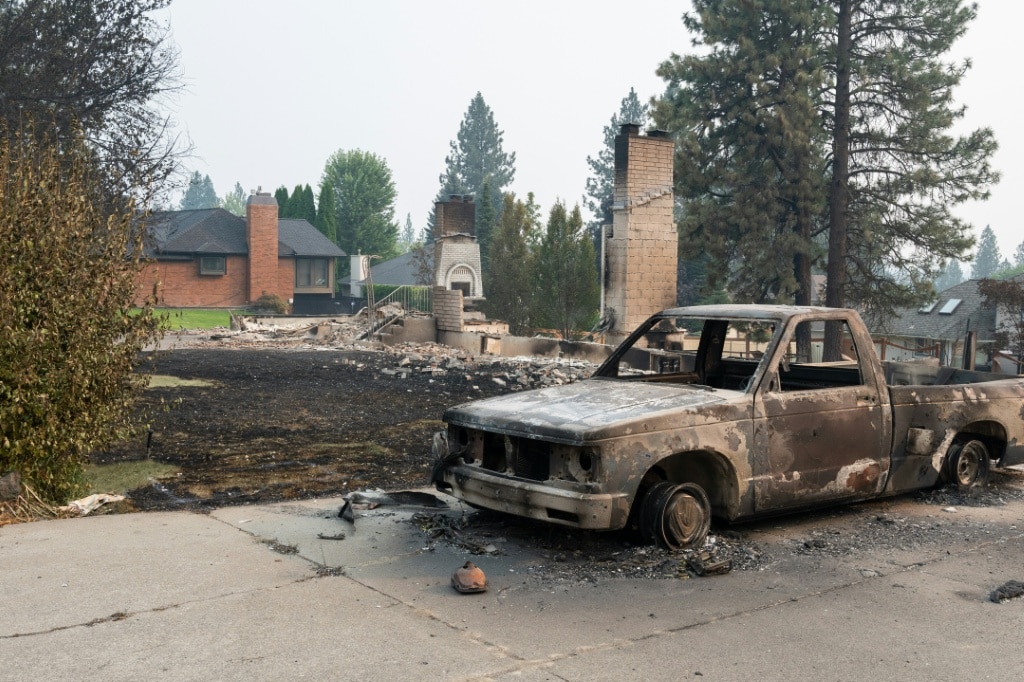
As wildfire crews raced against the clock to contain a trio of destructive blazes that have displaced tens of thousands of people across Spokane, Washington, U.S. law enforcement announced the arrest of an arson suspect linked to the largest of the three fires on Monday.
Supercharged by years of extreme drought and record-shattering heat waves that have dried out vegetation across the U.S. Pacific Northwest, the wildfires have swept through thousands of acres of land surrounding the northwestern city, destroying hundreds of residential and commercial structures and leaving evacuees uncertain of when they will be able to return to their homes. A striking image of an untouched Virgin Mary statue standing in front of a completely incinerated home in Spokane’s Balboa neighborhood has underscored the uneven, devastating destruction of the blazes.
Spokane County Sheriff John Nowels told reporters late Monday that 37-year-old Aaron Farinacci had been taken into custody on first-degree arson charges in connection with the Old Trails fire, the largest of the three active blazes. The suspect was initially detained near the fire’s starting point on Saturday, but was released before investigators connected him to the ignition of the blaze. A witness reportedly saw Farinacci kneeling near the patch of dry grass where the fire first ignited. When he was rearrested, law enforcement found waterproof matches and a butane lighter in his possession, which investigators believe were used to start the fire. Nowels added that Farinacci has a prior manslaughter conviction on his criminal record, and he is currently being held on $1 million bail. Investigators have found no evidence linking him to the other two large fires burning in the Spokane area.
As of Monday, preliminary aerial damage assessments conducted by authorities estimate that between 700 and 1,100 structures have been destroyed by the blazes, which broke out over the weekend. Federal interagency fire tracking system InciWeb reports that the three fires have together burned 8,026 acres (3,248 hectares) of land across the Spokane region. Fortunately, firefighters have been able to make “significant gains” in containing two of the three blazes, taking advantage of a temporary window of cooler temperatures, higher humidity, and reduced wind speeds that have slowed fire spread. As of Monday, no injuries have been reported, though authorities have been unable to contact 14 people who were in the fire zone; officials have not yet labeled them as missing.
Roughly 65,000 people have been evacuated from high-risk areas across Spokane, a massive displacement event that Sheriff Nowels called unprecedented for the region. Spokane Mayor Lisa Brown announced that crews are currently conducting block-by-block assessments of damage and checking for hot spots that could trigger reignition, and warning that evacuees may not be able to return to their homes for weeks. Washington Governor Bob Ferguson called the event “likely the worst natural disaster in Spokane’s history”, and declared a state of emergency on August 1, noting that long-term drought and extreme heat have turned much of the region into tinder.
Climatologists say the increasing frequency and intensity of wildfires across the western U.S. are directly tied to human-caused climate change, which has driven rising average temperatures, extended severe drought periods, and created a warmer atmosphere that draws more moisture out of organic vegetation, turning it into fuel for wildfires. UCLA climatologist Daniel Swain noted that the Spokane fires come on the heels of “one of the warmest winters on record for eastern Washington”, which led to a severe snow drought that left vegetation far drier than normal going into the summer wildfire season.
The Spokane blazes are just one part of what state officials have called an extraordinary wildfire season for Washington. David Upthegrove, head of Washington’s Department of Natural Resources, confirmed that 16 major blazes are currently burning across the state, burning a collective 262,000 acres of land. As of late Monday, local utility company Avista reported that more than 3,700 customers across the region were still without power, after the Old Trails fire jumped the Spokane River Saturday afternoon and spread into the city’s urban core.
The temporary period of cooler conditions that aided firefighters Tuesday is expected to be short-lived, with forecasts calling for temperatures to climb back into the mid to high 90s Fahrenheit (mid-30s Celsius) by the middle of the week, creating dangerous conditions again for fire spread. For evacuees like Spokane resident Geoff Beadles, who fled his home with his fiancée and two dogs, the scope of the destruction is almost unimaginable: “Just driving around looking at the homes — it’s just one of the most heartbreaking things I’ve ever seen in my life,” he told reporters.