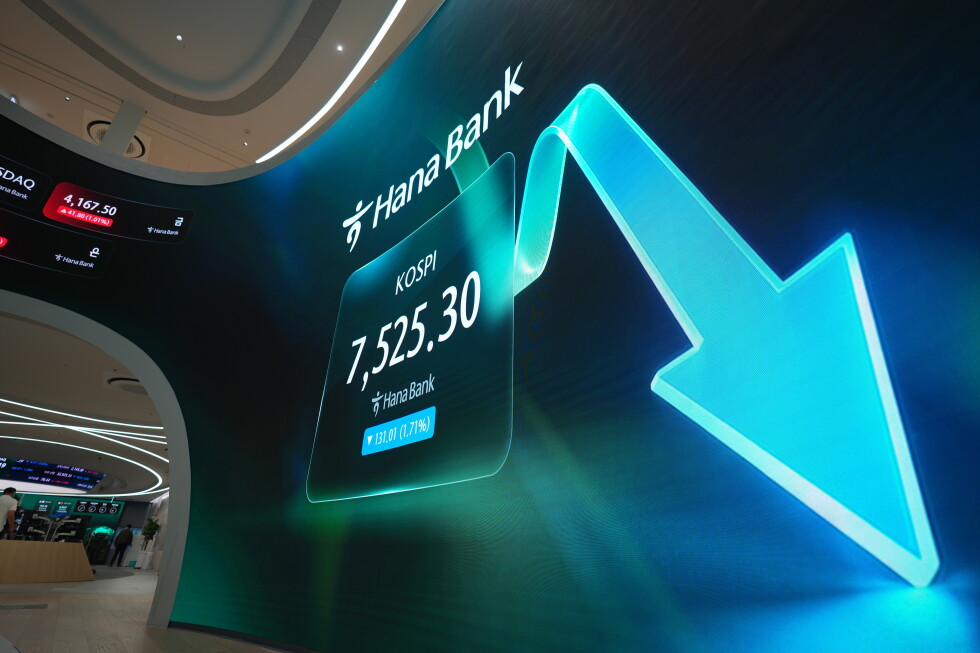
Global financial markets faced a day of heightened volatility on Wednesday, driven by a sudden escalation of geopolitical tensions between the United States and Iran that sent crude oil prices jumping sharply, while a painful correction in overinflated artificial intelligence-related equities dragged most major global indexes lower.
The market upheaval began after U.S. President Donald Trump announced from the sidelines of the NATO summit in Ankara, Turkey that the interim ceasefire agreement with Iran is effectively “over,” even as he left the door open for continued diplomatic negotiations. Trump’s announcement came in direct response to recent attacks on three commercial vessels operating in the strategic Strait of Hormuz, which preceded new U.S. military strikes on Iranian targets.
Within hours of Trump’s comments, international oil benchmarks surged by more than 5%: Brent crude, the global benchmark, climbed 5.6% to top $78 per barrel, while the U.S. West Texas Intermediate benchmark jumped 5.8% to settle at $74.55 a barrel. This sharp reversal comes after oil prices had steadily declined from peaks above $100 a barrel, returning to roughly pre-conflict levels seen before the U.S.-Iran war began in late February.
The existing 60-day interim ceasefire deal between Washington and Tehran had opened the Strait of Hormuz, a critical waterway that carries roughly one-fifth of the world’s daily oil trade, to unobstructed free passage. But the agreement has been fraught with tension from the start: Iran has maintained its right to control vessel routing through the strait and has vowed to impose transit fees once the interim deal expires, a move that would upend decades of established open access practice for the waterway. Tuesday’s attacks targeted ships that were all following the traditional routing along Oman’s coastline, rather than the new route mandated by Tehran, setting off the latest cycle of escalation.
The geopolitical shock to oil markets arrived alongside a growing wave of investor anxiety that the months-long AI stock boom has pushed valuations far beyond what underlying productivity and profit gains can support, even after massive investments in chip manufacturing capacity and data center infrastructure.
Ipek Ozkardeskaya, a senior analyst at Swissquote, noted in a Wednesday market commentary that geopolitical developments will almost certainly drive short-term market sentiment. “A further deterioration in the situation could weigh further on equity valuations along with rising stress in technology,” she warned.
The investor sell-off hit European markets first: Germany’s DAX index fell 1.1% to close at 25,191.69, France’s CAC 40 declined 0.9% to 8,358.67, and the U.K.’s FTSE 100 slid 0.8% to 10,579.09. U.S. equity futures also pointed to further declines ahead of the opening bell, with S&P 500 futures edging 0.1% lower and Dow Jones Industrial Average futures down 0.4%.
Across Asian trading sessions, losses were even steeper for AI-heavy indexes. Tokyo’s Nikkei 225 dropped 2.1% to 66,819.05, while South Korea’s Kospi plummeted 5.4% to 7,246.79. The South Korean benchmark has seen extreme whipsaw movement in recent weeks, briefly topping the 9,000 mark last month before entering a sharp correction driven by heavy selling of top tech stocks including Samsung Electronics and SK Hynix, two of the world’s largest memory chip manufacturers for AI systems. Samsung extended its losses to fall 6.3% in early Wednesday trading, after a 7% drop the previous session, while SK Hynix gave up early gains to close 5.7% lower.
Not all Asian markets moved lower: Taiwan’s Taiex gained 0.6%, and Hong Kong’s Hang Seng Index jumped 3% to 24,193.56, led by a 14% surge in shares of Chinese AI startup Zhipu (also known as Z.ai, traded as Knowledge Atlas Technology). The company made its $558 million Hong Kong trading debut in early January, and a six-month lock-up period for its cornerstone investors was set to expire this week. Market analysts had previously warned the expiration could trigger a large sell-off, but state-owned China National Radio reported late Tuesday that nearly 70% of cornerstone investors have committed to retaining their holdings. Zhipu’s share price has already soared more than 1,300% since its January debut, defying broader market caution. Mainland China’s Shanghai Composite Index bucked the Hong Kong trend to decline 0.5% to 3,970.88, while Australia’s S&P/ASX 200 shed 0.2% and India’s Sensex lost 0.7%.
The AI stock sell-off first began on Wall Street on Tuesday, when the sector’s roller-coaster rally reversed sharply to drag the broader market lower. The Nasdaq composite, which has a heavy weighting toward tech and AI stocks, fell 1.2%, while the S&P 500 declined 0.4% and the Dow fell 0.2% despite a majority of individual S&P 500 stocks posting gains. Top semiconductor stocks bore the brunt of the selling: Advanced Micro Devices fell 6.5%, Intel dropped 9.7%, and Micron Technology lost 4.7%. Even SpaceX, parent company of AI firm xAI, fell 6.8% in its first trading day after being added to the Nasdaq 100 index.
In currency markets, the U.S. dollar saw mild gains, rising slightly to 162.26 Japanese yen from 162.11 yen in the previous session, while the euro edged up to $1.1426 from $1.1414.