Two senior United Nations leaders have issued a stark warning to Western nations: continued disengagement from Afghanistan risks pushing the conflict-weary country back into widespread instability, with ripple effects that will extend far beyond its borders. The warning came during a joint visit to Afghanistan by UN High Commissioner for Refugees Barham Salih and UN Development Program chief Alexander De Croo, who spoke to The Associated Press in a shared interview Tuesday. Salih, who joined the conversation via video link, emphasized that recent global policy toward Afghanistan has delivered a clear lesson: turning a blind eye to the country’s crises serves no one’s interests.
“Despite the long list of unresolved challenges this nation faces, it is far more prudent to remain engaged, provide targeted support and back policy reforms that keep Afghanistan stable and secure,” Salih said. Without active international engagement, he added, the world risks a resurgence of instability that fuels transnational threats including drug trafficking, violent extremism, organized criminal activity and large-scale refugee displacement.
After four decades of continuous armed conflict, Afghanistan is an impoverished nation almost entirely reliant on international aid, and it currently grapples with a cascading series of overlapping crises that compound one another: devastating natural disasters amplified by accelerating climate change, and the largest single wave of returning refugees the globe has witnessed in 70 years. “In Afghanistan, you never face just one crisis at a time,” De Croo explained to reporters. “Crises stack one on top of the other, and that layered pressure is what we see shaping daily life here right now.”
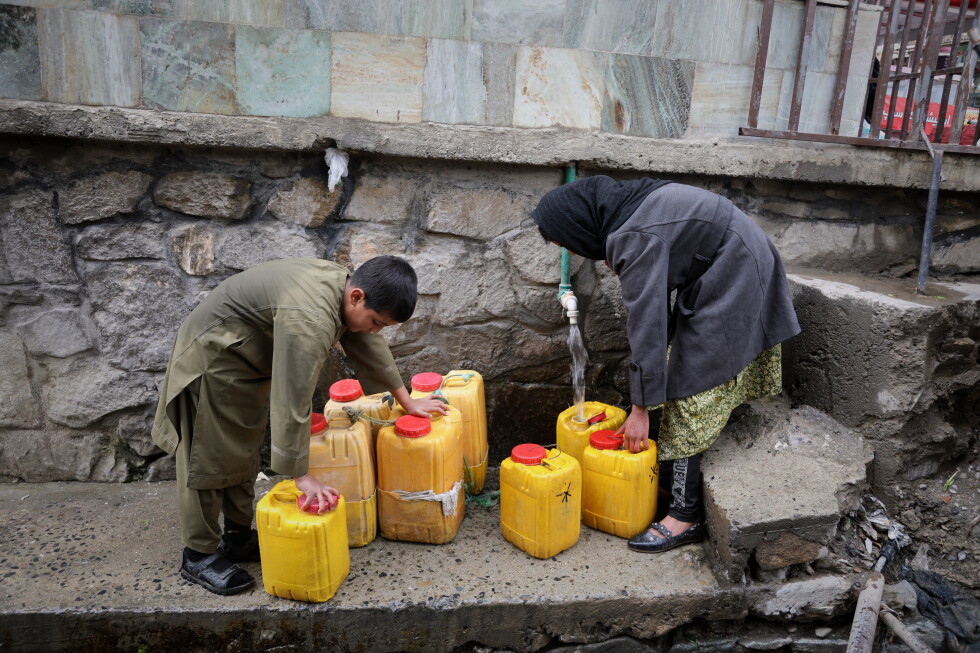
Since 2023, nearly 6 million Afghans have been forced to return to their home country, the overwhelming majority expelled from neighboring Pakistan and Iran amid harsh government crackdowns on undocumented migrants. UN projections indicate an additional 2 million Afghans could be forced to return in 2025, placing already strained local communities under unprecedented pressure. With widespread poverty endemic across Afghanistan and acute malnutrition threatening the lives of the most vulnerable groups, most host communities already operate with barely enough resources to support their existing populations.
Already difficult conditions have been made far worse by deep cuts to international aid, and the Taliban government’s systemic exclusion of half the country’s population: since seizing power in August 2021, following the chaotic withdrawal of U.S.-led NATO troops, the Taliban has banned women and girls from accessing secondary and higher education, and barred women from working in most sectors of the economy. Afghanistan also remains largely diplomatically isolated: no Western country has extended formal recognition to the Taliban-led government, though Russia became the first major global power to grant recognition in 2025. A small crack in this isolation emerged last month, when a Taliban government delegation traveled to Brussels to hold talks with European Union officials focused on diplomatic cooperation and the repatriation of Afghans residing in European countries.
Against this daunting backdrop, the two UN leaders acknowledged that unexpected progress has been made in key policy areas, most notably public security, anti-corruption efforts and the reduction of illicit drug production. “I would not ignore the progress that has been achieved — progress few observers would have predicted possible just five years ago,” De Croo said. He highlighted that opium production, for which Afghanistan was long the world’s largest supplier, has dropped by 95% since the Taliban government launched a national poppy eradication campaign.
De Croo stressed that if the international community abandons Afghanistan now, the negative consequences will not be contained within the country’s borders. “If Western nations want to live in peaceful, stable societies, that goal cannot be achieved through domestic policy alone,” he explained. “Your own peace and stability depends on peace and stability in your broader neighborhood.”
The draconian national restrictions imposed on women and girls remain the single biggest point of tension between the Taliban government and the global community. The UN leaders confirmed they raised the issue directly during meetings with Afghan officials during their visit, and both argued that constructive, sustained engagement is the only path to incremental progress on the issue. “We hope that constructive engagement will open a path forward to reform,” Salih said. “Tangible progress and inclusive policy reforms are essential to building a political system that serves all Afghans.”
Deep cuts to international aid have already left measurable, lasting damage across the country, De Croo confirmed. Over the past 12 months alone, 422 medical facilities have been forced to shut down because of lost funding, leaving more than 3 million Afghans without access to basic primary healthcare. Earlier this year, the World Food Program announced that funding shortfalls had forced it to turn away three out of every four acutely malnourished children seeking life-saving nutritional support.
While the Taliban launched its poppy eradication campaign shortly after taking power, De Croo noted that the sharp drop in opium production was also supported by international programs that provided alternative crop options for farming households dependent on poppy cultivation. Funding for these programs has been slashed dramatically amid broader international aid cuts, raising fears that poppy production could rebound if support is not restored. “If we cannot continue working with farmers to provide them with viable alternatives to drug production, we risk seeing the entire trade reemerge,” De Croo warned.
Although global media and political attention has shifted away from Afghanistan in recent years, Salih noted that despite all the country’s challenges, the current moment offers a critical opening for the international community to reengage. “It is vital to remind the world that the cost of inaction far outweighs the cost of sustained engagement,” Salih said. “The truth is simple: you cannot ignore Afghanistan, and the problems that emerge in Afghanistan will not stay contained in Afghanistan.”