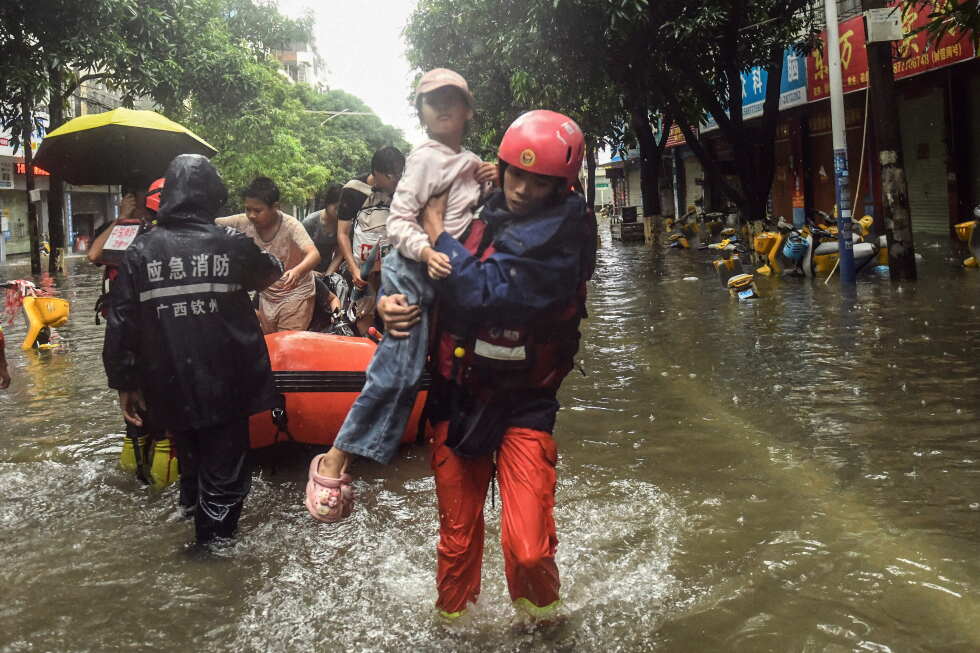
As remnants of Tropical Storm Maysak dumped historic volumes of rain across southern China’s Guangxi Zhuang Autonomous Region, authorities and local residents are grappling with widespread destruction, massive displacement, and a growing humanitarian crisis that emerged by Wednesday. As of Tuesday evening, regional officials confirmed six fatalities and 11 people still unaccounted for in the flood disaster, with more than 130,000 local residents forced to evacuate their inundated communities, according to the region’s official propaganda office.
Many stranded residents remained trapped in affected areas waiting for emergency rescue teams to reach them, even days after the worst of the rainfall began. Lu Xiaofei, a professional working in the nearby tech hub of Shenzhen, shared details of her brother’s trapped family in Lu Village, located in Guangxi’s Qintang District. Her brother, his wife, their 9-month-old infant, his parents, and elderly grandfather have been confined to the second floor of their home, after floodwaters rose to more than the height of an adult. Since Tuesday morning, the household has been cut off from both electricity and running water, Lu told the Associated Press in a phone interview.
Lu added that her brother reported flood levels climbed further overnight, leaving the family in an increasingly desperate situation: their supplies of drinkable water are nearly exhausted, and local emergency responders have not yet reached their community. Dozens of nearby villagers face identical unaddressed crises, she said. Many other trapped residents have turned to social media to plead for assistance, posting footage of their submerged neighborhoods and drawing public attention to critical shortages of food, water, and emergency supplies.
Local Chinese outlet Litchi News has also reported a secondary hazard spreading through Hengzhou City: snakes from commercial breeding facilities were swept away by floodwaters and are now loose across populated areas. Multiple residents have reported the loose snakes attempting to enter local homes, with more than a dozen people already bitten by the wandering reptiles, according to a local villager quoted by the outlet.
China’s National Meteorological Center confirmed that relentless heavy rain has pummeled central-eastern and southern districts of Guangxi since last Saturday. Cumulative rainfall totals have hit between 100 and 400 millimeters (4 to 16 inches) across most affected areas, while the hardest-hit locations have recorded more than 900 millimeters (35 inches) of total precipitation. Forecasters warned that additional heavy rainfall would continue to batter the region through Wednesday, worsening already dangerous flood conditions. In response to safety risks, multiple regional passenger train services have been suspended indefinitely.
As Guangxi continues its emergency response to Maysak’s aftermath, a new severe weather threat is already approaching southeastern China: Super Typhoon Bavi is projected to make landfall in the region over the coming weekend. The extreme weather disaster in China is part of a broader pattern of deadly monsoon and tropical storm activity across South and East Asia this season. In southeastern Bangladesh, monsoon rain-triggered landslides have killed multiple Rohingya refugees, including five children, while neighboring India has seen more than a dozen fatalities from severe monsoon flooding across its northern and eastern regions over the past three days.
This reporting featured contributions from AP writer Fu Ting based in Washington, D.C.