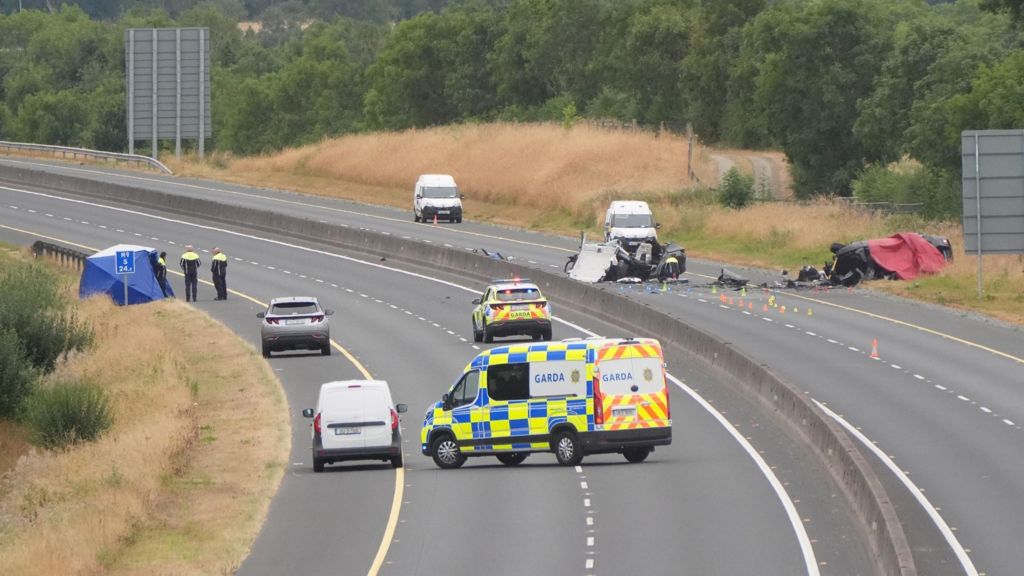
A devastating head-on collision on Ireland’s M9 motorway has claimed the lives of five teenagers and left four other people critically injured, triggering renewed calls for urgent action to address rising road fatalities across the Republic of Ireland. The crash unfolded shortly after 3:00 a.m. local time on Sunday between Junction 3 and Junction 4 on the M9 Northbound, in County Kildare, following a series of attempted interventions by Irish police, known as An Garda Síochána, to stop the vehicle carrying the teenagers.
Details of the incident have been outlined by the Garda Representative Association (GRA), the body that represents rank-and-file Gardaí. According to GRA Assistant General Secretary Tara McManus, officers had encountered the teenagers’ vehicle multiple hours before the collision and made several attempts to stop it, including deploying stinger spike devices to disable the car. After the vehicle took evasive action and began traveling the wrong direction down the motorway, command and control centers issued a mandatory order for officers to disengage the pursuit.
McManus explained that this disengagement policy aligns with existing standard operating procedures for Gardaí, noting that roads policing officers do not receive formal training for high-speed vehicle pursuits. She added that officers face severe personal and professional risks if they choose to proceed with a pursuit outside of approved training guidelines.
Irish national broadcaster RTÉ News has released the identities of the five deceased teenagers: Joe Carthy from Athy, County Kildare; Alex McCarthy from Carlow; Kamil Pustkowski from Limerick; and Jeremy O’Brien and Jack Kennedy. The four injured victims, two women in their 30s, one woman in her 20s, and a 7-year-old boy, are all from Carlow. Two of the injured are currently listed in critical condition, while the remaining two are considered to be in serious but stable condition.
McManus described the scene first responders encountered as horrific, adding that many of the Gardaí who attended the crash will likely require long-term psychological counseling to process the trauma of what they witnessed, with impacts potentially lasting months or even years. The GRA has also publicly stated its support for stronger road safety legislation, including harsher criminal penalties and longer driving bans for those convicted of dangerous road behavior.
The tragedy has prompted fresh calls for systemic change from road safety advocates, including Leo Lieghio, vice president of the Irish Road Victims Association. Lieghio, who lost his own 16-year-old daughter Marsia to a fatal road incident in Dublin in 2005, spoke of the overwhelming grief now facing the families of those killed and injured in the M9 crash. “Their lives have been turned upside down through no fault of their own. They will be going through hell,” he said.
Lieghio pushed for urgent policy shifts that prioritize early intervention and clear consequences for reckless or criminal driving. He proposed targeted structural reform programs for young people engaging in dangerous road activity, alongside a broader cultural push for greater personal responsibility among all drivers. Lieghio also emphasized that bystanders have a role to play, urging members of the public to report dangerous driving they witness to authorities.
Latest road safety data underscores the growing scale of the crisis: as of mid-August 2026, 123 people have died in road incidents across the Republic of Ireland, an 18-year increase compared to the same period in 2025. An Garda Síochána has been approached for additional comment on the incident and existing pursuit policies, and formal investigations into the crash are ongoing.