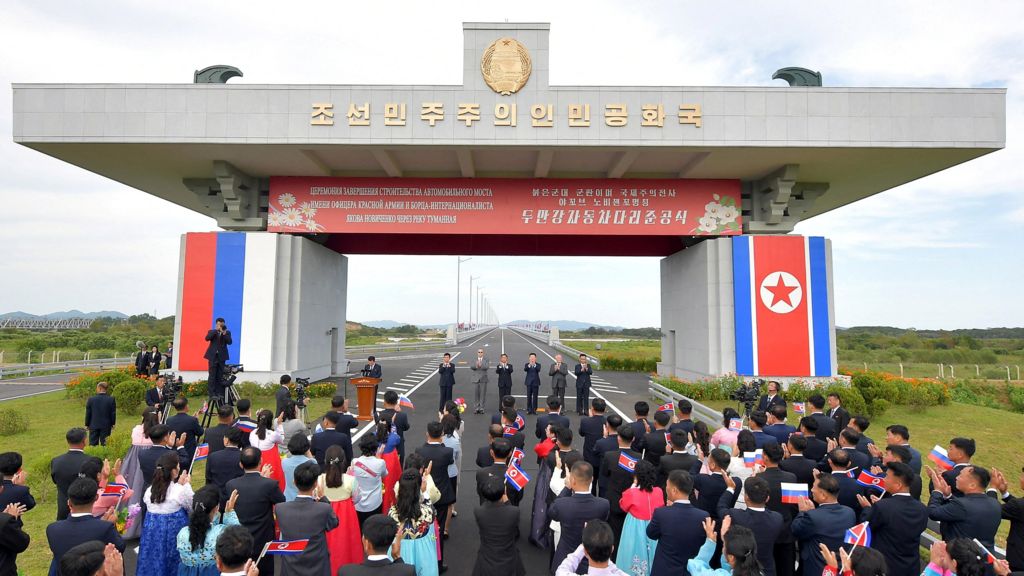
After 495 days of construction marked by minor delays, the first permanent road bridge connecting Russia and North Korea across the Tumen River has officially opened, linking the Russian border city of Khasan and North Korea’s Rason. The new infrastructure comes amid rapidly deepening bilateral ties that have accelerated dramatically since Russia launched its full-scale invasion of Ukraine, drawing international scrutiny over the bridge’s intended uses beyond stated civilian and economic goals.
Prior to the opening of this 1-kilometer crossing, the two nations shared air and rail connections, but road travel relied on a temporary, cumbersome workaround: wooden planks laid over the existing rail bridge that required special government approval for any passage. Satellite imagery captured by BBC Verify in May 2025 already showed the completed bridge alongside newly built access roads, a fortified border checkpoint, expanded parking facilities, and supporting infrastructure, signaling the project was nearing completion ahead of its official launch.
Russian Prime Minister Mikhail Mishustin, who appeared at the opening ceremony via video link, framed the infrastructure as a landmark milestone in bilateral relations. He called the bridge a “new symbol of friendship” between Moscow and Pyongyang, noting that bilateral ties are currently “at an unprecedented high level.” His North Korean counterpart Pak Thae Song echoed the sentiment, describing the opening as a historical event for cross-border cooperation. Russian state news agency TASS reports the bridge is designed to handle up to 300 vehicles and 2,323 cross-border travelers per day. According to the Russian government, the crossing will operate exclusively for cargo shipments initially, with passenger service scheduled to launch later in 2026. Mishustin emphasized that the new link will provide “powerful impetus for the further development of trade, economic, scientific, technological and cultural cooperation” between the two countries.
Pyongyang’s official state media has echoed this framing, stating the bridge will primarily facilitate “personnel exchanges, tourism and trade.” Since Russia reopened travel to North Korea for Russian tourists in 2024, a small but steady stream of Russian visitors has traveled to destinations including Pyongyang and the Wonsan-Kalma beach resort, while North Korea has continued to restrict entry for tourists from most other nations. The bridge is also widely expected to simplify cross-border travel for North Korean laborers already working in Russia. Current South Korean estimates place roughly 10,000 North Korean citizens working in Russian construction sites and logging camps, a practice banned under United Nations sanctions, though many workers reportedly enter Russia using fraudulent student visas.
However, independent observers and international analysts have raised sharp concerns that the bridge’s primary purpose is to support Russia’s war effort in Ukraine, leveraging the deepened strategic partnership Moscow and Pyongyang formalized during Vladimir Putin’s 2024 visit to North Korea — Putin’s first trip to the country in 24 years. A Ukrainian open-source intelligence (OSINT) collective, Truth Hounds, has warned the crossing is intended “primarily to establish a covert military logistics corridor” that will enable expanded military support for Russia’s invasion.
Truth Hounds noted that under the 2024 strategic partnership treaty, the bridge could be used to move North Korean military personnel, senior military officials, and construction workers directly into Russian territory, while allowing Russian military technology and critical resources to flow in the opposite direction to North Korea. These concerns align with existing estimates from South Korea’s intelligence service, which assesses that North Korea has already shipped between $7 billion and $14 billion worth of rockets, missiles, and artillery shells to Russia via maritime routes, and that roughly 11,000 North Korean troops are currently actively fighting alongside Russian forces against Ukraine.
Victor Cha, a senior analyst at the Washington-based Center for Strategic and International Studies (CSIS), told BBC Verify that the accelerated construction of the bridge directly reflects the surge in cross-border activity driven by the war. “The speed of construction is a reflection of the volume of trade activity between the two sides. This is spurred largely by North Korea’s provision of troops, weapons, munitions, and labourers for Putin’s war in Ukraine,” Cha explained. He added that before the full-scale invasion of Ukraine, the Russia-North Korea border was “one of the sleepiest links between North Korea and its two neighbours.”
The opening of the bridge caps a rapid expansion of bilateral cooperation that has included a mutual pledge from Putin and North Korean leader Kim Jong Un to come to one another’s defense in the event of external “aggression,” deepening geopolitical polarization amid the ongoing war in Ukraine.