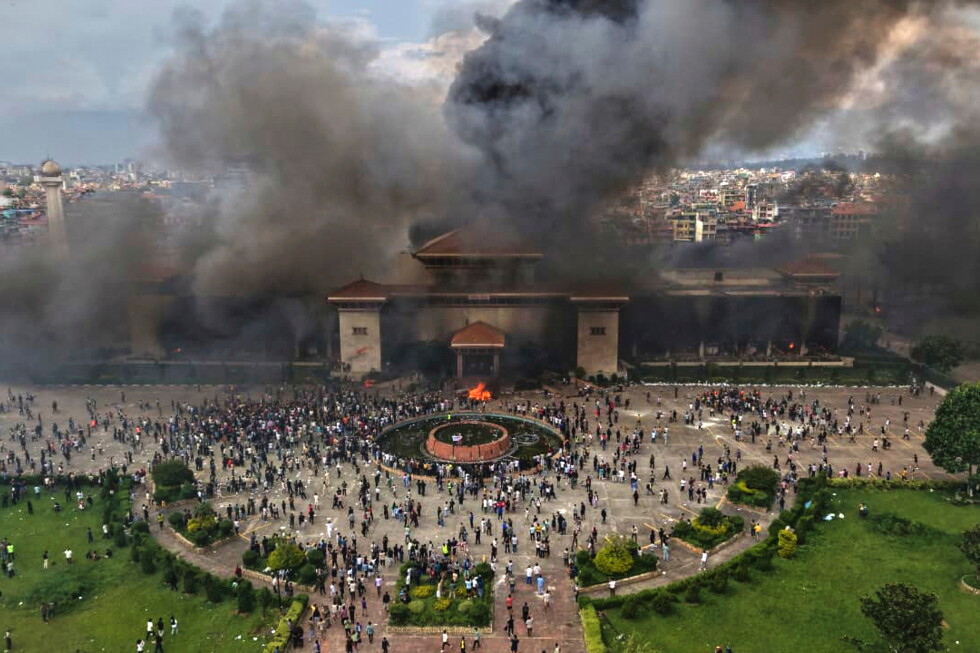
Two weeks after catastrophic flash floods tore through Nepal’s mountainous regions and river valleys, the full scale of destruction is coming into focus, presenting a severe early test for the Himalayan nation’s newly formed administration. The disaster has swallowed entire residential settlements, washed out critical road connections and bridges, leaving widespread ruin in its wake. Preliminary damage assessments count 7,500 homes completely destroyed, a further 20,000 structures in need of major reconstruction, and at least 12 operational hydropower projects heavily damaged. With the current estimated damage toll reaching $2.56 billion, the recovery burden falls disproportionately on a country whose total national budget for the 2024 fiscal year stands at just $14 billion, making the cost of recovery staggering even at this early stage. By official counts, more than 1,300 people across Nepal and neighboring Tibet have been confirmed dead, with roughly 5,000 others still unaccounted for as search operations continue in hard-to-reach remote areas. This disaster arrives at an exceptionally delicate moment for Nepal, which is only just emerging from months of crippling political unrest that toppled the previous government and left the country in a prolonged period of uncertainty. The upheaval that shook the nation began in September last year, when widespread youth-led protests over systemic government corruption and a controversial social media ban escalated into violent clashes. Security forces opened fire on demonstrators, killing dozens of protesters, while angry demonstrators set fire to government buildings and the private residences of senior political figures. The unrest ultimately forced then-Prime Minister K.P. Sharma Oli to resign, leaving the country governed by an interim caretaker administration for months. It was from this period of chaos that 36-year-old Balen Shah, a former Kathmandu mayor and political outsider who became the face of the nation’s youth-driven reform movement, emerged to lead his party to a landslide electoral victory in March. Sworn into office just months ago, Shah’s new administration holds a popular mandate to overhaul a dysfunctional political system widely criticized for failing to deliver basic services and public goods to the Nepali people. Now, before the new government can even solidify its footing, it must confront an unprecedented natural disaster that demands immediate, coordinated action. To its credit, the administration has already mobilized the national army, police forces, helicopter rescue fleets and medical teams to coordinate evacuation efforts and deliver emergency relief alongside local government authorities. Thousands of affected residents have been rescued from flood-hit areas to date, but the response effort has been hampered by significant obstacles. Blocked mountain roads, debris-choked hydropower tunnels, widespread shortages of specialized heavy rescue equipment and a lack of trained disaster response personnel have slowed efforts to reach cut-off remote communities, exposing deep gaps in Nepal’s national emergency response capacity. These challenges are further compounded by the fact that most of Shah’s cabinet and senior leadership are new to national-level governance, with little prior experience managing large-scale crises of this magnitude. Guna Raj Luitel, editor of the Kathmandu-based current affairs magazine *The Diplomat Nepal*, argues that the government’s inexperience has left it poorly prepared to respond to a catastrophe of this scale. “Nepal is a disaster-prone country, but we have failed to learn from the past,” he noted in an interview. Even as search and rescue operations continue, attention is already turning to the daunting long-term task of reconstruction, which threatens to strain Nepal’s limited public resources to breaking point. While preliminary damage assessments put direct losses at $2.56 billion – nearly one-fifth of the country’s entire annual national budget – independent analysts estimate the full cost of complete reconstruction could reach $4 billion to $5 billion. Beyond the immediate physical damage, the disaster is expected to deal a major blow to tourism, one of Nepal’s most critical economic lifelines. The flooding hit during the peak tourism season, leaving communities that rely on visitor income for the majority of their annual earnings facing prolonged financial hardship. The floods also caused severe damage to one of Nepal’s key hydropower corridors, which contributes roughly 10% of the country’s total current electricity generation capacity. When counting projects currently under construction, the corridor accounts for nearly 20% of Nepal’s total planned generation capacity, according to Uttam Bhlon, vice president of Nepal’s Independent Power Producers’ Association. The massive reconstruction bill adds new pressure to a new government already facing demands to increase funding for public education, healthcare, job creation and national infrastructure investment. Nepal has already formally requested international assistance from the United Nations and the global community, and several countries and humanitarian aid groups have already dispatched emergency supplies and specialized rescue teams to support the response effort. But government officials have made clear that far more international support will be required to complete the full reconstruction of affected regions. Luitel argues that wealthy developed nations have a particular responsibility to step up support, noting that Nepal cannot be expected to shoulder the entire cost of a climate-linked disaster on its own. While researchers have not yet drawn a direct causal link between this specific flood event and human-caused climate change, the broader context of Nepal’s growing vulnerability to extreme weather is impossible to ignore. Scientists suspect the disaster was triggered by a high-altitude slope collapse involving rock and glacial ice that sent a massive surge of debris and water downstream through Himalayan river valleys. Broader climate data confirms that the Himalayan region is warming far faster than the global average, with rapidly retreating glaciers and shifting patterns of rainfall and snowfall altering the landscape dramatically. Nepal is uniquely exposed to these risks because the majority of its population and critical infrastructure are located in steep river valleys below unstable mountain slopes. At the same time, the country contributes a negligible share to global greenhouse gas emissions: the World Bank estimates Nepal accounts for just 0.1% of global emissions, despite facing some of the worst climate impacts. Sumnima Udas, a Nepali member of Parliament and chair of the country’s international relations and tourism committee, who has seen the flood damage firsthand, describes the affected regions as “a wasteland” and warns that reconstruction will not be a simple process. Udas notes that while Nepal has taken meaningful steps to reduce its own environmental footprint – including nearly doubling its national forest cover over the past 30 years, generating the majority of its electricity from clean hydropower, and emerging as a leader in electric vehicle adoption among low-income nations – these efforts cannot protect the country from the wider climate changes transforming the Himalayas. She argues that Nepal needs more than just emergency relief: the country must invest in more robust early warning disaster systems, build more climate-resilient infrastructure, and reconsider the placement of new settlements, roads and hydropower projects to reduce future risk. Udas echoes calls for industrialized nations to take greater responsibility for supporting vulnerable developing countries like Nepal in adapting to and recovering from climate-linked disasters. “This is not them versus us,” she said. “This is about humanity and the planet.”
Nepal endured months of political upheaval. Devastating floods are now testing its new government