On Monday, North Korea’s state-run Korean Central News Agency (KCNA) confirmed that the country carried out a second test-launch of ballistic missiles fitted with cluster bomb warheads earlier this weekend — a move widely interpreted as a deliberate demonstration of Pyongyang’s advancing efforts to develop weaponry capable of piercing joint United States and South Korean defense systems. The announcement aligns with multiple launch detections by South Korean, Japanese, and U.S. military authorities that tracked projectiles launched off North Korea’s eastern coast on Sunday.
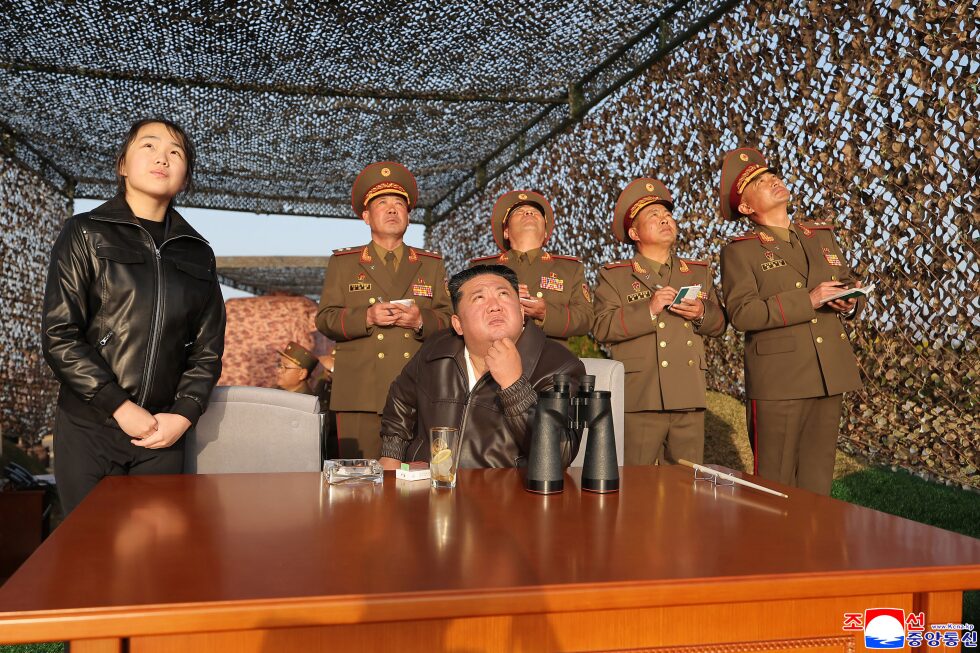
Released KCNA photographs captured North Korean leader Kim Jong Un and his teenage daughter Kim Ju Ae, both clad in matching black leather jackets, observing the test from a coastal observation post as the rocket arced over the water, leaving a thick trail of gray smoke in its wake. In recent weeks, South Korea’s National Intelligence Service has assessed that the young daughter, who has appeared alongside Kim at multiple high-profile military events, is being positioned as Kim Jong Un’s eventual successor.
According to KCNA’s official account, Kim personally oversaw the launch of five upgraded Hwasong-11 Ra surface-to-surface ballistic missiles, each armed with a combination of cluster bomb warheads and fragmentation mine warheads. All missiles successfully struck a pre-designated island target, and Kim expressed full satisfaction with the results, noting that the test carried profound military significance for strengthening North Korea’s high-density strike capabilities.
This test marks the second cluster warhead-equipped ballistic missile launch North Korea has carried out this month. Earlier tests involved the Hwasong-11 Ka variant, which Pyongyang claimed is capable of turning a 6.5 to 7-hectare area (equivalent to 16 to 17.2 acres) into ash.
While North Korea has tested cluster munitions in the past, regional defense analysts point to the ongoing Iran-Israel conflict as a key catalyst for Pyongyang’s recent push to showcase its existing cluster stockpiles and accelerate development of more advanced designs. The conflict has thrust the destructive capacity of cluster weapons into the global spotlight: Israel has accused Iran of deploying these munitions to overwhelm its overstretched air defense networks. Cluster warheads operate by detonating at high altitude, scattering dozens of small submunitions across a wide geographic area — a design that makes them extremely difficult to intercept with traditional missile defense systems.
Globally, more than 120 nations have ratified the Convention on Cluster Munitions, an international treaty that bans the production, stockpiling, and use of these weapons. Notably, North Korea, Iran, Israel, and the United States are not signatories to the agreement.
North Korea has ramped up its development of nuclear arsenals and advanced conventional weapons since high-profile nuclear diplomacy between Kim Jong Un and then-U.S. President Donald Trump collapsed in 2019. Pyongyang’s current military modernization priorities include multi-warhead nuclear missiles, hypersonic glide vehicles, and submarine-launched ballistic missiles — all systems that would drastically improve North Korea’s ability to defeat layered U.S. and South Korean missile defenses.
In recent months, Trump has repeatedly signaled his interest in reviving diplomatic talks with Kim, and Kim Jong Un has left the door open for dialogue with the former president, while insisting that Washington must drop its demand for North Korean nuclear disarmament as a precondition for any negotiations. Against this backdrop, Trump is scheduled to travel to Beijing in May for a rescheduled summit with Chinese President Xi Jinping. Many regional observers argue that North Korea’s recent string of missile tests is a calculated strategy to strengthen its negotiating position ahead of any potential diplomatic opening that could emerge from the U.S.-China summit.