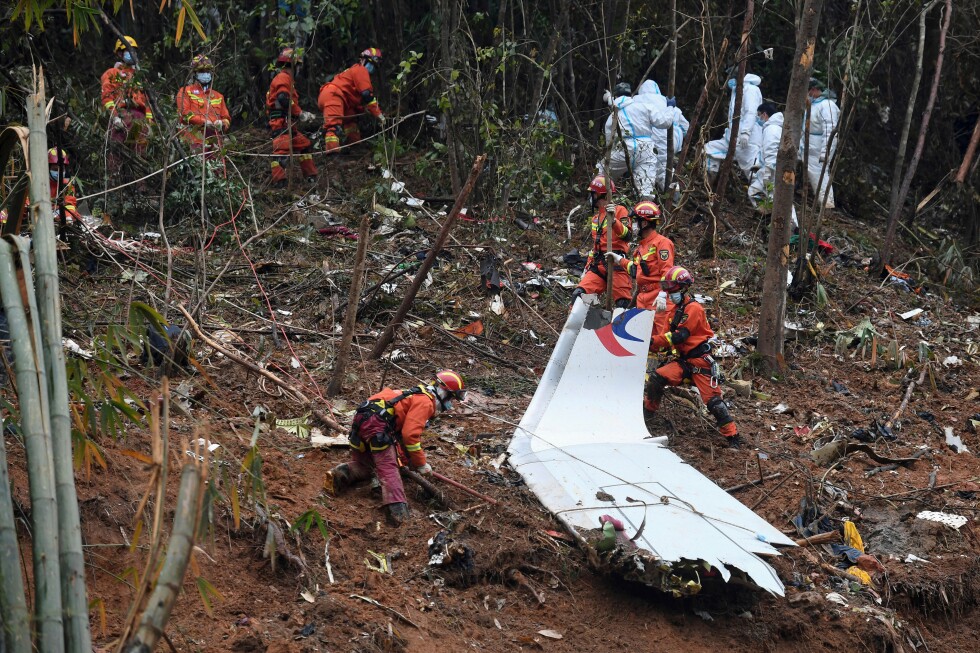
Nearly four and a half years after the March 2022 fatal crash of a China Eastern Airlines Boeing 737-800 that killed all 132 people on board, newly unsealed flight data obtained by U.S. investigators has pulled back the curtain on a sequence of events that strongly suggests intentional cockpit tampering.
The U.S. National Transportation Safety Board (NTSB) joined the Chinese-led investigation shortly after the crash, as the jet and its engines were manufactured by U.S.-based companies, and the agency is globally recognized as a leading authority on black box flight data analysis. NTSB published its internal analysis of flight recorder data dated July 1, 2022, but the document was only released in response to a public records request on May 1, with news of the report’s contents breaking publicly earlier this week.
The flight data reveals a clear pattern: both of the jet’s engines were fully shut down mid-flight, followed by an uncontrolled nosedive and a full 360-degree roll before the aircraft slammed into a mountain. Aerospace safety experts note that the 737’s fuel control levers are designed with a locking mechanism that prevents accidental shutoff. To cut fuel to both engines, a person must intentionally pull both levers out of their locked position and move them to the cutoff position — a sequence that cannot occur from accidental bumps or routine turbulence.
Former NTSB and Federal Aviation Administration crash investigator Jeff Guzzetti, who has decades of experience probing civilian aviation disasters, says the flight control data bears all the markers of a cockpit struggle over control of the jet. “Typically, when you initiate a roll, you get a smooth, steady movement of the control wheel in one direction,” Guzzetti explained. “But here, the control wheel moved back and forth repeatedly, as if one person was trying to counter another’s input to roll the plane. It’s not conclusive, but it definitely has the earmarks of a struggle in the cockpit.”
Guzzetti added that the available data aligns with a pattern seen in past intentional pilot crash events, including the 2015 Germanwings crash in the French Alps that killed all 150 people on board, and the 1999 EgyptAir crash off the coast of New York that was attributed to the co-pilot’s deliberate action. The data stops recording when the aircraft was still at 26,000 feet, after the flight recorder and all of the jet’s hydraulic systems lost power following the engine shutoff. While the cockpit voice recorder, powered by a backup battery, continued recording through the final moments of the flight, Chinese civil aviation authorities have not released a transcript of the audio, and remain the lead body responsible for publishing the final investigation report.
To date, more than four years after the crash, China’s Civil Aviation Administration has not published its full final report. International aviation standards require investigative bodies to aim to release a final report within one year of a crash. Previously, Chinese investigators had shared preliminary findings that found no mechanical abnormalities with the aircraft, no issues with crew credentials, and no external factors such as severe weather that contributed to the crash. John Cox, CEO of aviation safety consulting firm Safety Operating Systems, confirmed the NTSB data shows no evidence of mechanical failure of the jet itself.
The flight was operating a routine domestic route from Kunming, a major city in southwest China, to Guangzhou, a commercial hub near Hong Kong. Before losing contact with air traffic control, the crew did not report any in-flight emergencies. The jet entered a rapid nosedive from 29,000 feet, briefly showed signs of partial recovery before crashing into a mountainside, leaving a 20-meter crater and igniting a large wildfire in the area.
The revelations from the declassified NTSB report have reignited longstanding debates across the global aviation industry over pilot mental health protocols. Currently, many commercial pilots around the world avoid seeking professional help for mental health concerns out of fear that a diagnosis will lead to the immediate revocation of their flight medical certification, grounding them without pay for months or longer while they navigate a lengthy, arduous recertification process. Many nations also ban commercial pilots from taking common psychiatric medications such as antidepressants, even when the medication effectively manages symptoms and does not impair flight ability.
Recent high-profile incidents have underscored the ongoing risks of this approach: in 2023, an off-duty Horizon Air pilot who had used psychedelic mushrooms days prior attempted to shut off the engines of the commercial flight he was riding in the jumpseat of, an incident that only failed because other crew members intervened to stop him.
The 2022 China Eastern crash was a devastating outlier for China’s commercial aviation industry, which has achieved a strong modern safety record following a string of deadly accidents in the 1990s that spurred widespread regulatory overhauls. China Eastern Airlines is one of China’s four large state-owned major air carriers.