Fresh transatlantic friction has emerged after former President Donald Trump reignited longstanding threats to cut the United States military footprint in Germany, NATO’s leading European hub and the EU’s biggest economy. The renewed warning comes on the heels of critical remarks from German Chancellor Friedrich Merz, who claimed the U.S. was being publicly humiliated by Tehran amid its slow-rolling diplomatic negotiations tied to the ongoing U.S.-Israel conflict with Iran.
Talk of reducing American troop levels in Germany is far from new. For years, Trump has openly pondered pulling back U.S. military assets from the country, and in recent months he has repeatedly lashed out at NATO for declining to back the U.S. in its two-month military campaign against Iran. Ever since Trump took office, NATO allies have braced for potential troop withdrawals, with repeated warnings that European nations would ultimately have to take full ownership of their own security, including defense support for Ukraine.
Currently, between 80,000 and 100,000 U.S. military personnel are stationed across Europe, a number that fluctuates with ongoing operations, training exercises and rotational deployments. NATO allies widely expect that the additional U.S. troops deployed to the continent after Russia’s 2022 full-scale invasion of Ukraine would be the first to depart if drawbacks move forward. Germany hosts some of the U.S. military’s most critical European infrastructure: this includes the dual headquarters for U.S. European Command and U.S. Africa Command, Ramstein Air Base, the Landstuhl Regional Medical Center that treats wounded service members from conflicts across the Middle East and South Asia, as well as deployed American nuclear missiles.
Ed Arnold, a European security specialist at London’s Royal United Services Institute (RUSI), a leading defense think tank, argues that a full or large-scale withdrawal is highly unlikely, pointing out that the U.S. derives enormous strategic benefit from its German bases, which enable critical logistics and support for combat operations across the Middle East. Arnold labeled Trump’s latest threat as nothing more than political bluster, noting a long-standing gap between civilian political rhetoric and U.S. military priorities. “The issue with some of these threats is that they are not quite as galling as they were a couple of years ago,” he explained, pointing to growing European familiarity with Trump’s patterned rhetorical outbursts.
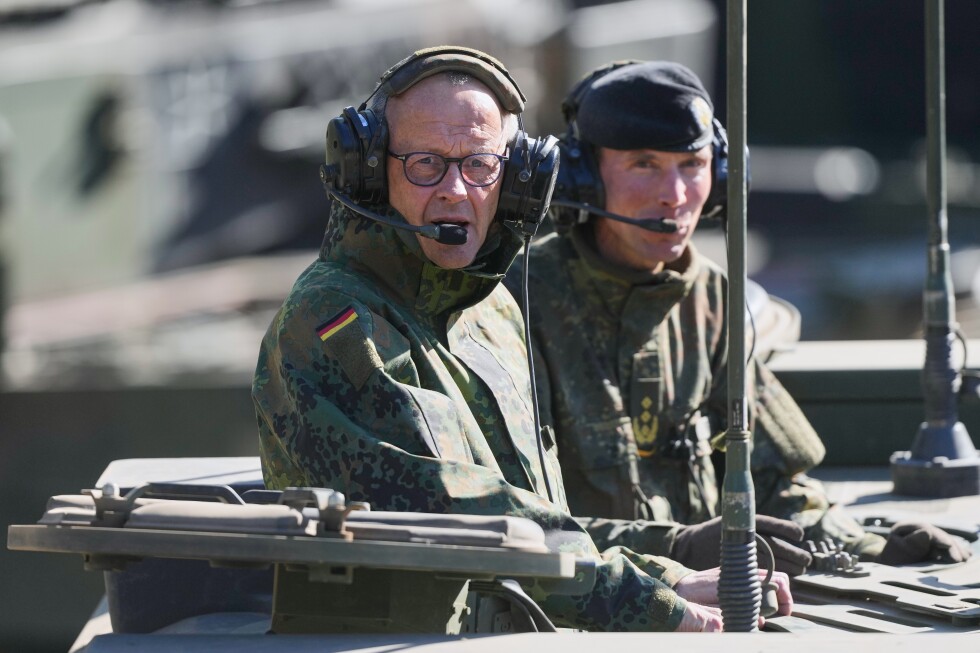
Neither NATO nor the German federal government issued immediate official responses to Trump’s social media post. During a visit to a military training site in Munster, northern Germany on Thursday, Merz did not directly reference Trump’s comments, but obliquely pushed back by referencing longstanding transatlantic cooperation. “We work shoulder to shoulder for mutual benefit and in deep trans-Atlantic solidarity,” Merz said, adding that his government has made significant progress over the past year to bolster Germany’s own national security.
Arnold notes that European allies are far more concerned about more immediate shifts in U.S. defense policy: the redeployment of American Patriot missile systems and stockpiled ammunition from Germany to the Middle East, as well as official notifications to Eastern NATO allies including Estonia that U.S. weapons orders will be delayed amid Washington’s new priority of supporting operations against Iran. A senior Western official, speaking to the Associated Press on condition of anonymity to discuss sensitive diplomatic matters, said there is no record of any active discussions between the U.S., Germany or other NATO allies about imminent troop reductions in Germany. The official added that Europe, and Germany in particular, have already stepped up to take greater responsibility for continental security following the release of Berlin’s new national military strategy.
This is not the first time unexpected U.S. defense announcements have roiled transatlantic security planning. Last October, Washington confirmed it would cut between 1,500 and 3,000 troops from NATO deployments along the alliance’s border with Ukraine. The last-minute announcement unsettled Romanian officials, who host a key NATO air base on the country’s eastern flank. A full review of U.S. military posture across Europe and other global regions was launched by the Trump administration early last year, with findings originally scheduled for public release in late 2025 that have yet to be published. The U.S. has, however, given allies a formal commitment to provide advance notice of any posture changes to avoid creating dangerous security gaps at a time when Russia grows increasingly confrontational.
Many senior European leaders hold the assessment that Russian President Vladimir Putin could launch an offensive attack on another European nation by the end of the decade, particularly if Russia secures a victory in its ongoing war in Ukraine. The outbreak of the U.S.-Iran conflict has only heightened speculation that U.S. troop withdrawals from Europe could move forward, with a flurry of closed-door meetings held between Trump administration officials, NATO Secretary-General Mark Rutte and European leaders since hostilities began on February 28. Over the past year, European NATO members and Canada have already begun adjusting to a new strategic reality, where they will bear primary responsibility for Europe’s conventional defense, with the U.S. shifting its NATO contribution to primarily nuclear deterrence and a smaller forward-deployed troop presence.
Beyond the current uncertainty over troop levels, European allies have largely grown accustomed to Trump’s frequent public outbursts. In recent months, they have weathered insults labeling them as cowards and seen Trump brand NATO a “paper tiger.” Repeated threats of full withdrawal over issues like alliance defense spending targets have left allies desensitized to social media announcements hinting at potential action. The most lasting damage to NATO cohesion, many officials agree, has come from Trump’s ongoing public fixation on annexing Greenland, a semiautonomous territory of NATO member Denmark, which has included trips to the island by Trump’s family members and senior administration officials. In September, an announced freeze on some security assistance funding for European states bordering Russia also sowed widespread confusion, after Baltic defense leaders confirmed they had received no official advance notification of the policy shift.