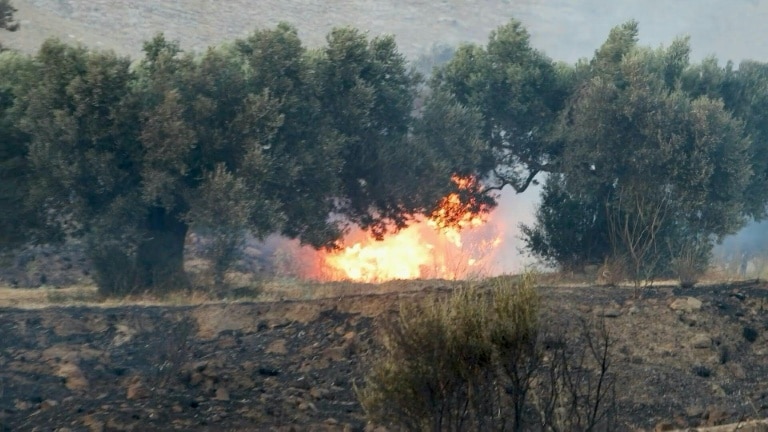
Greece faced another day of escalating wildfire disaster on Friday, as gusty winds reaching 55 miles per hour sparked new blazes across the country, exhausting firefighting teams and forcing emergency evacuation orders for a western Athens suburb. The outbreak marked the fourth consecutive day of widespread fire activity, which has already torn through popular tourist regions, left local residents displaced, and claimed the lives of three firefighters.
Civil Protection authorities issued an emergency mobile alert ordering partial evacuation of Haidari, a suburban community located roughly seven miles west of central Athens, after a wildfire ignited on a nearby mountain. Fire department officials confirmed they have mobilized a massive response force for the blaze, including 100+ ground firefighters, five helicopters, and four water-bombing aircraft.
This new fire near the Greek capital is part of a broader national emergency that has hit regions across the country this week, most notably the major tourist island of Crete. There, the blazes have already destroyed thousands of acres of land and left dozens of local business owners ruined. Thrasyvoulos Paterakis, a 69-year-old cafe owner in the Crete resort town of Agia Galini, told reporters his entire business – which supported both his own family and that of his son – was completely destroyed by the flames. “We’re now out on the street,” he said.
Greek Civil Protection officials classified most of the country’s regions, including the Athens metro area, Crete, multiple Aegean islands, and parts of the Peloponnese, as under “very high” wildfire risk on Friday, the second-highest risk tier. The powerful gusty winds have not only accelerated fire spread but also disrupted ferry travel to many top tourist destinations, complicating both travel and emergency logistics.
Theodore Giannaros, a senior researcher at the National Observatory of Athens, explained that extreme wind is making the blazes far harder to contain. “The gusts are literally carrying the fire and spreading it in all directions,” he told public broadcaster ERT. “The strong winds are lifting embers that can spark new outbreaks, sometimes far from the main fire front.”
Two separate new blazes also broke out Friday in Viotia, a coastal region 53 miles northwest of Athens. When seasonal residents refused to comply with an initial evacuation order, coastguard and fire department crews deployed vessels to extract roughly 200 people from the coastal village of Agios Vasileios by sea, moving them to safety at a nearby beach, according to Greece’s national news agency ANA.
In a piece of good news, firefighters managed to stop an advancing blaze in the eastern Peloponnese before it reached Mycenae, the iconic UNESCO-recognized Bronze Age archaeological site, protecting the historic landmark from damage.
Satellite data from the European Union’s Copernicus climate monitoring program shows that between Wednesday and Thursday alone, approximately 4,500 hectares (11,120 acres) of land was burned south of the popular Cretan tourist town of Rethymno. Officials added that the combination of strong winds and Crete’s rugged, mountainous terrain continues to slow and hamper firefighting efforts across the island.
Authorities have already issued a maximum-level fire risk alert for Saturday, covering the greater Athens area, parts of Crete and the Peloponnese, central Greece, and the country’s northeastern border region with Turkey.
Greece’s unique geography, made up of hundreds of scattered islands, adds an extra layer of complexity to rapid emergency response, but additional firefighting resources have already been dispatched to hard-hit Crete to support frontline crews. Greek Prime Minister Kyriakos Mitsotakis warned Thursday that the country is bracing for what lies ahead. After escaping the worst of the heat and fire activity that hit France and Spain earlier this summer, Mitsotakis said Greece is now headed for “difficult days.”
Like the rest of the Mediterranean basin, Greece is on the frontlines of the climate crisis, which has increased the frequency and severity of heat waves, drought, and summer wildfire activity across the region.