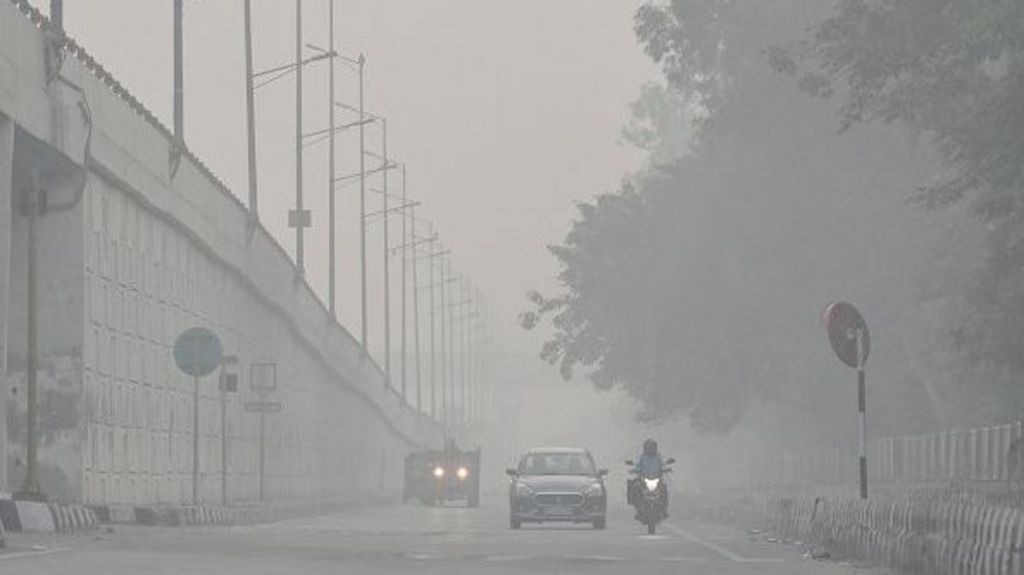
As winter’s cooler temperatures settle across India’s northern plains, the national capital Delhi is once again grappling with a sharp, familiar deterioration in air quality that has pushed public health risks to alarming levels. Official air quality index (AQI) readings for the city crossed the 300 threshold this week, landing at 377 on Wednesday morning to fall firmly in the Central Pollution Control Board’s (CPCB) “very poor” classification, a stark reversal after Delhi logged its cleanest October average AQI in eight years. The sudden drop in air quality, which follows recent rainy, windier conditions that had cleared accumulated smog, has been traced to a confluence of meteorological and human-driven factors: plummeting temperatures, stagnant low wind speeds, and a surge in agricultural stubble burning in the adjacent states of Punjab and Haryana, where northwesterly winds now carry smoke from post-harvest field fires directly over the capital. The fine particulate matter driving the hazardous readings, PM2.5, measures roughly 30 times smaller than the width of a human hair, allowing it to penetrate deep into lung tissue and enter the bloodstream. Prolonged exposure to these levels of pollution carries severe health risks, including chronic respiratory illness, aggravated cardiovascular conditions, and disproportionate harm to vulnerable groups such as young children, elderly residents, and people with pre-existing medical conditions. In response to official forecasts that show very poor air quality persisting for the coming days, Delhi’s pollution management authorities have formally activated Stage II of the city’s tiered Graded Response Action Plan (GRAP), a framework of escalating emergency restrictions tailored to curb pollution sources as AQI levels rise. The new set of measures includes intensified street sweeping to suppress construction and road dust, increased parking fees to disincentivize private car use, expanded public transit services including 20 additional weekday Delhi Metro trips, and staggered government office timings to cut peak-hour traffic congestion. The public health crunch arrives just days ahead of Diwali, one of India’s most widely celebrated national festivals, a period that historically exacerbates Delhi’s annual winter pollution crisis due to widespread fireworks use that releases dense clouds of toxic gases and fine particulate matter into already smog-choked air. Last year, Delhi residents woke to a thick, toxic haze the morning after Diwali, even after courts had ordered a shift to lower-emission firework alternatives. This year, India’s Supreme Court has issued targeted regulations governing firework use across the National Capital Region: certified “green firecrackers”, which use reformulated chemical blends to produce 30% to 40% fewer emissions than conventional variants, are permitted for sale and use only during two narrow daily windows on November 7 and 8, between 6 a.m. to 7 a.m. local time and 8 p.m. to 10 p.m. The court has also imposed a total ban on firework detonation within 300 meters of designated silence zones, including hospitals, elder care facilities, and K-12 schools. All approved green firecrackers are required to carry scannable QR codes that allow consumers and enforcement officials to verify their manufacturing origin and certification status. Still, regulators acknowledge that enforcement remains a persistent, systemic challenge: the Supreme Court noted in its latest ruling that uncertified, highly polluting conventional fireworks have long been illegally marketed and sold as green alternatives even under full bans. To crack down on violations, law enforcement agencies have been ordered to conduct regular random patrols of designated firework sales zones, carry out spot QR code checks, and seize all unapproved stock. The seasonal air pollution crisis is not isolated to Delhi. India’s financial hub Mumbai, which typically benefits from coastal winds that disperse airborne pollutants, also recorded a very poor AQI reading of 322 on October 24, driven by low wind speeds, construction dust, open garbage burning, cross-border pollutant drift, and pre-Diwali firework emissions. While Mumbai’s air quality has since improved to a “satisfactory” AQI of 89 as of Wednesday, with adjacent Navi Mumbai logging a moderate 118 AQI, the recent smoggy two-week stretch prompted widespread resident documentation of the haze across social media platforms, highlighting that poor urban air quality is now a nationwide public health priority across Indian metropolitan areas.
Delhi air quality worsens ahead of Diwali as firework restrictions enter force