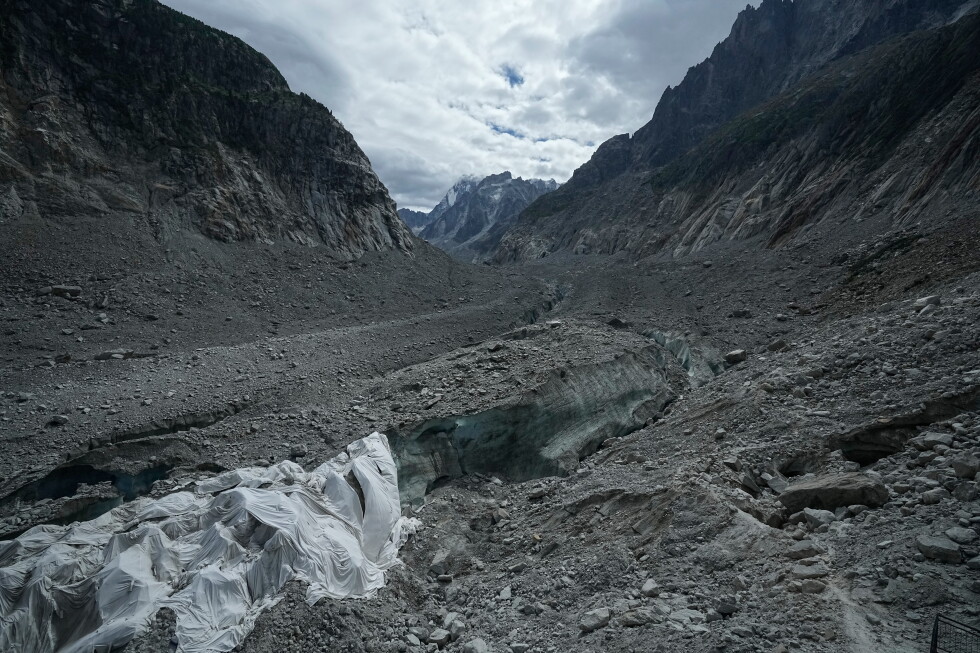
For hundreds of years, the mountain communities straddling the French-Italian border at the foot of Western Europe’s tallest peak have lived in the shadow of Mont Blanc — the “White Mountain” — whose seemingly permanent snowfields and glaciers defined both its name and its iconic landscape. Today, that centuries-old landscape is unraveling at a pace that has alarmed scientists, local leaders and long-time residents alike, as accelerating climate warming drives catastrophic change across the Alpine range.
Europe’s sweltering record-breaking heat waves this summer pushed temperatures to unprecedented highs at high altitude, thawing permafrost that has acted as natural cement holding the Alps’ rocky slopes together for millennia. As cold, centuries-old terrain warmed and softened, unstable cliffs fractured, sending massive cascades of rock tumbling down from the heights. Even one of the most notoriously hazardous gullies regularly traversed by climbers aiming for Mont Blanc’s 4,805-meter summit became temporarily impassable, its routes rendered too dangerous to attempt.
“We weep for our mountain, the way it’s changing. It hits us in the gut,” said Stéphane Bozon, deputy mayor of Chamonix-Mont-Blanc, the French alpine town that sits at the mountain’s base. Since mid-July, Bozon explained, the frequency of rockfalls has climbed steadily. Glacial retreat, rapid snowmelt, widening crevasses and sudden rock collapses have closed off multiple once-accessible areas, making travel across many high-altitude routes far more dangerous than just a generation ago.
Temperature data from France’s national weather service Meteo France underscores the scale of the warming. On Aiguille du Midi, a 3,842-meter peak in the Mont Blanc massif, the average July temperature has jumped from 1.6°C (33.8°F) in 1994 to 3.3°C (37.4°F) this year — the warmest July ever recorded at the site. “The mountain really dried out, with temperatures unlike any I had ever experienced,” Bozon added.
The crisis unfolding on Mont Blanc mirrors a growing global pattern of climate-fueled glacial and mountain disasters, highlighted by the devastating August floods that killed dozens of people across Nepal and southern Tibet. That catastrophe was triggered when a combination of glacial ice and bedrock collapsed, sending a surge of debris and water roaring through Himalayan river valleys. Most scientists agree that rising temperatures driven by the burning of fossil fuels created the unstable conditions that led to the disaster, and as global average temperatures continue to climb, the likelihood of similar events will only increase.
Across the Alps, glaciers long celebrated for their icy grandeur are now viewed with growing apprehension, as shrinking ice and thawing terrain erode their stability. For Bozon, who oversees public safety for Chamonix, the urgent priority is preparing for worst-case scenarios, in which large chunks of glacial ice or unstable mountain rock could break away and crash into populated lowland areas. “We have to move quite quickly because this summer has shaken us and year after year we’re being shaken by the glaciers’ retreat,” he said.
On the Italian side of the border, researchers are documenting similarly dramatic damage from this year’s record heat. Since 1991, Alpine glaciers in Italy’s Lombardy region have lost more than 40% of their total surface area, according to the region’s official glacier monitoring service. Vanda Bonardo, head of the Italian branch of the International Commission for the Protection of the Alps, noted that once-reliable high-altitude snowfall has increasingly been replaced by rain, further eroding terrain stability. “So we’ve also seen the effects on the stability of the terrain,” she added.
Ludovic Ravanel, a climate researcher at Savoie Mont Blanc University who specializes in how rising temperatures impact mountain ice, snow and permafrost, explained that permafrost’s role in holding steep rock faces together cannot be overstated. This year’s repeated back-to-back heat waves pushed that ancient ice to a breaking point. “That doesn’t mean that all the rock faces will collapse in the coming years or decades but quite a number of them are on the verge of becoming unstable and remain stable today only because of the presence of that ice. As the ice changes, we have seen a huge, huge number of rock falls and rock collapses this year,” he said.
Ravanel defines a major collapse as a rock fall involving more than 100 cubic meters of rock — enough to fill a large standard shipping container. He projects that the total number of major collapses across the Mont Blanc massif this year will likely reach roughly 400, a figure that is 10 times higher than the average recorded two decades ago. The last time the region came close to this level of activity was 2022, which was already labeled a “catastrophic year” with nearly 300 major collapses. “This has really been one of the defining features of the summer of 2024,” he said.
For mountain guides who have built their lives around leading climbs on Mont Blanc, the rapid shift has been both professionally challenging and deeply disheartening. Stuart MacDonald, a Chamonix-based guide, says he is stunned by how quickly and extensively the massif’s hanging glaciers have retreated in just the last decade. When he leads groups up the slopes, he often points out visible markers of the melt: “where the glacier was last year and this is where it was 10 years ago. And that usually has quite an effect.”
This summer, elevated melt and constant rockfall risk made MacDonald’s job “pretty challenging,” and he was forced to cancel a planned summit ascent just last week. “You hear it before you see it and then you’ll turn round and you’ll just see an enormous cascade of rocks coming down a slope and it can be quite terrifying,” he said. “What’s most scary is that sometimes these rocks are falling on routes that we used to be climbing at this time of year. It can be depressing sometimes when you look at something that you maybe climbed in July or August in the past and you see that it’s absolutely impossible to do it now.”