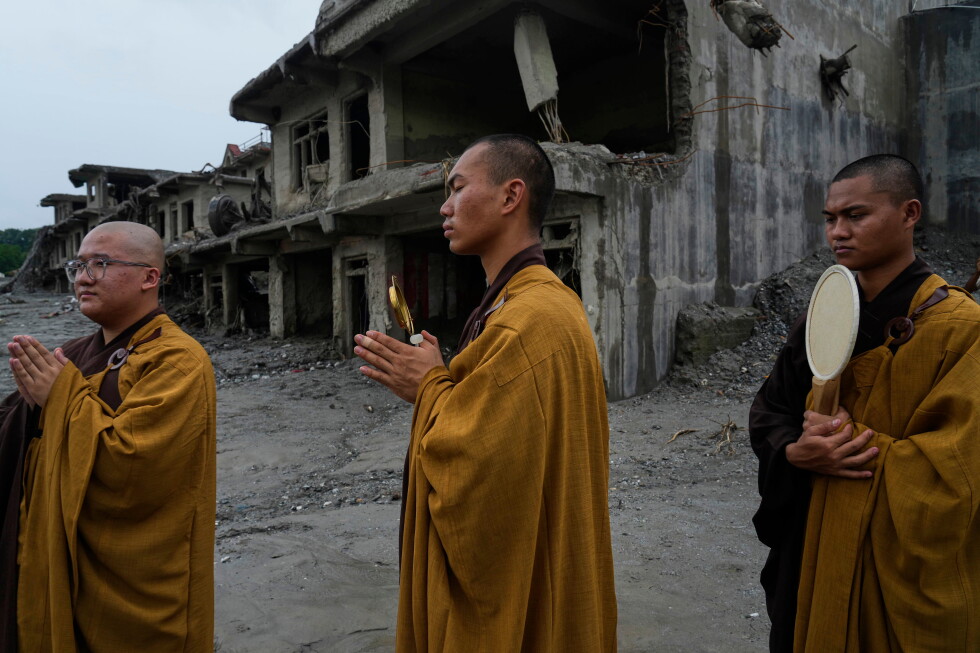
Two weeks after catastrophic flash floods swept through southern Nepal and the Tibet Autonomous Region of China, Nepal marked a national day of mourning on Monday to honor the hundreds of lives lost to the disaster, capping 13 days of traditional mourning for grieving families across the Hindu-majority nation.
According to Nepal’s national disaster management agency, the flooding that struck on August 26 has already claimed more than 1,300 lives across Nepal and Tibet, with close to 5,000 people still unaccounted for — a number that includes foreign nationals working and traveling in the flood-hit region.
In traditional Nepalese Hindu culture, the mourning period for lost loved ones spans exactly 13 days, during which immediate family members remain at home to receive condolences and respect from extended relatives and community members. The 13th day marks the conclusion of the mourning process, when families hold final rituals to offer prayers for the peaceful journey of the departed souls. For hundreds of families whose relatives remain missing, swept away by floodwaters or buried under landslide debris, these rituals have taken the form of symbolic funerals, carried out without the recovery of their loved ones’ remains. Per Hindu tradition, cremation is a non-negotiable final rite, and holding the ceremony even without a body gives many grieving families a small measure of spiritual closure amid their uncertainty.
The Nepalese government had previously designated Monday as an official national day of mourning, requiring all federal and local government offices to lower their national flags to half-mast as a mark of respect. In the capital city of Kathmandu, dozens of grieving family members gathered outside the prime minister’s office and major government ministry buildings to demand that authorities accelerate search and rescue operations. Many of the missing are workers employed at hydropower projects along the rushing Bhotekoshi River, who were either swept away by surging floodwaters or trapped under debris from flood-triggered landslides.
Search operations are still ongoing for the hundreds of people who remain missing after the disaster. In recent days, rescue teams have pulled multiple survivors from the debris more than a week after the floods struck: two Nepalese workers were extracted from a damaged hydropower plant on Friday, followed by a Chinese worker rescued alive on Saturday, giving hope to families still waiting for news of their relatives.
Authorities have shifted the bulk of their rescue resources to 12 affected hydropower projects, where roughly 900 workers are still listed as missing, with an estimated 500 believed to be trapped inside construction tunnels under mountainside debris. Specialized rescue teams from four countries — China, India, South Korea, and the United States — have joined the search effort, combing through mangled infrastructure, collapsed debris piles, and remote tunnel networks in the hopes of finding more survivors more than two weeks after the disaster.