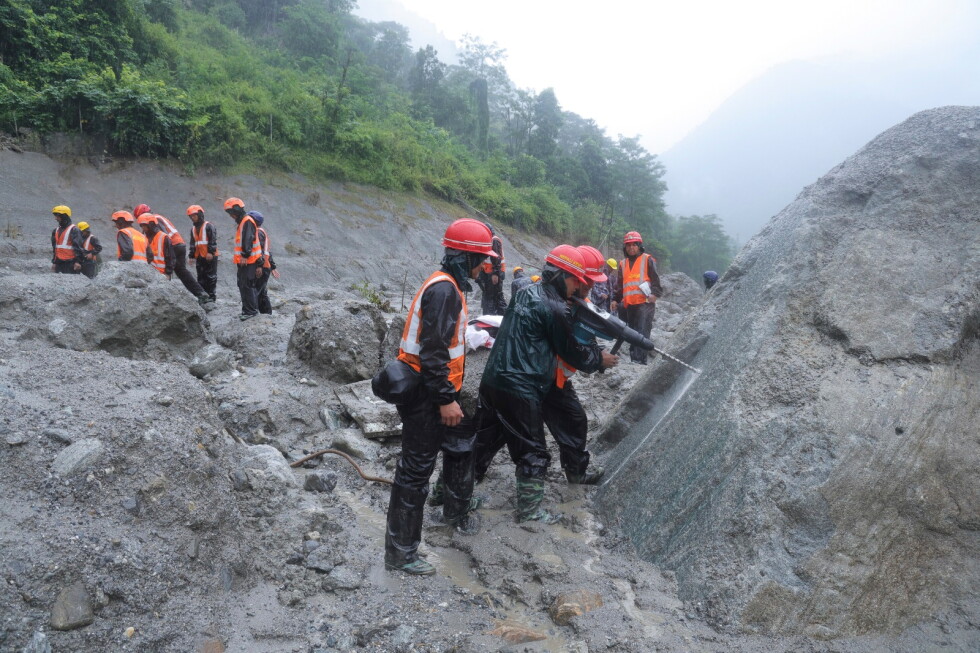
In the flood-scorched hills of central Nepal’s Dhading district, crews are currently digging through layers of thick sludge to reach a submerged hydropower plant, a critical energy facility that keeps the lights on for more than 20,000 local residents. As workers clear debris from equipment buried when last week’s devastating flood surged off the mountains, disaster and climate experts are pushing for a fundamental shift: instead of simply rebuilding the facility in the same vulnerable riverside spot that led to its destruction, Nepal must prioritize long-term climate resilience when reconstructing its damaged infrastructure. The scale of the devastation stretches far beyond this single power station. Across Nepal, catastrophic floodwaters and landslides have left as many as 900 workers missing from a dozen active and under-construction hydropower projects, the Independent Power Producers’ Association Nepal reports, with hundreds of those workers believed to be trapped inside project tunnels. Combined, the disaster has claimed more than 900 lives across Nepal and southern China, with another 4,700 people still unaccounted for. For Nepal’s energy sector alone, the damage has taken an estimated 700 megawatts of generation capacity offline – roughly 10 percent of the country’s total available power. Beyond energy infrastructure, tens of kilometers of roads, dozens of bridges, and hundreds of critical public facilities including schools and hospitals have been destroyed or heavily damaged. As Nepal’s government shifts from immediate rescue and response to long-term recovery planning, experts say the top priority must be avoiding the mistakes that left the country so exposed to this disaster. “Authorities have to take a hard look in the mirror now and ask how they will be rebuilding in these places. They will also have to take a close look at other projects in Nepal that have not been built yet, whether they’ll be approved after this event,” said Jakob Steiner, a geoscientist from the University of Graz in Austria currently based in Dhaka, Bangladesh. Hydropower projects across the worst-hit districts of Rasuwa, Nuwakot, and Dhading have been fully or partially destroyed, a blow that hits particularly hard because hydropower forms the backbone of Nepal’s national electricity grid, serves as a core driver of economic growth, and generates critical export revenue for the low-income Himalayan nation. Most of Nepal’s untapped hydropower potential falls into the run-of-river category, meaning facilities are built directly alongside steep, narrow river corridors where land is scarce and flood and landslide risks can escalate in a matter of minutes. Many workers who are now missing took shelter in the projects’ large access and water diversion tunnels – structures big enough to accommodate full-sized trucks – when the flood hit, but have been unable to escape as debris blocked exit routes. Experts are calling for a complete rethinking of how Nepal plans its infrastructure, arguing that reconstruction should not just replace destroyed assets, but build systems that can absorb and recover from future climate-driven disasters. Ramraj Narasimhan, senior director at the Coalition for Disaster Resilient Infrastructure, says the goal should not be to make every single structure completely indestructible, but rather to build redundancy into critical systems to keep essential services running even when damage occurs. “If it gets damaged, let it get damaged, but can we build in redundancy in the system?” Narasimhan explained. That approach can mean a range of adjustments from selecting safer construction sites away from high-hazard river bends and unstable slopes, to adding alternate transportation routes, backup power generation, improved early warning systems, and risk-mitigation tools like disaster insurance to speed up recovery after an event. Risk assessments must also account for how a single infrastructure failure can cut off access for multiple isolated mountain communities, experts say. These changes are long overdue: the Coalition for Disaster Resilient Infrastructure estimates that $124 billion worth of Nepal’s existing infrastructure is exposed to climate-driven disasters, leading to an average of nearly $760 million in annual disaster losses. The country’s national disaster response fund, however, holds only a tiny fraction of that amount, leaving it ill-equipped to handle major catastrophic events like the recent flood. Climate scientists warn that risks across the Himalayan region are growing faster than almost anywhere else on Earth, driven by human-caused global warming. Glaciers across the Hindu Kush Himalaya are losing ice at an accelerating rate, while permafrost degradation, unstable mountain slopes, growing glacial lake outburst risks, and increasingly erratic monsoon rainfall are all combining to raise the frequency and severity of catastrophic floods, landslides, and debris flows, according to the International Center for Integrated Mountain Development, a Kathmandu-based climate research organization. For extreme events as large as the recent flood, even the most robust physical flood defenses are often overwhelmed, making early warning systems the most critical tool to protect human life, Steiner noted. In this case, the flood was detected at the China-Nepal border soon after it formed, but it moved so rapidly downriver that communities and workers upstream had little to no warning. There was, however, a gap of time between detection and the flood reaching downstream hydropower sites, raising urgent questions about why warnings were not issued faster to alert workers at risk. The disaster is expected to spark heightened scrutiny of future hydropower project approvals, with advocates calling for more rigorous, site-specific environmental, social, and disaster risk assessments, paired with stronger land-use regulations and accountability for project developers. Himanshu Thakkar, coordinator of the South Asia Network on Dams, Rivers and People, warns that large hydropower infrastructure can itself worsen downstream damage, acting as a “force multiplier” for disaster when large structures, construction debris, and altered river channels amplify the force of floodwaters. Thakkar argues that Nepal should diversify its energy mix to include more decentralized solar power generation, which carries far lower climate risk in the mountainous Himalayan landscape. As Nepal begins the long process of recovery, the question facing the country is not just how fast it can rebuild what was lost – but whether it will choose to rebuild those assets in harm’s way, ahead of the next inevitable climate-driven flood.