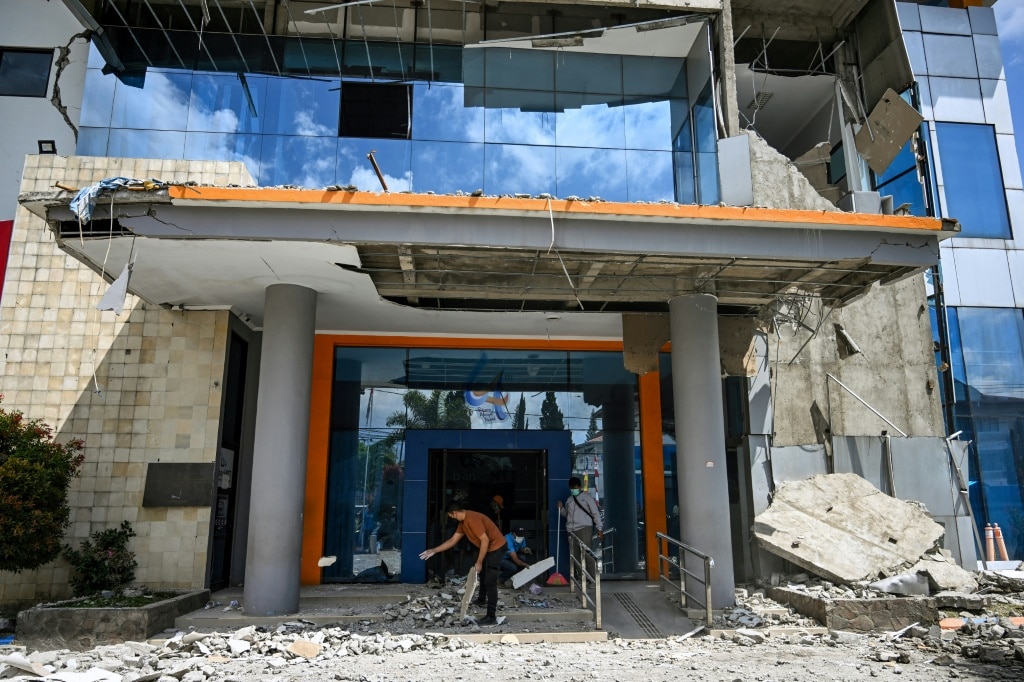
Two days after a powerful 7.7-magnitude earthquake struck eastern Indonesia’s Flores Island, more than 12,800 people remain displaced from their damaged or destroyed homes, waiting for critical emergency aid as hundreds of aftershocks continue to shake the region.
The shallow quake, centered just off Flores’ north coast, hit early Saturday, leaving 53 people dead and more than 100 injured. As of Monday morning, Indonesia’s national disaster agency (BNPB) confirmed no additional missing persons, but the scale of displacement has risen steadily, with thousands of survivors now sheltering in public facilities including schools, police stations and government compounds, or in makeshift camps assembled from scrap materials.
Reporters from Agence France-Presse visiting Mbay, the small town closest to the epicenter in Nagekeo Regency, observed survivors living in hand-built tents constructed from tarpaulin and scavenged poles. Thirty-two-year-old Mbay resident Junaidin, who shares his tent with roughly 29 other people, explained why survivors refuse to return to their properties: many structures have either fully collapsed or developed severe structural cracks that make them uninhabitable. “We only go back home to get water, clothes, pillows, and then we spend the nights here,” he told AFP.
For many island residents, the fresh disaster triggers traumatic memories of an identical 7.7-magnitude quake that hit Flores in 1992, which spawned a deadly tsunami that killed an estimated 2,500 people. That collective trauma has left survivors too afraid to sleep indoors even after the initial shaking stopped, with many spending consecutive nights outside.
Junaidin echoed a widespread frustration among survivors, noting that no government aid had arrived in his community as of Monday, while national Independence Day celebrations were held with large-scale ceremonies thousands of kilometers away in Jakarta. “As for help from the government, there hasn’t been any — no tents, no medicine, no food, no drinking water, nothing,” he said. “Please open your eyes, government. We are your people, we are part of you. So please look after us.”
Thirty-one-year-old Siti Saudah Daso, a Mbay mother of three, described the panic of evacuation that left her family with nothing but the clothing they wore. “We fled with nothing. Just the clothes on our backs. We’re victims; we’re going through a disaster,” she said. While promises of aid have been made, she added, “there’s no proof. So honestly, we’re a bit upset, disappointed.”
In response to the disaster, the Indonesian Air Force has mobilized three aircraft — two Hercules transport planes and one Boeing jet — to airlift 13 tons of emergency supplies including food, clean drinking water, clothing and medical equipment. Helicopters will also be deployed to deliver provisions directly to cut-off, isolated communities that are hard to reach by land, according to the commander of El Tari Air Base in Kupang, speaking to Indonesia’s state-run Antara News Agency. Military personnel have also been deployed to coordinate aid distribution in the hardest-hit areas, but survivors say the critical supplies have not yet reached them.
Search and rescue operations are still ongoing across the affected zone, with teams conducting both ground and air sweeps to confirm no victims are trapped or unaccounted for. “There haven’t been any reports on missing persons, but we are still scouring the area just to be sure,” search and rescue official Fathur Rahman told AFP Monday morning.
BNPB spokesman Berton Suar Pelita Panjaitan confirmed that at least 914 houses across Flores have suffered severe damage, with hundreds more sustaining minor structural harm. Dozens of public buildings — including schools, health clinics and government offices — have also been damaged in the quake. Non-governmental organization Save the Children warned Monday that more than 8,000 children in the affected region now face heightened safety risks and widespread disruption to their education.
Indonesia sits on the Pacific Ring of Fire, a geologically active zone that sees frequent seismic and volcanic activity. The country has suffered some of the deadliest natural disasters in recorded history, including the 2004 9.1-magnitude quake off the coast of Sumatra that triggered a massive Indian Ocean tsunami, killing more than 220,000 people across the region, 170,000 of whom were in Indonesia.