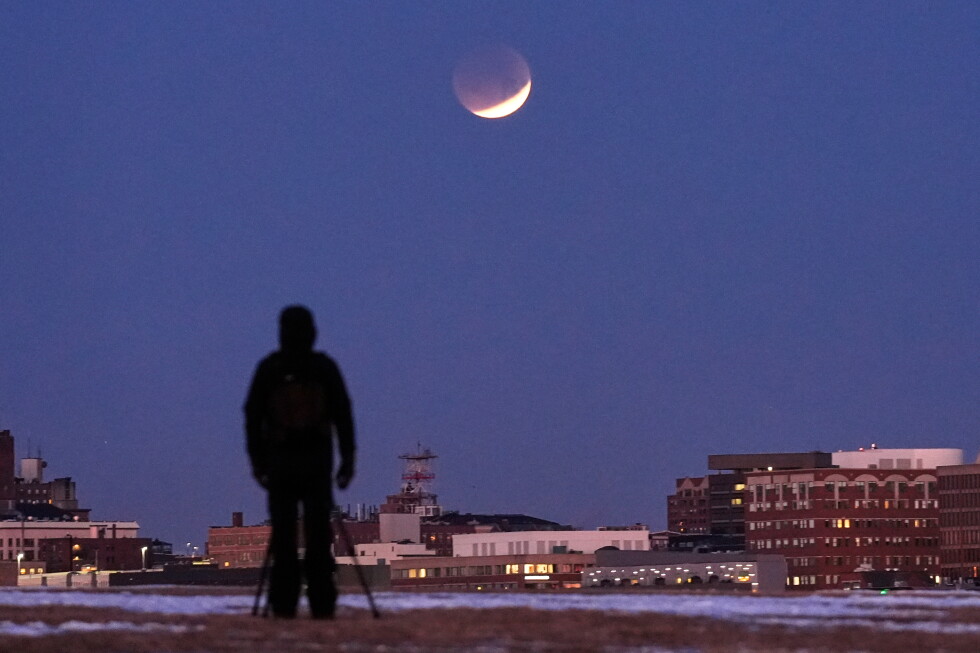
CAPE CANAVERAL, Fla. – Just two weeks after a total solar eclipse drew crowds across Europe, a rare, deep partial lunar eclipse is set to take center stage in the night sky, offering the best views to observers across the Americas. On Thursday night through early Friday, Earth’s shadow will cover 96% of the lunar surface, marking one of the most striking partial eclipses of recent years. This celestial event falls at a time of renewed global interest in lunar exploration, following NASA’s successful April Artemis II mission that carried astronauts on a record-breaking lunar flyby – the first step in the agency’s long-term plan to land humans on the moon and establish a permanent, crewed base staffed by both people and robotic explorers.
From his vantage point aboard the International Space Station, NASA astronaut Jack Hathaway emphasized the momentum of modern space exploration in an interview with The Associated Press last week. “This is a great time to be part of the space program, right? We’re not slowing down,” Hathaway said.
Astronomical events like this follow a consistent pattern: solar and lunar eclipses always occur in pairs, triggered when the sun, moon and Earth align with extraordinary precision. A remarkable cosmic coincidence makes these alignments even more dramatic from Earth’s surface: the moon is 400 times smaller than the sun, and also sits 400 times closer to our planet, leaving the two celestial bodies appearing nearly identical in size to observers on the ground.
Unlike the recent total solar eclipse, which was only visible along a narrow path across Greenland, Iceland and Spain, this upcoming lunar eclipse will unfold slowly over several hours, and reach a far larger global audience. If skies remain clear, the partially eclipsed moon will be visible to billions of people across North and South America, Europe, Africa and the Middle East. Even the 10 people currently living in orbit – seven crew members on the International Space Station and three aboard China’s Tiangong space station – may get a chance to view the event from their unique orbital perspective.
ISS commander Jessica Meir noted that space offers an unparalleled view of cosmic phenomena ranging from eclipses to auroras. For this lunar eclipse, Earth will pass directly between the sun and the moon, casting a warm reddish-orange shadow across most of the lunar surface. Because the alignment is not perfectly centered, it will be a partial eclipse rather than a full total eclipse, meaning it will not produce a full “blood moon” effect. The full duration of the eclipse, from the moment the full moon touches the faint outermost edge of Earth’s shadow to when it exits completely, will stretch 5.5 hours, with the partial phase lasting more than three hours. Peak coverage will occur just after midnight Eastern Daylight Time.
Nearly 1 billion people across the United States, Canada, Central America and South America will have unobstructed views of the entire event. In total, more than 3 billion people – around 44% of the global population – will be able to observe at least part of the eclipse. For skywatchers in Europe, Africa and the Middle East, the eclipsed moon will set before the event concludes, cutting viewing time short. In Hawaii, the northwestern U.S. and western Canada, the moon will rise later, meaning observers will only see the latter stages of the eclipse.
This event is the second lunar eclipse of 2024, and the fourth total eclipse of any kind this year. The year opened with a total lunar eclipse over the Americas, Australia and East Asia in March. For skywatchers hoping to see a full total lunar eclipse across North and South America, the wait will stretch several years: the next full total lunar eclipse will not grace the skies of the hemisphere until 2029. The next complete lunar blackout anywhere in the world will occur on New Year’s Eve 2028, with the best views reserved for observers in Asia and Australia.