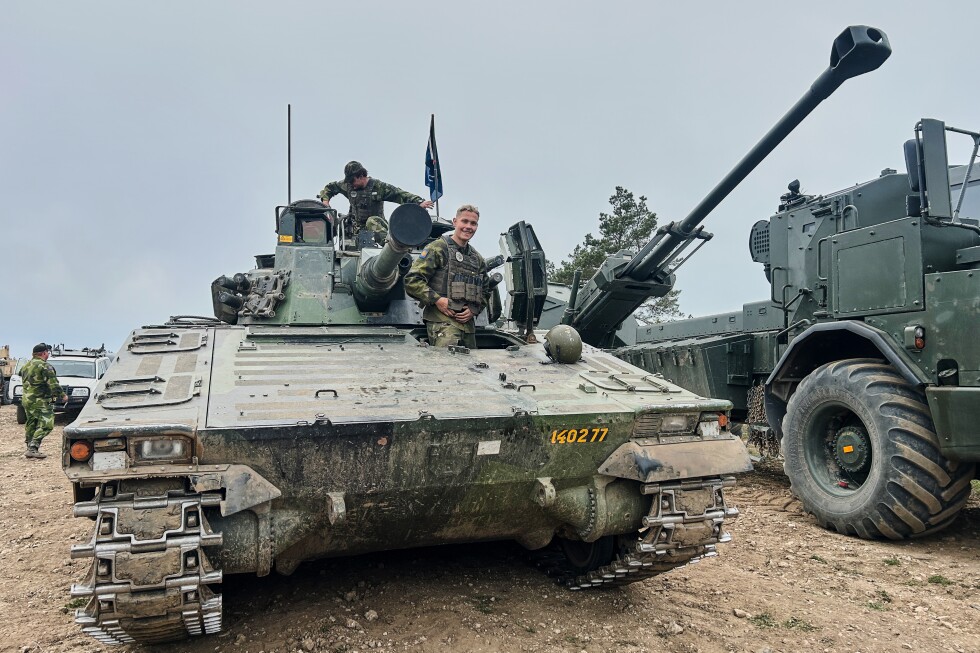
On the strategically vital Baltic island of Gotland, a newly inducted NATO member Sweden is running large-scale military wargames designed to prepare for a growing threat along the alliance’s eastern frontier — with an unusual and telling addition: Ukrainian military advisors sharing hard-won battlefield expertise in modern drone warfare. The Associated Press was granted exclusive access to the exercise, which comes at a moment of dual uncertainty for transatlantic security: mounting Russian hybrid aggression across Europe, and growing questions about the reliability of the United States, NATO’s long-standing military powerhouse, under the second Trump administration.
The wargame scenario crafted by Swedish military planners imagines a hypothetical incursion and sustained hybrid campaign against Gotland, where enemy sabotage has triggered widespread power outages and crippling food shortages. Crucially, the exercise is designed to test alliance coordination before NATO’s Article 5 collective defense clause — which triggers an automatic mutual defense response for all members — is ever invoked. “In theory, it could happen tomorrow,” Rear Adm. Jonas Wikström, the exercise director, told the AP.
For months, multiple intelligence assessments and an AP investigation have documented a sharp ramp-up in Russian hybrid operations across Europe, including coordinated cyberattacks targeting critical civilian infrastructure, widespread disinformation campaigns to destabilize allied governments, and covert sabotage operations. The wargames held this week on Gotland are a direct response to this growing risk, with U.S. troops joining Swedish forces to practice coordinated responses.
Uncertainty over U.S. commitment to the alliance hangs heavily over the exercise. Since returning to the White House in January 2025, President Donald Trump has repeatedly cast doubt on NATO’s value, once calling the bloc a “paper tiger.” Most recently, Trump ordered the withdrawal of at least 5,000 U.S. troops from Germany, and has openly threatened to pull thousands more troops out of Europe. The administration has also shifted U.S. air defense systems and missiles from European deployments to the Middle East amid tensions with Iran, leaving noticeable gaps in regional air defense capabilities, and multiple European allies have reported significant delays to their scheduled orders for U.S.-manufactured weapons. Trump has also paused U.S. intelligence sharing with Ukraine, and has repeatedly aligned with Russian positions in negotiations to end the ongoing war.
Sweden’s chief of defense, Gen. Michael Claesson, acknowledged that shifts in U.S. military posture reshape alliance dynamics. “The U.S. is Europe’s most militarily capable ally so any change in the American presence affects the overall dynamics,” he told the AP, noting that public announcements of troop cuts are often misinterpreted as a full American withdrawal from the continent. While Claesson denied that recent initiatives — including a planned hybrid joint navy combining Nordic, Baltic, British, and Dutch forces, and a separate combined frigate fleet from the U.K. and Norway — were a deliberate hedge against a future U.S. withdrawal from alliance commitments, he added that “everything that offers European allies freedom of action is good.”
One of the most valuable contributions to the wargames came from the contingent of Ukrainian drone pilots, who brought firsthand experience from three years of frontline combat against Russian forces. Invited to train Western troops on the evolving tactics of modern drone warfare, the Ukrainian advisors soundly defeated Swedish ground forces in a practical training drill, a 24-year-old Ukrainian drone pilot who goes by the call sign Tarik told the AP. “They stopped the training three times” for Swedish troops to rework their tactics, Tarik said. “If it were real life they would have been dead.”
Another Ukrainian pilot, call sign Karat, explained that Western forces lack the on-the-ground understanding of frontline drone operations that Ukraine has developed through trial by fire. Karat, who flies small first-person-view attack drones against Russian positions, noted that many operations rely on improvisation, with pilots sometimes operating without reconnaissance support. “You need to see this with your own eyes,” he said, adding that Swedish troops have strong foundational skills but need to improve their drone hardware, update their tactical doctrine, and help senior commanders build a deeper understanding of how drone warfare changes modern battlefields.
Alliance military leaders agree that Ukraine’s hard-won expertise is urgently needed across NATO. In recent months, the border between Russia and NATO has seen a sharp rise in unauthorized drone incursions, many of them Ukrainian drones that were jammed and redirected off course by Russian electronic warfare systems. “What they’ve taught us is you have to really focus on your survivability and how you can’t be detected,” said Brig. Gen. Curtis King, the U.S. military lead for the exercise. King added that Western forces also need to invest in long-range detection capabilities to spot incoming drones before they can reach their targets. A key ongoing goal, he said, is integrating radar systems built by different manufacturers across multiple allied countries to create a unified, shared threat tracking picture — a process that has already begun but is not yet complete. “We’re not there yet,” King noted.
Gotland, the site of the exercise, was chosen for its unmatched strategic importance in the Baltic Sea. Located between Russia’s heavily militarized exclave of Kaliningrad and the Swedish mainland, control of Gotland effectively grants dominance over the central Baltic, a key maritime route for Russia’s shadow fleet of oil and gas tankers that generates critical revenue for Moscow’s war machine in Ukraine. After the end of the Cold War, Sweden drew down its military presence on the island, but Russia’s 2022 full-scale invasion of Ukraine forced a major re-evaluation, prompting Sweden to rebuild its garrison and move forward with NATO accession alongside Finland in 2024.
Gen. Claesson warned that the strategic value of Gotland makes it a likely target for Russian probing of NATO’s unity. “A very reasonable scenario” is that Russian President Vladimir Putin could seek to seize a small portion of Gotland territory to test whether the alliance is willing to invoke collective defense, Claesson said. That kind of limited probe, he explained, would allow Putin to gauge NATO cohesion without triggering an immediate full-scale conflict.