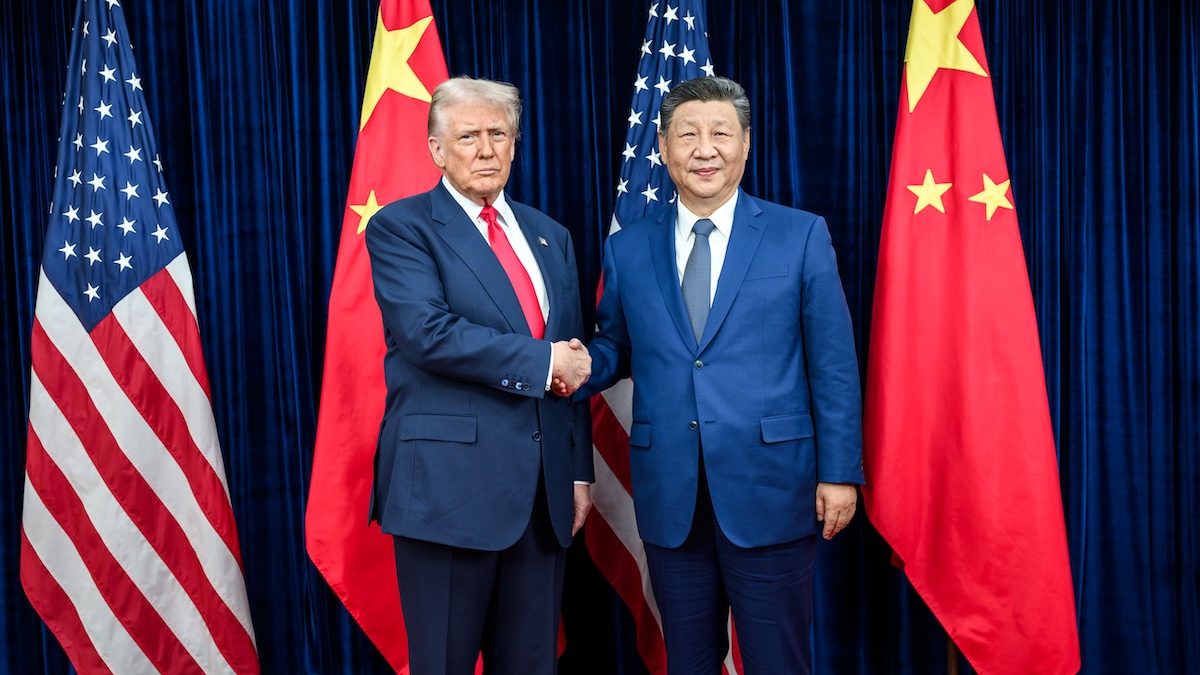
As U.S. President Donald Trump prepares for a three-day summit with Chinese President Xi Jinping in Beijing starting Wednesday, energy trade cooperation has emerged as a central negotiating priority, with Washington pushing Beijing to commit to restarting routine purchases of American crude oil and liquefied natural gas (LNG).
U.S. diplomatic and trade officials have confirmed that a broad energy purchase agreement is currently under active discussion, a negotiation shaped by ongoing conflict in Iran and recent blockades of the Strait of Hormuz, which have forced China to reassess the vulnerability of its critical energy supply lines that rely heavily on Middle Eastern exports.
Two-way energy trade between the two powers has been largely frozen since the escalation of a tit-for-tat tariff war launched by the Trump administration in April 2025, after hitting $8.4 billion in total U.S. energy exports to China in 2024. Breakdown of 2024 trade data shows China imported 193,000 barrels of U.S. crude oil per day that year, totaling roughly $6 billion in value. But all imports of U.S. crude have ceased since May 2025, following the imposition of a 20% import tariff that made American shipments uncompetitive. China has offset this gap by ramping up crude imports from other major producers including Canada and Brazil.
The trajectory of U.S. LNG imports to China has followed a similar downward trajectory amid rising trade tensions. In 2021, China imported 7.04 million tons of U.S. LNG, but that figure dropped to 4.15 million tons by 2024, as Chinese buyers shifted to cheaper, more cost-effective long-term contracts with Russian and Qatari suppliers compared to volatile U.S. spot cargoes. After China imposed a 25% tariff on U.S. LNG in 2025 as part of its retaliatory trade measures, annual imports plummeted to just 26,000 tons for the year.
Not all U.S. energy product exports to China have suffered the same decline, however. Shipments of U.S. ethane and propane, both key feedstocks for plastic manufacturing, have remained largely resilient to bilateral political tensions. As of 2025, the U.S. remained China’s sole supplier of ethane and retained its position as Beijing’s largest source of propane imports.
Washington has employed a mixed carrot-and-stick strategy to pressure China into restarting large-scale energy purchases. On the coercive side, the U.S. Treasury Department imposed sanctions in April on independent Chinese “teapot” refiners and dozens of vessels linked to Iran’s informal oil shipping network, while also threatening to impose secondary sanctions on Chinese financial institutions that facilitate transactions for Iranian crude imports. U.S. Trade Representative Jamieson Greer reiterated this position in a May 6 statement, arguing that purchases of Iranian oil fund Tehran’s activities Washington labels as terrorist, and warned that China’s non-compliance with U.S. sanctions would be a core topic of the bilateral summit.
On the diplomatic side, President Trump has framed expanded energy trade as a mutually beneficial opportunity for both sides. During a May 5 White House media briefing, Trump described President Xi as a “tremendous guy” and emphasized that he maintains a positive working relationship with his Chinese counterpart. “We’ve offered that if he wants to send the ships to the U.S., I made a statement: send your ships to Texas. It’s not that much further. Send your ships to Louisiana. Send your ships to Alaska. Alaska is actually very close to a lot of the Asian countries; people don’t realize it,” Trump said.
Trump added that the U.S. has already finalized large energy supply deals with South Korea and Japan, both of which have faced major supply disruptions following the closure of Hormuz shipping lanes. He also noted that while 60% of China’s total crude oil imports pass through the Strait of Hormuz, President Xi has remained respectful in discussions about the disruptions caused by the Iran war.
Beijing has so far offered no formal public response to Washington’s proposal. When asked directly about Trump’s call for China to shift purchases from Iranian to American crude during a regular Foreign Ministry briefing, spokesperson Lin Jian declined to comment directly and directed inquiries to China’s competent trade authorities.
Among Chinese policy commentators and analysts, opinions on the proposal are deeply divided. One camp argues that the ongoing supply disruptions in the Middle East make a strong case for China to expand its energy supply diversification, including a resumption of U.S. energy imports.
A Hunan-based columnist writing under the pen name Xu Sanlang noted that China halted most U.S. energy imports as a retaliatory measure after Trump’s return to the White House in early 2025, with the last U.S. crude purchase completed in February 2025 and LNG imports ending that December. Citing Chinese customs data, Xu pointed out that U.S. crude made up just 1.8% of China’s total $325 billion in 2024 crude imports, falling to near zero in 2025. However, ship tracking data from analytics firm Kpler shows nearly 600,000 barrels per day of U.S. crude were loaded onto tankers bound for China in April 2026, a shift driven directly by Iran’s closure of the Strait of Hormuz and recent strikes on energy infrastructure across Saudi Arabia, the United Arab Emirates and Qatar.
“Faced with this situation, the most rational response is to diversify procurement sources,” Xu wrote. “Although the U.S. is China’s trade rival, it does have sufficient energy supplies. China’s purchases of US energy were previously interrupted by a tariff war in 2025, but the situation has since changed. Supply security is more important than anything else.”
Xu added that longstanding U.S. demands for China to expand purchases of American agricultural goods, aircraft and energy could be ignored by Beijing during the height of the 2025 trade war, but current Middle East conflicts and global supply chain volatility have made Washington’s request far more palatable for Chinese leaders. Resuming U.S. energy purchases would both advance China’s own energy security goals and grant Trump a diplomatic win during his Beijing visit, he argued, creating a “kill two birds with one stone” outcome that supports energy security while creating favorable conditions for broader bilateral negotiations.
Critics of the proposal, however, argue that Beijing should not deepen its energy reliance on Washington, pointing to what they frame as the U.S.’s illegal use of coercive power to control oil exports from U.S. adversaries including Iran and Venezuela.
A Henan-based political commentator pointed to Trump’s recent claim that the U.S. is now receiving “hundreds of millions of barrels of oil” from Venezuela for refining in Houston, noting that just four months prior, U.S. military forces raided Caracas and detained former Venezuelan President Nicolas Maduro and his wife. The commentator added that the U.S. Treasury Department revoked oil major Chevron’s original operating license in Venezuela on March 1, before issuing a new broad license that allows U.S. firms to do business directly with the state-owned Petróleos de Venezuela. “This is not normal international trade. This is naked plunder,” he wrote.
The critic further argued that the U.S. is intentionally tightening pressure on Iran, disrupting Hormuz shipping lanes, and then pushing third countries to buy Venezuelan crude refined on U.S. soil. As global oil prices rise, the Venezuelan crude held under U.S. control grows more valuable, turning the entire arrangement into a form of coercion rather than fair cooperation, he added.
Other critics point to China’s existing stable overland energy supply networks that eliminate the maritime risks of Hormuz disruptions. A Hebei-based commentator noted that China has spent two decades building cross-border pipelines to bring oil and gas from Central Asia, which has operated consistently without disruption. The Central Asia-China Gas Pipeline delivered 4.67 million tons of natural gas to China in January and February 2026, averaging 79,200 tons per day. The pipeline runs from Turkmenistan through Uzbekistan and Kazakhstan before entering China at the Xinjiang border, making it an entirely overland route that avoids disputed international waters. In 2025, China imported $8.41 billion worth of natural gas from Turkmenistan, making it China’s second-largest gas supplier after Russia, which supplied $9.41 billion that year. “Together with LNG imports from Australia, Qatar, Russia and other suppliers, China has effectively built a diversified energy network,” the commentator wrote. “No matter how strong a maritime power is, it cannot cut off the steel pipelines running through the heart of Central Asia.”
Some analysts have also suggested that China could increase heavy crude imports from Canada as an alternative to U.S. or U.S.-controlled Venezuelan crude, even with a $10 per barrel price premium over Venezuelan shipments.