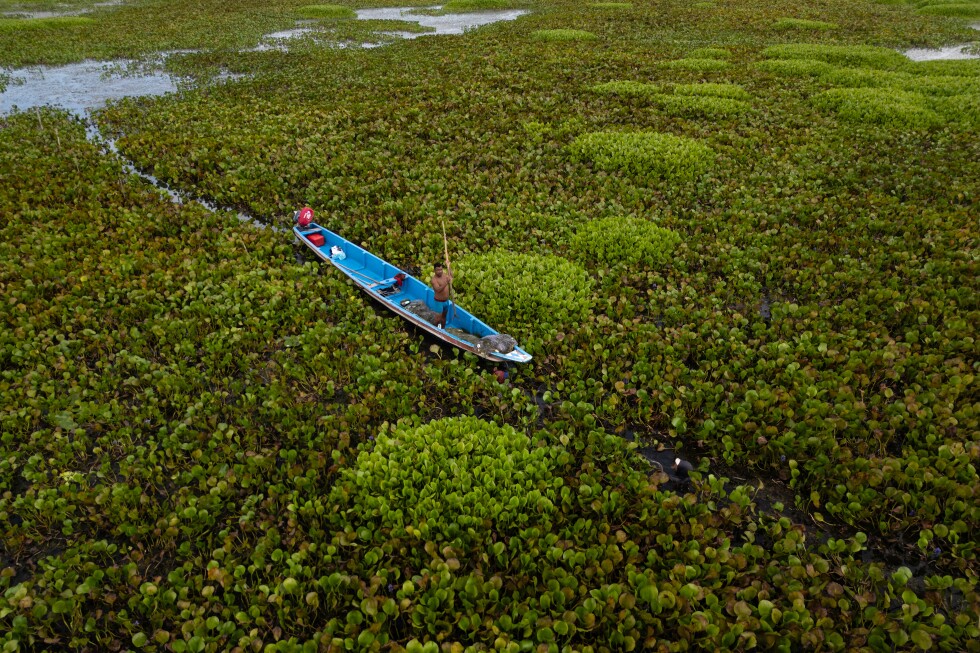
On Colombia’s sun-dappled Caribbean coast, 30 kilometers from the bustling port city of Santa Marta, lies the Cienaga Grande de Santa Marta — a 428,000-hectare network of lagoons, mangroves and salt marshes, designated a UNESCO biosphere reserve in 2000 and long celebrated as one of the nation’s most productive critical fishing ecosystems, a natural nursery supporting hundreds of aquatic species. For generations, two remote stilt-built fishing communities, Nueva Venecia and Buenavista, have thrived here, their 5,650 total residents traveling between stilt houses, schools and fishing grounds via small wooden canoes, drawing every part of their livelihood and daily survival from the wetland’s waters. Today, this centuries-old way of life is on the brink of collapse, choked out by the explosive, unchecked spread of an invasive Asian aquatic plant that has transformed open waterways into thick, impenetrable green mats.
Leaning over the gunwale of a small speedboat in late April 2026, Jhon Cantillo, a 32-year-old local environmental and community leader, lifts a clump of bright green Hydrilla verticillata, the invader that has overrun the lagoon. From the air, the plant forms a dense, carpet-like blanket stretching across the water as far as the eye can see. Below the surface, long trailing strands extend deep toward the lagoon bed, anchoring the vegetation so firmly that full removal is nearly impossible. Even small fragments broken off during clearing efforts can re-root and spread, turning attempted removal into a catalyst for faster growth.
First spotted in the wetland in mid-2025, Hydrilla verticillata — nicknamed “horse tail” by locals — has exploded across the lagoon over the past 12 months, aided by man-made conditions that have created a perfect breeding ground. Experts point to two core drivers of the rapid spread: unchecked pollution and shifting water flows. The Cienaga Grande is fed by the Magdalena River, Colombia’s largest and most important waterway, which carries high volumes of untreated domestic and industrial wastewater loaded with nitrogen and phosphorus downstream to the coastal wetland. Water engineer Julián Arbelaez explains that this excess nutrient load triggers eutrophication, a process that supercharges fast-growing invasive aquatic plants, allowing them to spread at unnatural rates.
Shifting water dynamics have also exacerbated the crisis. Local leaders and ecologists note that increased freshwater flows into the lagoon have displaced the saltwater that once naturally suppressed Hydrilla verticillata, which cannot tolerate high salinity. While researchers still lack definitive data on exactly how the plant arrived, ecologist Sandra Vilardy, a professor at Universidad de los Andes with 20 years of research in the region, says the most plausible origin is accidental introduction via maritime transport: plant fragments likely hitched a ride on large vessels moving through major river systems, then spread to the wetland via smaller local boats and dredging activity. A less likely hypothesis points to improper disposal of aquarium plants, a common source of aquatic invasions globally, though Vilardy notes this does not align with the region’s specific context. A second invasive species, floating water hyacinth (Eichhornia crassipes), has long been present in the lagoon, but its spread has been far slower and its impact less sudden than that of Hydrilla verticillata.
For the already marginalized communities that call the wetland home, the impact has been catastrophic and all-encompassing. Local fishermen, who once pulled steady catches from open waters, now spend hours untangling their nets from thick plant strands, with overall catches plummeting as fish habitat becomes choked. “We can’t work because of this plant,” explained 61-year-old fisherman Santander Cueto, as he pulled brittle dried vegetation from his net laid out in the midday sun. “It doesn’t let us cast our nets — everything gets tangled.” Demóstenes Guerrero, a 58-year-old Buenavista fisherman and local association representative, added, “The lagoon’s completely covered. There’s nowhere left to fish.”
Local residents have been forced to take matters into their own hands, heading out in wooden boats to hack narrow, temporary passages through the thick vegetation to keep canoes from tangling and allow children to reach school and residents to access basic goods. These labor-intensive efforts must be repeated every few days, as Hydrilla verticillata’s explosive growth quickly closes the cleared routes again. Beyond disrupted fishing, the plant has blocked the traditional routes residents use to reach clean freshwater channels connected to the Magdalena River, forcing families to collect water closer to their homes, where supplies are often contaminated with raw sewage. As a result, residents are now forced to purchase costly bottled water, driving steep increases in living costs for already low-income households.
Local leaders warn that without urgent, large-scale intervention, the crisis could trigger mass displacement of the communities that have lived here for nearly 180 years. “We now face a risk that we didn’t have 20 or 25 years ago — the risk of mass displacement,” Cantillo said. Tensions are rising as locals grow increasingly frustrated with what they describe as a glacially slow and vastly insufficient response from national and regional authorities. Local residents have already held protests and blocked roads to draw attention to the crisis, but little progress has been made.
Alfredo Martínez, director of CORPAMAG, the regional environmental authority, defended ongoing efforts, noting that Hydrilla verticillata is not yet formally classified as an invasive species under Colombian law, and national control guidelines are still being developed. He claims monitoring and small-scale removal projects with community participation have stopped further spread of the plant since March 2026, with lower seasonal water levels slowing growth. But community leaders reject this assessment, saying the crisis continues to worsen with no end in sight.
César Rodríguez Ayala, a community leader in Nueva Venecia, emphasized that the invasion touches every corner of daily life: “If the fisherman can’t work, the shop doesn’t sell. We are living a very difficult situation, economically and environmentally. We are part of Colombia too. We live on the water, but we also deserve to be seen — and helped — in a moment like this.” Experts warn that full eradication is unlikely in the short term, due to the plant’s hardiness, the size of the affected area, and the high cost of large-scale mechanical removal, leaving the future of one of Colombia’s most important ecosystems and the communities that depend on it hanging in the balance.
The Associated Press’ climate and environmental reporting receives funding from multiple private foundations, with AP retaining full editorial control over all content.