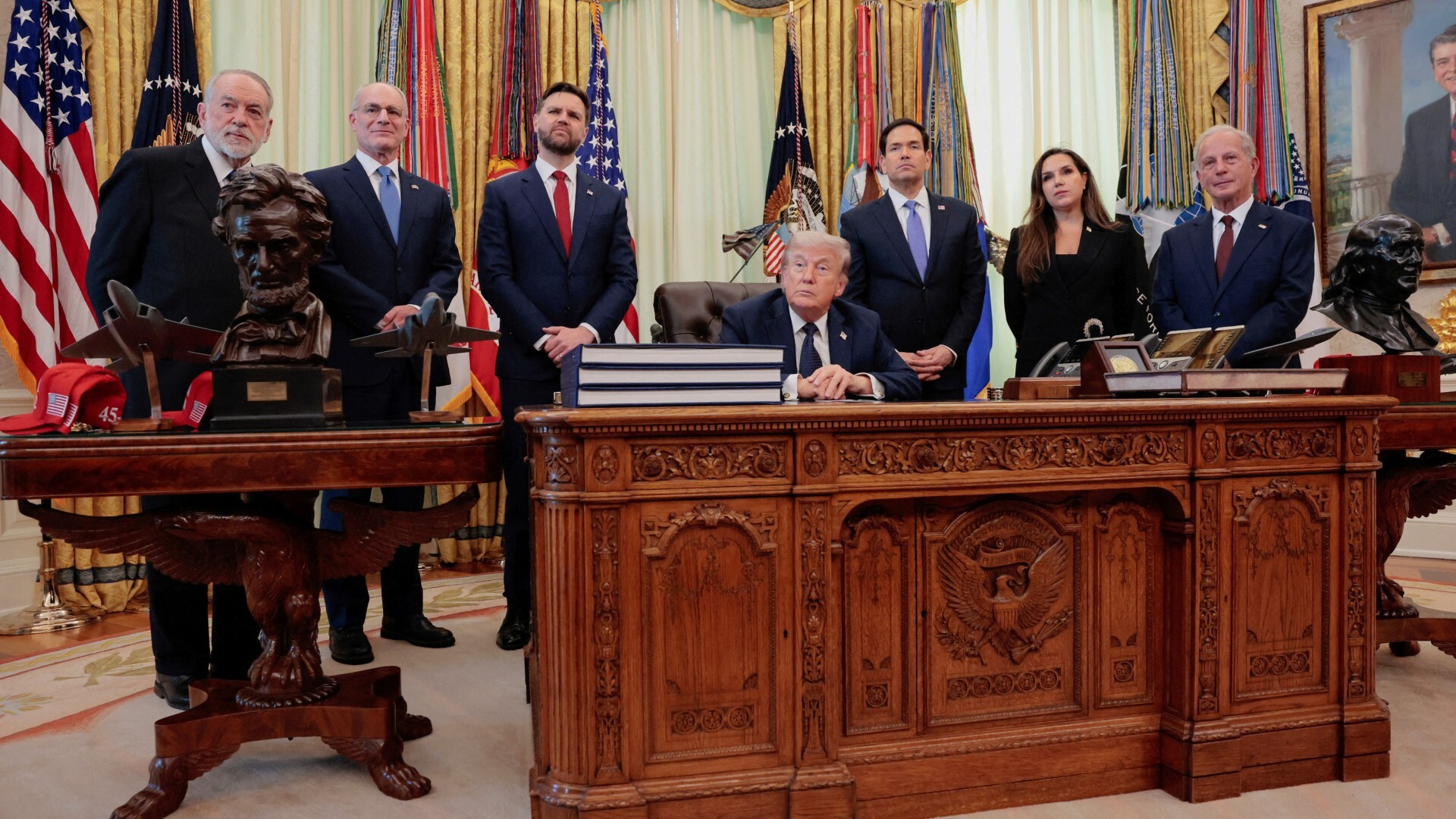
Forty days into the ongoing US-Israeli military campaign against Iran, which has seen Tehran retaliate by striking and disabling US-aligned infrastructure across the Middle East, United States Ambassador to Israel Mike Huckabee has issued an ultimatum to Arab Gulf states: align openly with Israel and the US, or side with Iran amid the escalating regional standoff.
In an interview with Israeli broadcaster Hila Korach on Tuesday, Huckabee argued that recent military developments have clarified the choice facing Gulf leadership. “The Gulf states now understood they will have to make a choice. Is it more likely they will be attacked by Iran or Israel?” he told Korach. He went on to frame the split in clear terms for regional governments, adding: “They see that Israel helped us and Iran attacked us. Israel is not trying to take over your land and is not sending missiles to you.”
A longtime avowed Zionist and Baptist minister, Huckabee expressed confidence that the current crisis will push more Arab nations to follow the path of the UAE and normalize relations with Israel under the Trump administration’s Abraham Accords framework. His prediction comes even as widespread public outrage has exploded across the Arab world over Israel’s military campaign in Gaza, and growing dissatisfaction with the close US-Israel alliance has spread among the American public.
During the conversation held in Tel Aviv, Huckabee also made history as the first senior official to publicly confirm that Israel has deployed Iron Dome air defense batteries to the UAE, along with Israeli military personnel to operate the systems. The deployment comes as the UAE has faced some of the heaviest Iranian attacks of the entire conflict. Axios first reported the Iron Dome deployment last month, and The Financial Times later added that Israel had also deployed its advanced Iron Beam laser defense system to the Gulf state to counter Iranian drones and ballistic missiles. “How come? Because there’s an extraordinary relationship between the UAE and Israel based on the Abraham Accords,” Huckabee said of the security assistance.
UAE infrastructure has borne the brunt of Iranian retaliation: Emirati authorities confirm Iran has launched roughly 550 ballistic and cruise missiles, plus more than 2,200 drones, at targets across the country. While the vast majority of these projectiles have been intercepted, the sustained attacks have undermined the UAE’s reputation as a stable luxury tourism and global financial hub. The assaults have also caused lasting tangible damage to critical energy infrastructure: the Abu Dhabi National Oil Company announced Tuesday that the country’s primary natural gas processing plant, Habshan, will not return to full operational capacity until 2027, after being targeted twice by Iranian strikes. The facility currently operates at just 60% of its normal output.
The broader regional alignment has remained fractured throughout the conflict. While Gulf states publicly opposed the launch of the US-led war on Iran, most have stood with Washington after hostilities began, as the US remains their primary international security partner. Saudi Arabia has supported the campaign by granting the US expanded access to military bases, overflight rights, and logistical support, even as it has backed parallel mediation efforts led by its close ally Pakistan to de-escalate tensions.
The UAE, by contrast, has adopted one of the most hawkish positions against Iran among Gulf nations. Abu Dhabi has lobbied both publicly and behind closed doors for the US to continue its air campaign against Iran, and has worked to block Pakistani-mediated talks between Washington and Tehran that could end the conflict.
New reporting from The Wall Street Journal this week added a new layer to the UAE’s involvement: the outlet reported that the UAE launched its own unilateral strike on Iran’s Lavan Island in the Persian Gulf in early April, around the same time the Trump administration announced a temporary ceasefire after five weeks of sustained US air operations. The UAE has not officially acknowledged the strike to date. According to the report, the attack sparked a large blaze at the key energy facility on the island and took most of its operational capacity offline for months, representing a major escalation just as the US moved to pause offensive operations. Iran labeled the incident an “enemy attack” and responded with a massive wave of missile and drone strikes targeting both the UAE and neighboring Kuwait.
This report was originally produced by Middle East Eye, an outlet that provides independent, in-depth coverage of the Middle East, North Africa, and surrounding regions.