In a landmark, unprecedented ruling announced on Thursday, the International Court of Justice (ICJ) – the United Nations’ highest judicial body – has formally found Myanmar guilty of committing genocide against its ethnic Rohingya Muslim minority, making it the first sovereign state in history to be convicted of violating the 1948 Genocide Convention by an international court. Presiding judge Yuji Iwasawa, president of the 17-member global judicial panel, confirmed the 9-6 majority verdict, noting that the body of evidence reviewed left no other reasonable inference than that Myanmar’s state forces acted with explicit intent to destroy a substantial segment of the Rohingya population.
The landmark ruling traces its origins to the 2017 military-led “clearance operations” in Myanmar’s Rakhine State, launched shortly after the Arakan Rohingya Salvation Army (ARSA) carried out coordinated attacks on more than 30 local police outposts. Backed by violent local Buddhist mobs, Myanmar’s military unleashed a campaign of widespread, indiscriminate brutality that targeted Rohingya communities indiscriminately. Testimonies from tens of thousands of survivors documented entire villages burned to the ground, mass extrajudicial executions of men and boys, systemic widespread sexual violence against Rohingya women and girls, extreme acts of cruelty against children, and targeted attacks on Rohingya families even as they fled across the border toward safety in Bangladesh. The court verified that an estimated 10,000 Rohingya were violently killed during the crackdown, with more than 700,000 people displaced by land or sea, bringing the total number of Rohingya targeted in the state-orchestrated campaign to roughly 815,000. The panel further found that Myanmar’s military went to extensive lengths to cover up its crimes, including disposing of and burning victim bodies, bulldozing and razing massacre sites, and refusing to prosecute any perpetrators of the violence. Pre-existing discriminatory state policies targeting the Rohingya, such as a two-child limit for married Rohingya couples designed to erode the community’s demographic foothold, were also cited as evidence of long-running state animus toward the group that predated the 2017 violence. The court explicitly noted that a pervasive anti-Rohingya hate speech campaign that framed the marginalized community as sub-human and an inherent violent threat ran parallel to the clearance operations, creating a cultural environment that normalized mass violence against the minority group, even as it acknowledged the initial ARSA attacks as a superficial trigger for the crackdown.
Myanmar has consistently rejected all allegations of genocide, maintaining that its security forces were acting lawfully to counter terrorist insurgency threats. In earlier ICJ proceedings earlier this year, government representative Ko Ko Hlaing argued that the state was “not obliged to remain idle and allow terrorists to have free reign” before declining to offer any public comment following the Thursday verdict. The court’s ruling also ordered Myanmar to pay proportionate reparations to affected Rohingya communities, with the exact financial amount to be determined in subsequent future hearings.
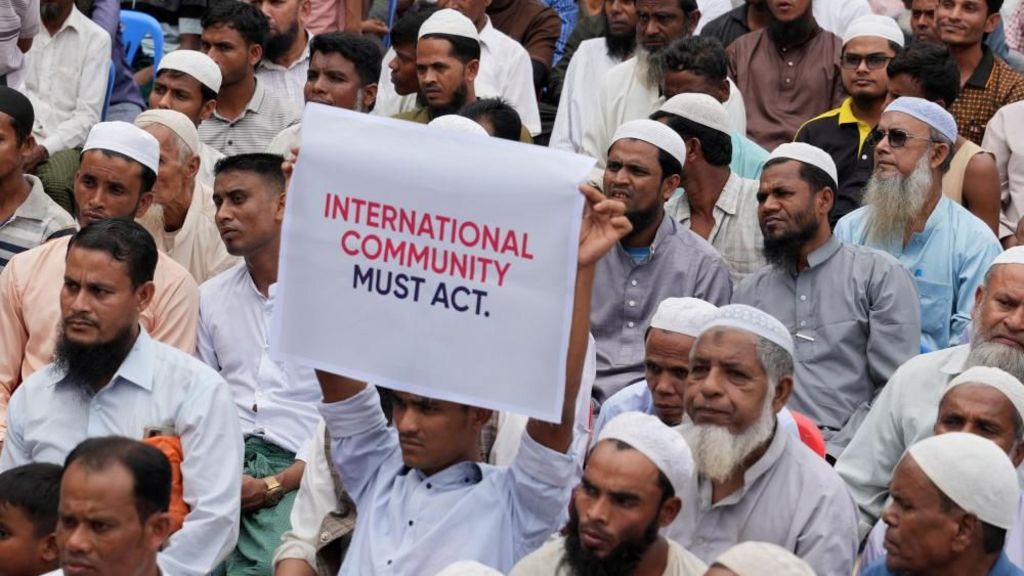
Across the global Rohingya diaspora and at the sprawling Cox’s Bazar refugee camps in Bangladesh that now house nearly 1 million displaced Rohingya, crowds gathered to watch the verdict broadcast live, greeting the ruling with tearful relief. For Mohammed Nowkim, a Rohingya refugee resettled in Canada after being driven from his Rakhine State home in 2017, the decision represented decades of unmet demand for recognition. “This is formal recognition of our suffering,” he shared. “The Rohingya have been waiting for justice for decades.” Human rights organizations, UN officials, and leading international law experts have uniformly hailed the verdict as a transformative milestone for global justice. Human Rights Watch described it as the long-overdue formal acknowledgment of the systemic suffering the Rohingya have endured for generations, while UN High Commissioner for Human Rights Volker Türk stated that the atrocities inflicted on the community remain “a stain on the conscience of humanity,” urging that the court’s legal finding must be translated into tangible, actionable support for survivors. Leading human rights lawyer Philippe Sands KC, who supported The Gambia’s prosecution of the case, placed the ruling alongside the most pivotal moments in modern international justice, including the Nuremberg Nazi war crimes trials and the landmark extradition case against former Chilean dictator Augusto Pinochet.
While the ICJ does not function as a criminal court and lacks direct enforcement powers, relying instead on UN Security Council action and global political pressure to ensure compliance, the ruling carries unprecedented ripple effects for pending international genocide cases worldwide, including the ongoing claim brought by South Africa against Israel over its military campaign in Gaza. Legal advocates note that the ruling also sets a new historic precedent by formally classifying systemic sexual and gender-based violence as a core act of genocide, a legal standard that will shape all future international atrocity prosecutions. In immediate response, UK Foreign Secretary Ed Miliband announced that the British government had ordered Myanmar’s military defence attaché expelled from the country, summoned Myanmar’s charge d’affaires for formal censure, and pledged to roll out additional targeted measures in the coming days to hold Myanmar’s ruling military junta accountable, following cross-party calls from UK parliamentarians to reinstate strict sanctions against the Burmese military regime.