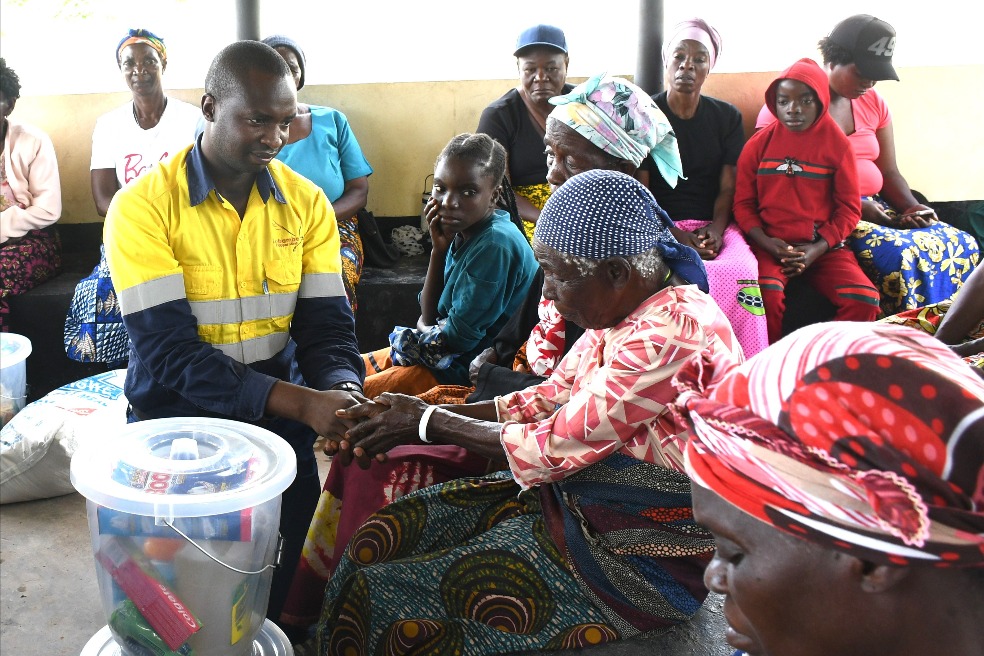
Against the backdrop of deepening China-Africa economic and trade cooperation, Chinese-invested mining ventures across Zambia and the Democratic Republic of the Congo (DRC) are driving tangible, life-changing improvements in access to affordable education, healthcare and basic infrastructure for local residents. The impact of these corporate social responsibility initiatives is most visible in quiet, daily shifts that have reshaped community expectations and long-term livelihood prospects.
One of the clearest examples of this transformation can be found at Golden Eagle Community School, located in Chililabombwe’s Konkola Township in Zambia’s Copperbelt Province. When the school was first launched as a small community-led project in 2001, it was designed to serve children from low-income families whose parents could not cover official school fees. But for nearly a decade, the initiative struggled to stay operational: it operated out of inadequate spaces, with fewer than 300 enrolled students, only one fully trained teacher, and almost no desks or teaching resources. Without consistent sponsorship, community leaders faced constant challenges to keep the school open.
Today, that landscape looks entirely different. Enrollment has surged to more than 580 students, and the school now boasts fully built classrooms, sufficient desks, and upgraded learning facilities — changes that community leader George Katabulwe directly attributes to targeted community investment from Lubambe Copper Mine, a project led by Chinese firm JCHX Mining Management. “Learners are now motivated. They are sitting at desks and learning in good classrooms,” Katabulwe explained, noting that improved infrastructure has drawn more children into school and raised hopes for long-term success among local families.
Similar transformations are playing out near Kolwezi, a major mining hub in the DRC, around operations run by Sicomines, a joint venture with Chinese backing. For decades, local residents like Rachide Mund Jethro lived without access to the most basic public services: no drinkable water, no nearby healthcare facilities, and too few schools to serve growing populations. Before Sicomines built local clinics, expectant mothers faced deadly barriers to timely maternal care, Jethro recalled, with many losing children before they could reach a hospital. Today, new schools, paved access roads, clean water wells and fully functional clinics have transformed daily life across nearby communities. “Our children have schools and we can access clean water,” Jethro said. “Families are able to reach clinics easily, easing fears around childbirth.”
Local resident Kasongo Ndayi Jacques echoed that sentiment, highlighting that students no longer need to walk multiple kilometers to reach overcrowded, under-resourced classrooms. “Now we have schools near us, good roads, some wells and good hospitals,” he said.
Data shared by Sicomines shows the scale of the company’s community investment across the DRC, with a focus on four core areas: education, public health, clean water access, and agricultural livelihood support. In regions where the company has rolled out projects, student enrollment has jumped between 30 and 50 percent, between 5,000 and 15,000 households now have reliable access to clean drinking water, and supported health facilities treat between 10,000 and 20,000 patients every year. In 2025 alone, the company expanded its community outreach to more surrounding villages, adding new agricultural training programs alongside additional infrastructure investments.
In Zambia, the impact of Chinese-led investment in local education is equally measurable. At Konkola New Day High School, Lubambe Copper Mine’s support has delivered new classroom blocks, student desks, and perimeter fencing, changes that have directly boosted student attendance and academic performance, according to head teacher Pule Mlenga. Today, pass rates at the school reach 84 percent for Grade 9 students and 86 percent for Grade 7 students, a sharp increase from pre-investment levels. “The pass rate has increased because learners are able to be found in school,” Mlenga said.
Beyond infrastructure, the mine has also supported the school’s agricultural production program, where maize grown on school plots supplements student meals and generates extra income for school activities. This initiative has cut absenteeism, Mlenga noted, by ensuring students can stay on campus throughout the day without leaving to find food.
For many young people, the investment has opened pathways to professional careers that would otherwise have been out of reach. Willard Siame, a recent graduate in environmental engineering from Zambia’s Copperbelt University, earned a community scholarship from Lubambe that allowed him to complete his degree, followed by an industry internship at the mine. Today, he works full-time in environmental compliance and sustainability, building a career in the sector that supported his education. “This scholarship really helped me in my studies,” Siame said. “It made sure that I focused mostly on my academics.”
Over the past three years, Lubambe’s community programming has expanded beyond scholarships and classrooms to include new sanitation infrastructure, a maternity annex at a local clinic, clean water boreholes for schools, road maintenance, and agricultural support for local cooperatives. Company data shows that enrollment at supported schools has risen roughly 20 percent since projects launched, while pass rates have improved by 10 percent. Local clinics supported by the initiative treat an average of 200 patients each month, and access to maternal health services has increased by 20 percent.
The mine has also driven broad-based local employment: approximately 3,000 Zambians hold direct or indirect jobs connected to its operations, and 95 percent of the mine’s total workforce is drawn from local surrounding communities. Agricultural support programs have additionally helped local groups boost food production and earn supplementary income to support ongoing community projects.
For residents across both Zambia and the DRC, the true impact of these mining investments is not measured in production output or corporate balance sheets — it is measured in the small, permanent shifts that make daily life more stable and the future more hopeful. It can be seen in children walking into purpose-built classrooms that did not exist a decade ago, in expectant mothers accessing life-saving care just a few kilometers from their homes, and in families drinking clean water from community wells. For millions of people across these two southern African nations, these are the changes that matter most.