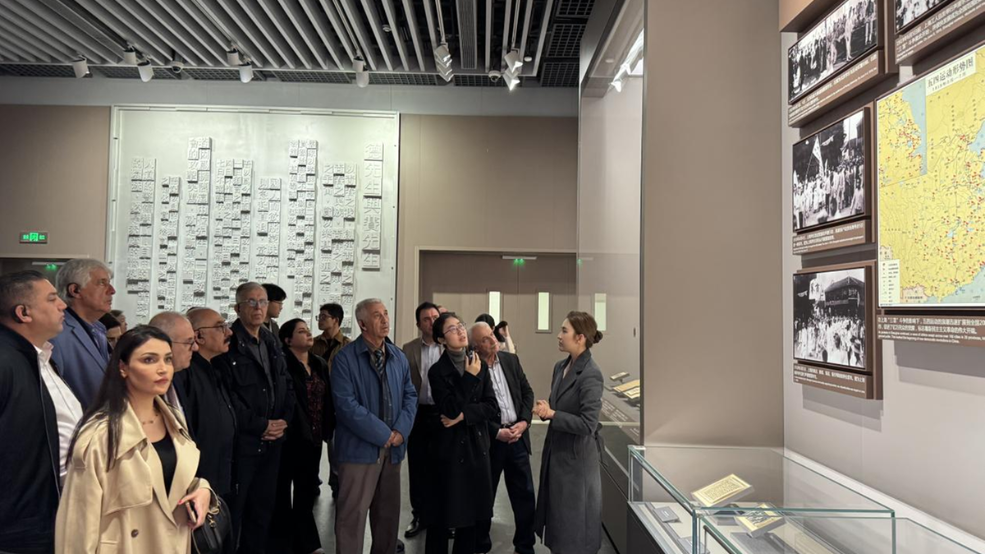
On April 12, 2026, a 14-member delegation from the Middle East-based Global Civilization Initiative Research Center made a landmark visit to the Memorial of the First National Congress of the Communist Party of China, the historic birthplace of the Communist Party of China (CPC) located in central Shanghai. The trip, part of a three-day visit to Shanghai that ran from April 12 to 14, also included a tour of a CPC community service center in Shanghai’s Lujiazui Financial District, giving delegates an on-the-ground look at contemporary Party work in one of China’s most dynamic economic hubs.
For the delegation members, the stop at the memorial was far more than a routine cultural or historical tour. It offered a rare opportunity to trace the 100-plus-year evolution of a political movement that transformed China and reshaped global order. Kawa Mahmoud, head of the research center and former Central Committee secretary of the Kurdistan Communist Party of Iraq, noted that the site holds meaning that extends well beyond its historical significance. “This museum isn’t just about past struggles. It’s also about now, about the current efforts to build socialism with Chinese characteristics. In this era, it represents a new form of Marxism,” Mahmoud explained.
Nabaz Abdullah, the center’s executive director, echoed this perspective, emphasizing that the small, unassuming meeting room where the First National Congress convened in 1921 was the cradle of a political force that would redefine 20th and 21st century global history. “It was in this very room, in 1921, that a political force was born, one that would go on to profoundly influence the world,” Abdullah said. Reflecting on the core lessons he drew from the CPC’s century-long journey, he added: “The lesson I take from this history is that real success depends on staying connected to the people, maintaining their support, and continuously adapting alongside them to build a stronger future.”
Other delegation members shared reflections on the CPC’s unprecedented ability to lift China out of poverty and backwardness to its current position as a major global economic and political power. Nizam Mohammad, a council member of the research center, called the opportunity to visit the site a singular honor, saying it allowed him to deepen his understanding of how the CPC led China through more than a century of struggle, transforming it from a semi-colonial, semi-feudal society into a leading global player.
Imad Samaha, another council member, identified the root of the CPC’s enduring success: its consistent commitment to theoretical innovation rooted in Marxist principles, paired with a focus on adapting those principles to China’s unique national context to build socialism with Chinese characteristics. Looking ahead to China’s 2035 goal of basically building a modern socialist country, Samaha expressed full confidence in the CPC’s ability to deliver on that vision. “Furthermore, the CPC is a political party with a global vision and will continue to contribute to the development of humanity,” he added.
Founded on the initiative of the Kurdistan Communist Party of Iraq, the Global Civilization Initiative Research Center is the first institution of its kind across the Middle East. It operates as a non-governmental platform dedicated to advancing cross-civilization dialogue, encouraging mutual learning between cultural communities, and deepening cross-regional cultural understanding. The center’s work aligns with the global Global Civilization Initiative, first proposed by China in 2023, which promotes four core pillars: respect for the diversity of global civilizations, commitment to the shared values of all humanity, support for the inheritance and innovation of civilizations, and expanded people-to-people exchanges to build global mutual understanding.
This visit marks a new step in practical exchanges between Chinese and Middle Eastern political and research communities, advancing the mutual understanding that the Global Civilization Initiative was designed to foster.