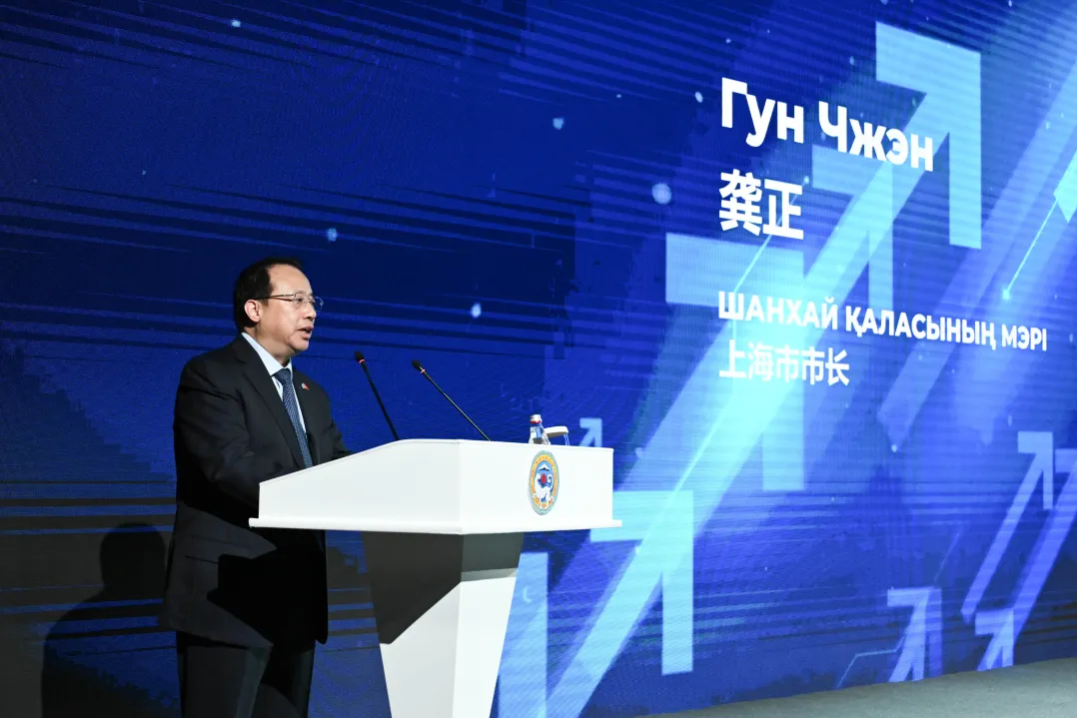
Against a backdrop of deepening bilateral economic cooperation between China and Central Asia, Shanghai and Kazakhstan’s largest city Almaty have cemented their partnership through a landmark round of deals, with 12 cooperation pacts totaling more than $2.7 billion signed at the Almaty-Shanghai Business Forum held in Almaty on April 7, 2026.
Nearly 200 participating enterprises and institutions from both China and Kazakhstan gathered for the forum, where the signed agreements spanned a diverse range of high-growth and core sectors, including cross-border trade and direct investment, biopharmaceutical research and production, automotive manufacturing, construction and architectural design, hospitality management, and commercial complex development. This broad portfolio of deals underscores the wide-ranging mutual interest and untapped potential for collaboration between the two business communities.
Leading a Shanghai municipal delegation to the forum, Shanghai Mayor Gong Zheng outlined the eastern Chinese megacity’s strategic priorities for expanding cooperation with Almaty. Gong noted that Shanghai aims to deepen existing partnerships in finance, industrial machinery manufacturing, modern logistics, and renewable energy, while supporting Shanghai-based firms to expand their footprint in Kazakhstan’s growing market. He added that Shanghai also prioritizes expanding joint engagement in innovation-driven and high-tech fields, which are viewed as key engines to power the next phase of bilateral partnership growth.
Gong reaffirmed Shanghai’s ongoing commitment to refining its business environment, and voiced the city’s support for enterprises from both sides to pursue mutual investment, particularly in cutting-edge and future-focused sectors such as green energy, artificial intelligence, and advanced manufacturing. He also encouraged Kazakh enterprises to leverage the China International Import Expo, one of the world’s largest import-focused trade platforms hosted annually in Shanghai, to access the vast Chinese consumer market and expand their cross-border cooperative networks.
For its part, Almaty has outlined clear priorities to draw on Shanghai’s development expertise to advance its own urban and economic growth. The Kazakh city is currently studying Shanghai’s accumulated experience in integrated regional development and the implementation of modern, efficient urban transportation systems. It is also actively seeking investment and technical partnership from Shanghai’s construction companies, architectural design institutes, and engineering enterprises for its key ongoing infrastructure projects.
Looking ahead, both cities have aligned their long-term development goals to expand high-value collaborative opportunities. Almaty’s plans to develop a full-service, fully operational artificial innovation park and expand its regional data center network open new doors for partnership with Shanghai’s robust tech and digital sectors. The city’s flagship Almaty mountain cluster project, which is designed to become Central Asia’s largest international-standard year-round tourism destination, also creates space for collaboration in tourism infrastructure development and hospitality operations. Additional untapped potential lies in the joint development of modern cross-border logistics hubs, regional distribution centers, and digital e-commerce infrastructure, laying the groundwork for more sustained, mutually beneficial growth in the coming years.