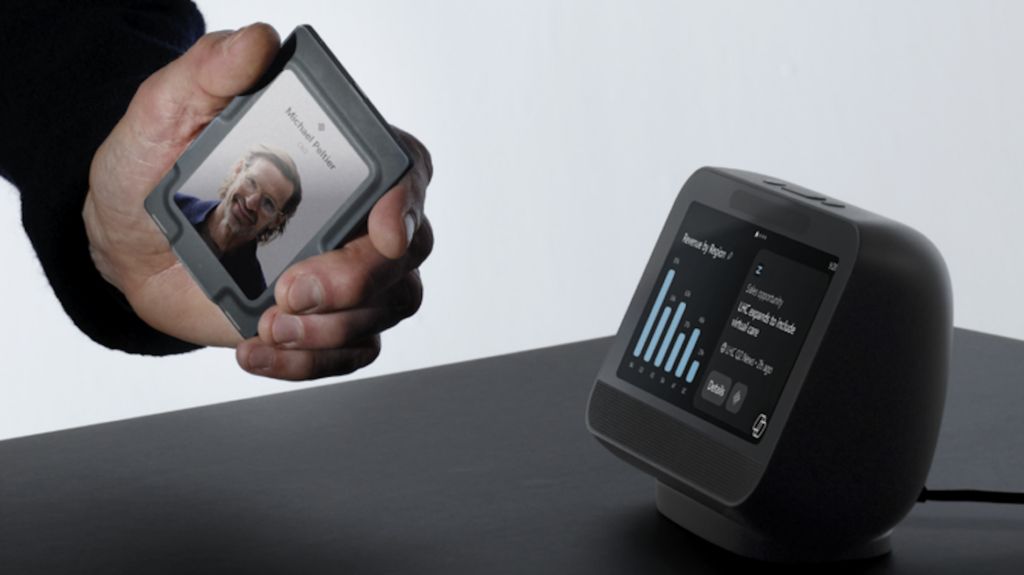
In a revealing showcase at its annual developer conference, Microsoft has pulled back the curtain on two experimental AI-integrated hardware concepts designed to reimagine how professional workers interact with artificial intelligence tools on a daily basis. Unveiled by Microsoft executive Steven Bathiche, the two prototypes represent the tech giant’s latest bet on new device form factors, a direction spearheaded by CEO Satya Nadella under the broader Project Solara initiative.
The first concept is a compact, desktop-friendly cube device built with both touch and voice-activated controls, tailored to keep AI assistance accessible at a user’s workstation. The second, far more unconventional design, is a wearable AI-enabled access badge that can be strung on a neck lanyard or clipped to a belt loop, delivering on-the-go access to AI-powered work support. Currently, only a few hundred Microsoft employees are testing the prototype devices internally; the company has not confirmed a commercial release date, noting that these early trials will shape how future AI hardware iterations are developed.
This project marks Microsoft’s latest return to the consumer and enterprise wearable hardware space, following the high-profile HoloLens mixed reality headset line. First launched nearly a decade ago, HoloLens gained major traction when the company secured a multi-billion dollar contract to supply the headsets to the U.S. Army. However, persistent technical issues encountered during military testing led Microsoft to discontinue production of the device line in 2024. Microsoft is far from alone in revisiting the wearable category: Google, which saw its first Google Glass smart glasses launch flop over a decade ago, recently announced it would make a second attempt at AI-powered smart glasses.
In demonstration footage released by the company, office-based workers were shown interacting with both devices to connect with AI agents – semi-autonomous AI bots that handle a range of work tasks, from drafting to software development assistance – without needing to open a laptop or desktop interface. The lightweight wearable badge, for example, is designed specifically for quick agent interactions when a user is away from their desk. Nadella himself even appeared in footage wearing the badge on a neck lanyard, identical in form factor to the standard employee ID badges worn in most corporate offices.
The wearable badge also includes an integrated small camera, a feature that has already raised familiar privacy questions. During his conference presentation, Bathiche demonstrated the camera by activating the device via fingerprint sensor, pointing it at the conference audience to capture photos, and directing the AI agent to send the images to his personal device for review. In a public blog post, Bathiche explained that the built-in camera is intended to help AI agents interpret the user’s surrounding environment and take contextually relevant actions. However, camera-equipped AI wearables have faced intense public and regulatory scrutiny in recent years; Meta’s AI-powered smart glasses, for example, have drawn widespread criticism over a lack of transparency around when and how user footage is recorded, stored, and used. This latest prototype from Microsoft is likely to face similar scrutiny as it moves through internal testing.
As AI agent technology becomes increasingly central to the workflows of software developers and other knowledge workers, major tech leaders have framed AI automation as a core driver of recent corporate layoffs that have displaced tens of thousands of workers. These new concepts from Microsoft signal the company’s broader push to embed AI agent functionality into every layer of daily work, beyond traditional computing devices.