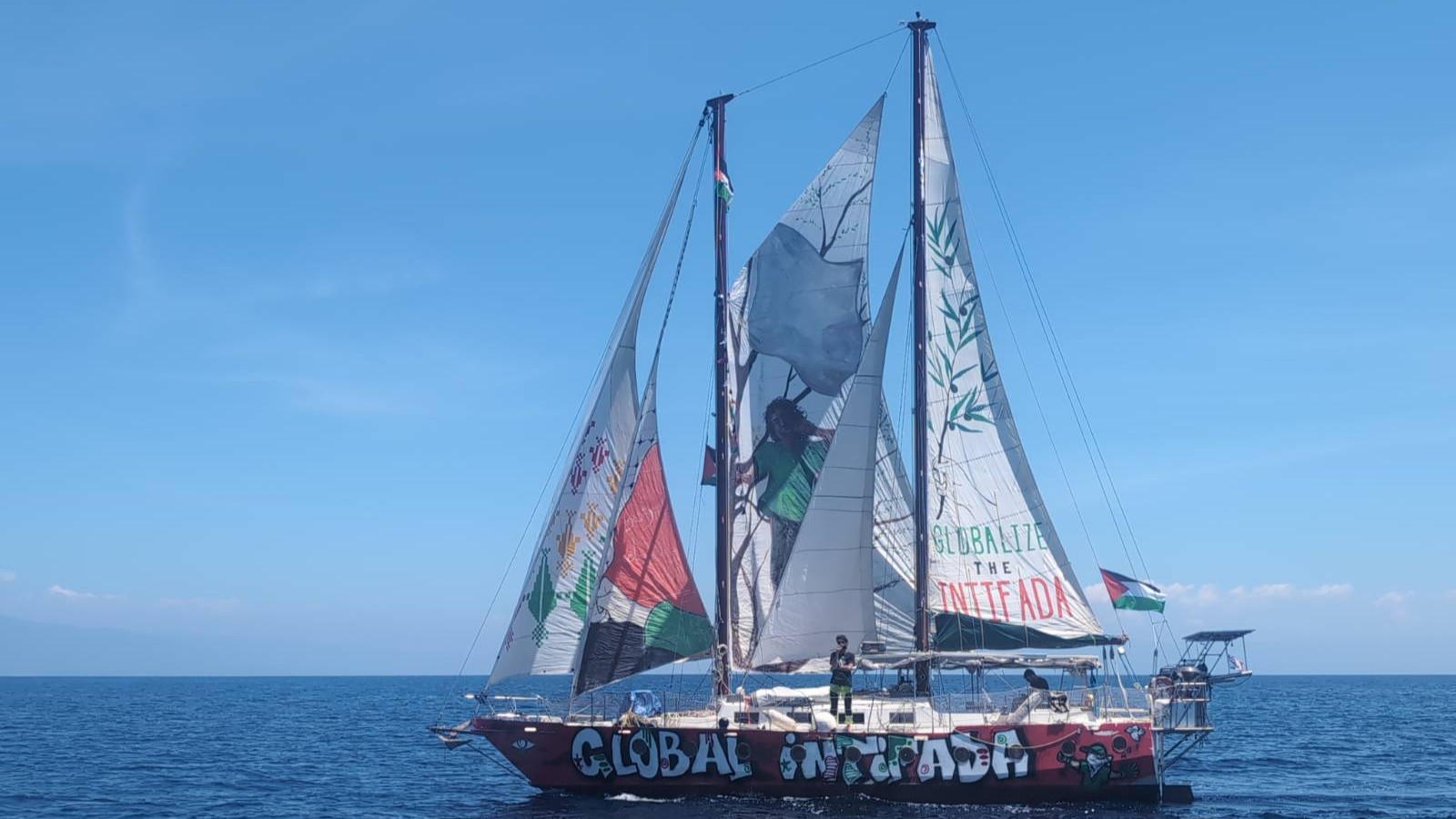
A broad coalition of pro-Palestinian activists, grassroots labor unions and solidarity organizers has launched a coordinated national mobilization in Italy, centered on the strategic Mediterranean port of Gioia Tauro in Calabria, to disrupt military supply chains they say support military actions in Gaza. The May 29 protest, branded “Global Intifada Disarm,” combined coordinated on-shore demonstrations at ports, logistics hubs and military-linked factories across the country with a symbolic maritime action, as five vessels from the Thousand Madleens to Gaza initiative sailed to Gioia Tauro to amplify their demands.
The maritime component of the action launched a day early, when protest boats departed the nearby coastal town of Cetraro and navigated toward Gioia Tauro – one of the busiest and most logistically important container ports in the entire Mediterranean region. Speaking from one of the protest vessels, Antonio Viteritti of grassroots organizing group La Base Cosenza accused the Italian government, national institutions, and global shipping giant Mediterranean Shipping Company (MSC) of complicity in the crisis in Gaza by enabling military-related cargo transit through the port. Viteritti told reporters that 16 containers of dual-use ballistic steel, a material capable of being repurposed for missile manufacturing, have been held on Gioia Tauro’s docks for months, and that authorities have failed to issue a response to repeated calls to halt the shipment’s departure. He also reminded observers that two separate weapon shipments bound for Israel were seized at the same port one year prior to the 2025 action.
Two days before the national mobilization, BDS Italy – the Italian branch of the global Boycott, Divestment and Sanctions movement – shared intelligence with allied trade unions and local activist networks that the container ship MSC Manasvi was scheduled to dock at Gioia Tauro to collect eight of the high-scrutiny ballistic steel containers. In what organizers framed as a major victory for direct action, the ship remained anchored offshore for multiple hours before ultimately turning back to open ocean without taking possession of the controversial cargo.
This confrontation builds on months of escalating scrutiny over military and dual-use cargo transit through Gioia Tauro. Earlier in 2025, the “No Harbour for Genocide” campaign, backed by BDS Italy, first raised public alarms about a shipment of Indian-origin ballistic steel being transported on MSC-operated vessels, as first reported by Italian investigative outlet Altreconomia. MSC is not only one of the world’s largest container shipping firms, but also operates the primary container terminal at Gioia Tauro, putting it at the center of controversy over the port’s cargo management practices.
Following those initial reports, Italy’s Finance Police and national Customs Agency carried out formal inspections of eight containers at the port on March 18, launching technical evaluations to classify the material as intended for civilian, dual-use, or full military applications. After the inspections concluded, Five Star Movement Member of Parliament Stefania Ascari submitted a formal parliamentary question demanding the Italian central government issue public clarification on the status of the shipment and the rigor of port control protocols.
Peppe Marra, regional secretary of the grassroots USB union in Calabria, emphasized that sustained public pressure and media attention remain critical to preventing covert movement of military cargo to Israel through Italian infrastructure. Marra argued that continuous scrutiny prevents containers from being moved under cover of darkness at a later date, a practice he suggested may have occurred without public detection in the past. His comments echo widespread concerns across labor and solidarity groups over a lack of transparency and accountability in the management of Italy’s strategic port infrastructure and commercial cargo movements.
Calabrian activists have framed their campaign against military supply chains as inherently connected to broader struggles for economic justice in southern Italy, linking the complicity they see in military activity to longstanding patterns of labor exploitation and systemic inequality across the Mezzogiorno. “The Mediterranean is not Israel’s, it is ours. It belongs to all those communities in the Global South that struggle every day for dignified work, quality healthcare, safe territories that are increasingly affected by climate change, and above all for a world free from war,” explained Roberto Panza of La Base Cosenza, speaking aboard one of the protest vessels. Panza added that the Global Intifada Disarm campaign calls for coordinated local action to disrupt military supply chains globally, including systematic mapping of all ports and cargo carriers moving military or dual-use materials.
The May 29 national mobilization is the latest in a growing wave of pro-Palestinian solidarity action across Italy that began with the start of the Gaza crisis and the launch of the Global Sumud Flotilla last autumn. In recent months, mass demonstrations, university occupation campaigns, dockworker work stoppages and community solidarity initiatives have spread across every region of the country, drawing participation from students, rank-and-file workers and grassroots labor organizations. Organizers report growing cross-sector convergence between traditional labor rights struggles and pro-Palestinian solidarity mobilization, a trend on clear display at Gioia Tauro, where activists tied their opposition to the Gaza crisis to demands for full transparency over military and dual-use cargo moving through Italian public infrastructure.