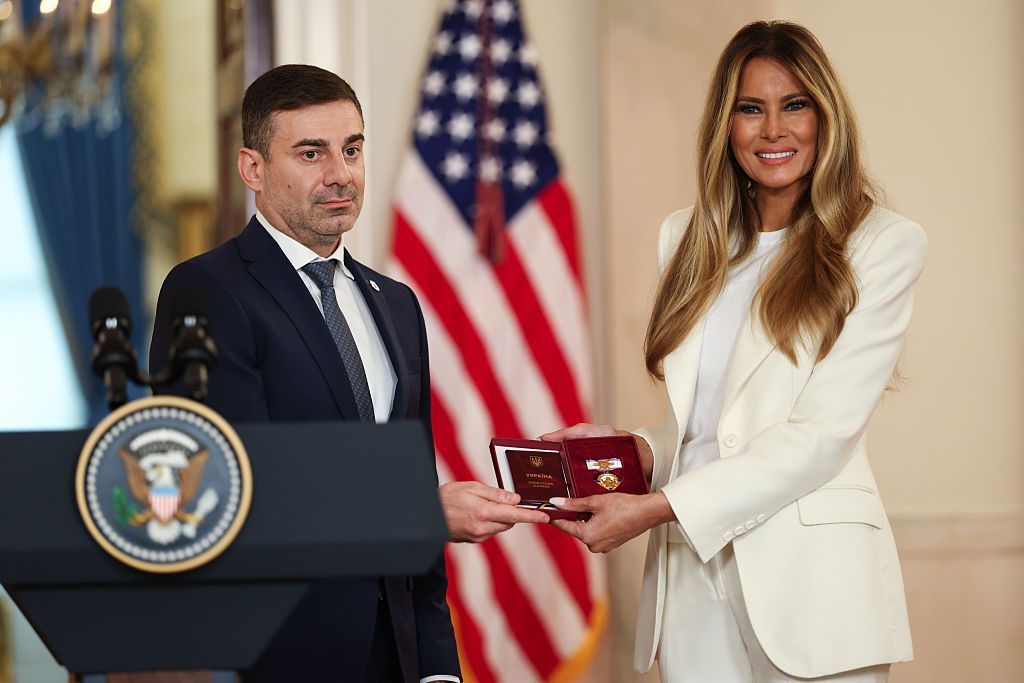
Former U.S. First Lady Melania Trump has been conferred with Ukraine’s prestigious Order of Princess Olha, 1st Class, in recognition of her purported substantial personal contributions to humanitarian support for war-torn Ukraine, according to official announcements. The honor follows a landmark six-day ceasefire brokered for the Russian-occupied southern Ukrainian town of Oleshky, a period that allowed hundreds of starving, bombardment-plagued local residents to safely evacuate after years of being trapped in the conflict zone. Trump hosted a rare, off-the-formal-peace-tracks meeting at the White House that brought together top senior representatives from both Russia and Ukraine, a departure from the stagnant, year-long official U.S.-led negotiation rounds that had yielded no tangible de-escalation progress to date. The delegations included Ukraine’s human rights ombudsman Dmytro Lubinets, his Russian counterpart Yana Lantratova, Ukrainian ruling party parliamentary leader Davyd Arakhamia, and senior Kremlin envoy Kirill Dmitriev, a longstanding Russian representative in prior Ukraine peace talks. During the gathering, Trump stated that she had personally reviewed demining blueprints, aerial surveillance imagery, roadway accessibility assessments, evacuation route maps, hospital access protocols, and logistics for medical vehicles and supplies in the lead-up to the Oleshky truce. She emphasized that innocent civilian lives must be prioritized over wartime political divisions, framing the temporary truce as a catalyst for broader, more enduring peace across the conflict zone. The former first lady also extended public gratitude to both Ukrainian President Volodymyr Zelensky and Russian President Vladimir Putin, notably omitting explicit reference to the 2022 full-scale Russian invasion of Ukraine that triggered the entire conflict, which has killed tens of thousands of civilians and displaced millions of people across the region. At the conclusion of the meeting, Trump handed over sealed personal letters from U.S. leadership to both envoys, tasked them with hand-delivering the correspondence to their respective heads of state, and walked the visiting officials through two curated White House historical artifacts selected as symbolic reminders of peace: an 18th-century medicine chest that survived the 1814 British burning of the White House, representing the path from historic adversarial conflict to enduring U.S.-UK alliance, and a 1899 diplomatic cup awarded to the French ambassador for mediating an end to the Spanish-American War. Both Russian and Ukrainian delegates publicly lauded Trump for her central, though largely unspecified, role in coordinating the Oleshky ceasefire, and conveyed formal expressions of gratitude from their respective presidents. Dmitriev highlighted Trump’s work to reunite children separated by the war, including Ukrainian minors previously transferred to Russian territory, and presented her with a framed drawing created by an 11-year-old evacuee from Oleshky. Arakhamia described the six-day truce as the largest de-escalation of the entire war since 2022, noting that the temporary ceasefire had allowed local residents to walk neighborhood streets for the first time in years without fear of incoming explosions, and that both sides were now learning the practical mechanics of sustaining peaceful conditions. Despite the widespread public praise for Trump’s involvement, multiple on-the-ground sources and political analysts have offered conflicting assessments of the scale of her contribution. A Kherson regional local government official told the BBC that nearly a full year of behind-the-scenes groundwork by local negotiators had already laid the foundation for the Oleshky evacuation, before external parties became involved late in the process to claim public credit. The source added that the original local negotiators who had worked on the plan for months were later barred from speaking publicly about the details of the process. Multiple independent political insiders also noted that the ceasefire was only possible after Russian President Putin opted to pause military operations in the Oleshky area, a choice that analysts frame as a strategic move to improve former U.S. President Donald Trump’s domestic political standing ahead of midterm elections, by demonstrating his administration’s ability to deliver tangible diplomatic progress on the Ukraine war. Even as the temporary truce allowed Oleshky residents to escape danger, the broader conflict across Ukraine remained active: days after the evacuation, a large-scale Russian missile strike on a civilian aid distribution center in Zaporizhzhia killed more than 40 people, with additional civilians still trapped under rubble, and ongoing drone and missile attacks continued to inflict civilian casualties across multiple regions of the country.
Melania Trump calls for lasting Ukraine truce as she hosts Russian and Ukrainian officials