As the Middle East slides toward broader military escalation, mediator Pakistan reaffirmed Thursday that direct negotiations between longtime adversaries the United States and Iran remain active, even as Washington launched a massive retaliatory strike campaign against Iranian targets following recent attacks on Jordan. The fast-paced 48-hour period of unrest has drawn in other key regional players, from Saudi Arabia launching its own strikes on militant groups in Iraq to Egypt facing its first direct attack of the expanding conflict, pushing regional leaders to sound alarms over spiraling violence.
The latest round of open hostilities came after a brief lull in fighting that was designed to create space for diplomatic progress. Pakistani Foreign Ministry Spokesperson Tahir Andrabi told reporters Thursday that discussions continue, with particular focus on de-escalation and securing stability around the Strait of Hormuz, one of the world’s most critical energy chokepoints. Pakistan previously helped broker a preliminary agreement between the two rivals that laid the foundation for talks aimed at a long-term settlement, and Andrabi said the country is working aggressively to return all delegations to technical talks outlined in the framework.
Previous negotiations that followed an April ceasefire collapsed earlier this month, after which Iran reclosed the Strait of Hormuz, through which roughly a fifth of global oil supplies pass daily. On Thursday, Iran’s Revolutionary Guards announced that two oil tankers attempting to transit the strait with U.S. military support had turned back after one vessel caught fire.
Amid the rising tension, Saudi Arabia announced the formation of a 14-nation regional maritime defense coalition to secure shipping lanes around the strategic Bab al-Mandab Strait. The move came one week after Yemen’s Iran-aligned Houthi movement announced a maritime embargo on Saudi Arabia and claimed responsibility for attacks on Saudi oil tankers in the Red Sea. The Bab al-Mandeb has grown in strategic importance for Saudi energy exports after the U.S.-Iran standoff shut down traffic through the Strait of Hormuz, cutting off the kingdom’s primary export route for crude.
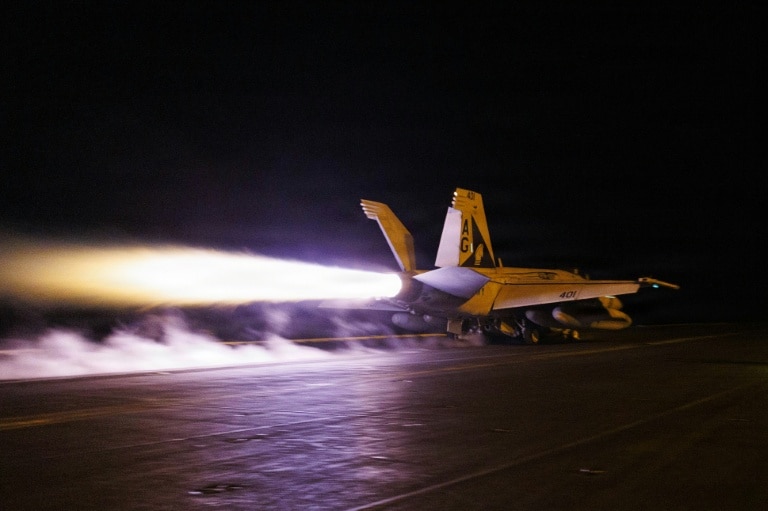
The U.S. military confirmed earlier Thursday that it had completed a heavy wave of strikes against Iran, targeting dozens of Revolutionary Guard sites including key command and control centers. U.S. President Donald Trump had pledged a forceful response after Iran launched an attack on Jordan, marking its second direct regional strike in as many days.
The Revolutionary Guard’s branch in Iran’s northwestern Zanjan Province confirmed that three of its members were killed in the U.S. strikes there. Iran’s official state news agency IRNA also reported strikes across multiple locations in southwestern Khuzestan Province, as well as on Qeshm Island in the Persian Gulf, including areas near the major cities of Abadan, Shadegan, Arvandkenar and Ahvaz.
For the second consecutive day, Jordan’s military announced it had intercepted a new round of Iranian missile attacks Thursday morning, shooting down five incoming missiles with no reported casualties. The Revolutionary Guard later confirmed the missile launch, saying it was a response to U.S. airstrikes launched from American bases stationed in Jordan that killed Iranian civilians on Qeshm Island.
In Kuwait, the defense ministry condemned what it called a “heinous” Iranian strike that hit a building owned by a Chinese company in northern Kuwait, killing one foreign worker and causing extensive structural damage.
The broader regional conflict, which began in February with joint U.S.-Israeli strikes on Iranian targets, has now impacted nearly every country across the Middle East and spilled beyond the region’s borders. While energy infrastructure across the Gulf has faced repeated drone and missile attacks since the conflict began, Egypt remained untouched until Wednesday, when an attack on Egypt’s Mediterranean gas import hub sparked a large fire that damaged two commercial vessels.
Egyptian government officials confirmed Thursday that a drone was responsible for the blaze, noting that no group had yet claimed responsibility. Houthi rebel media issued a statement denying the movement had any involvement in the attack. Iranian Foreign Minister Abbas Araghchi wrote on social media platform X that Egypt is a “valued friend and partner” to Iran, suggesting the attack was a false-flag operation carried out by Israel to destabilize the country.
Egypt’s presidency said an official investigation is ongoing to “uncover the full circumstances of the incident and implement all necessary measures to protect Egypt’s national interests and security.” During a phone call with Spanish Prime Minister Pedro Sanchez, Egyptian President Abdel Fattah al-Sisi emphasized that the international community must act collectively to end the rapidly escalating violence, according to his presidential spokesman.
Maritime trade analytics firm Kpler identified the two damaged vessels as the Energos Winter floating storage and regasification unit and the GasLog Salem tanker, adding that both ships were moved to offshore anchorage following the attack to avoid further risk. UK-based private security monitor Ambrey reported that the floating storage vessel, which is owned and operated by a U.S. firm, was hit by at least one drone. Port authority officials noted that the terminal remains fully operational despite the incident.