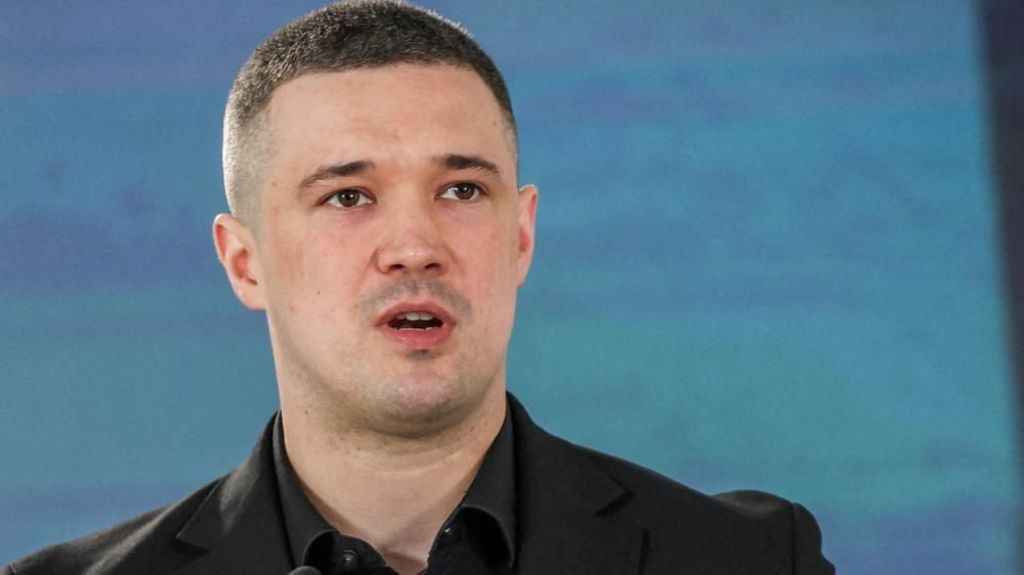
On Thursday, thousands of demonstrators filled central Kyiv’s streets, their anger simmering after Ukrainian President Volodymyr Zelensky removed the popular, reform-minded Defense Minister Mykhailo Fedorov in a sweeping cabinet reshuffle. The decision has split the country’s military community, sparked open accusations of authoritarian drift from critics, and raised urgent questions about the future of Ukraine’s military innovation agenda amid ongoing war with Russia.
For many of Ukraine’s frontline soldiers and wounded veterans, the removal of the 35-year-old Fedorov feels like a personal betrayal. A disfigured infantry soldier, recovering from combat injuries ahead of scheduled reconstructive surgery, captured the widespread despair in a viral Telegram video. “I hope when I wake up after the anaesthetic, Fedorov will be back at the Ministry of Defence,” he said. “Otherwise, everything I was fighting for will have been in vain.”
Maryna, an active-duty soldier who spoke on condition of anonymity to avoid disciplinary action, called the decision a deliberate insult to all Ukrainian service members. “It is a blatant slap in the face to all service members,” she told reporters. “It is truly difficult to put this into words without venting in frustration.” Like many critics, she fears the reshuffle signals a growing authoritarian turn in Kyiv: “A dictatorship is already unfolding here, with its own petty tyrants who think they have caught God by the beard.”
Military leadership has reportedly ordered rank-and-file soldiers to avoid public political commentary, forcing most serving personnel to speak only under pseudonym. Opinion even among soldiers is not uniform: Natasha, a frontline servicemember stationed near the Donbas front, noted that daily Russian multiple launch rocket system attacks on Ukrainian positions leave little bandwidth for political outrage over cabinet changes. Even so, she acknowledged widespread respect for Fedorov’s work, and blamed entrenched old-guard military leadership for his ousting. “If you can’t come to an agreement with the old fossils, they’ll eat you alive,” she said.
That old guard, in the view of many of Fedorov’s supporters, is led by 60-year-old Commander-in-Chief Gen. Oleksandr Syrskyi, a veteran officer shaped by the Soviet-era top-down military system. Once celebrated as a national hero for leading the 2022 defense of Kyiv, Syrskyi has become increasingly unpopular among frontline troops for his human-cost-heavy approach to warfare, earning him derogatory nicknames like “General 200” (a reference to the Soviet military code for combat casualties) and “The Butcher.” Still, some military insiders defend him: Andrii, a former frontline soldier now serving on the General Staff, argues there is currently no qualified replacement for Syrskyi’s experience leading large-scale combat operations.
What is undeniable is that the rift between Fedorov and Syrskyi had grown unresolvable ahead of Zelensky’s decision. Zelensky himself acknowledged the two men could no longer even share a room, while Fedorov has openly blamed Syrskyi for systematically blocking all his military reform and modernization efforts. “It was snowballing. Everyone knew about it. Zelensky had to make a decision,” Andrii said.
The generational and ideological clash between the two men encapsulates a broader divide running through modern Ukraine. Military analyst and former intelligence officer Ivan Stupak framed the divide in starkly technological terms: “Fedorov is an iPhone 16, Syrskyi is a telephone from the 1980s. You know, the same purpose but with different approaches.”
Fedorov first rose to prominence as Ukraine’s Minister of Digital Transformation, where he built a reputation as a relentless innovator committed to modernizing Ukraine’s public and military institutions. During his six-month tenure as Defense Minister starting in January 2026, he delivered a string of high-impact wins: he negotiated with Elon Musk to cut Russian frontline forces off from Starlink satellite internet, a move that disrupted Russian command and control and helped Ukrainian forces repel major Russian advances. He accelerated the integration of artificial intelligence and low-cost drone interception systems to defend Ukrainian cities from Russian drone attacks, and launched a sweeping bureaucratic overhaul of the Ministry of Defense to cut red tape and speed up weapons procurement. His signature “Army of Drones: Bonus” program, which offered frontline units financial incentives for destroying Russian equipment and personnel, was widely credited with boosting troop initiative and accelerating innovation in drone warfare, a capability that has allowed Ukraine to gain an edge over its much larger Russian adversary.
But even before his removal, Fedorov faced deep institutional resistance from the decades-old military bureaucracy. Stupak described the Ministry of Defense as a “swamp” resistant to change: “It’s made of very solid material and it’s very difficult to establish new technologies because lots of people have been there for decades and they don’t share his vision of digitalisation.”
Critics and observers now warn that Fedorov’s departure risks halting his ambitious modernization agenda entirely, despite Zelensky’s public assurances that reforms will continue. With autumn and winter approaching, Russia is widely expected to launch a new large-scale assault on Ukraine’s energy infrastructure, leaving the country more vulnerable without Fedorov’s leadership on drone and air defense innovation. Daria Kaleniuk, executive director of Ukraine’s Anti-Corruption Action Centre, called the decision a devastating setback for Ukraine’s war effort. “I’m very upset that all this progress, which was built by Fedorov, will be just destroyed and reversed in one of the most critical periods of the war,” she said. She also argued the move reveals a troubling authoritarian streak in Zelensky’s leadership, saying it sends a message that the president does not care about public opinion and rejects independent, effective leaders within his government: “That is very destructive for Ukraine.”
The decision to oust Fedorov fits a pattern of Zelensky sidelining or removing popular, effective officials, leading many critics to accuse him of concentrating power and moving toward authoritarian rule. Stupak noted the irony: as a comedian before entering politics, Zelensky built his career lampooning the authoritarian, self-serving post-Soviet political elite. Now, Stupak says, he has adopted the very traits he once mocked: “He’s collected all the factors which were the subject for his jokes. Maybe it’s because he’s been in his position for seven years.”
For activists like Kaleniuk, the recent street protests evoke a strong sense of deja vu. Exactly one year ago, massive anti-government protests – the first since Russia’s 2022 full-scale invasion – forced Zelensky to backtrack on a bill that would have gutted the power of two leading Ukrainian anti-corruption agencies. Today’s protesters are hoping for a similar reversal, even though Zelensky has already appointed acting Security Service head Yevhenii Khmara as interim defense minister.
While current protests are smaller in scale than last year’s demonstrations, Kaleniuk says the stakes are far higher: “These events are even more dangerous, because they directly impact our war effort.”
Maria Berlinska, founder of an NGO that trains volunteer aerial reconnaissance teams, summed up the widespread fear among reformists that even the most successful, loyal leaders are not safe from political sidelining. “You can become a key architect of the strategy of technological victory over the enemy,” she wrote in a Facebook post. “No matter how cool you are, it will not help you. At some point, you will simply be removed from the field.”