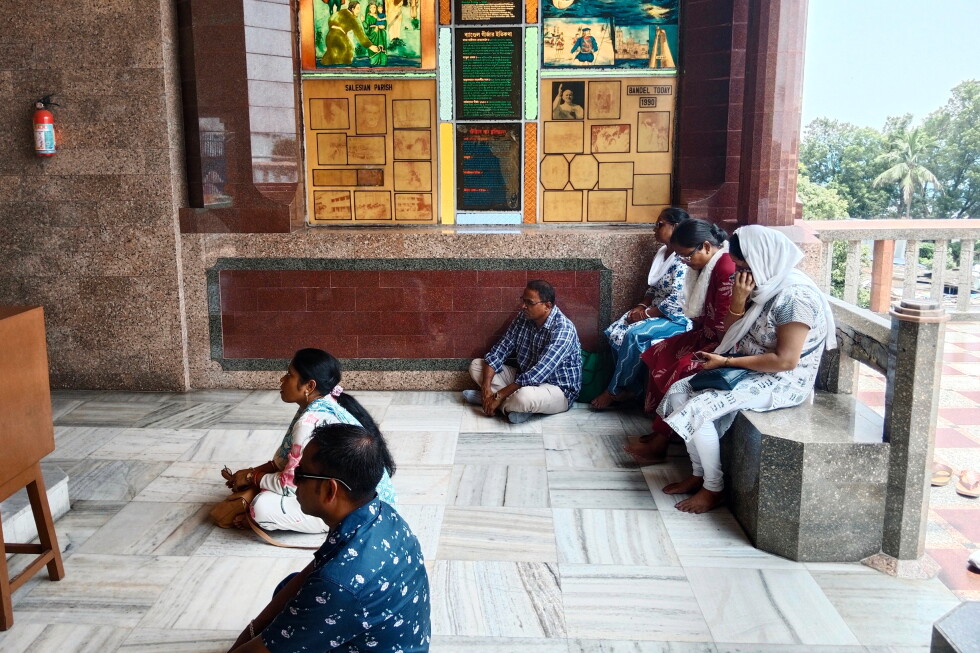
Nestled along the tree-lined banks of West Bengal’s Hooghly River, 50 miles north of state capital Kolkata, the 16th-century Basilica of the Holy Rosary—known locally simply as Bandel Church—has emerged as an unlikely beacon of interfaith harmony amid rising religious polarization across India. For 13 consecutive years, 28-year-old devout Hindu Rimpa Chowdhury has made a weekly pilgrimage to the shrine of Our Lady of Happy Voyage, the iconic statue of the Virgin Mary that draws thousands of cross-faith visitors each year. For Chowdhury and countless other non-Christian devotees, the church is far more than a historic Catholic site: it is a space of healing, community, and quiet peace that transcends religious boundaries.
Decades of interfaith devotion to the shrine are rooted in what visitors call the power of the divine feminine, a shared belief that aligns Mary’s protective energy with the long-standing Bengali tradition of revering female goddesses as the universe’s primordial life force. The church’s history stretches back to the late 1500s, when Catholic Augustinian friars and Portuguese colonial traders settled the Bengal riverfront, tying Marian devotion to Portuguese imperial expansion by placing all regional outposts under Mary’s protection. The original 1599 structure was destroyed twice—first in a 1632 invasion of the Portuguese settlement, then later in a major earthquake—but local legend cemented Mary’s enduring reputation as a divine protector after her statue was recovered intact from the depths of the Hooghly River. In 1988, Pope John Paul II formalized the shrine’s spiritual significance by granting it status as a minor basilica.
Today, the sprawling riverside grounds of the basilica serve as the core of a cross-faith community that spreads across nearby villages, many of which bear informal names honoring Marian apparitions ranging from Our Lady of Fatima to Our Lady of Good Health. Since the 1950s, Catholic nuns from five separate religious congregations have stewarded the shrine, prioritizing community outreach that serves people of all faiths while actively smoothing sectarian tensions. Their work spans far beyond spiritual care: Missionaries of Charity nuns founded by Mother Teresa (who visited Bandel Church in 1995, two years before her death) provide critical health services to surrounding local populations; the Auxilium Convent Sisters run a boarding school for underprivileged young girls, offering full education and support to help them live independently after graduation; and other congregations host retreats, counseling, and community education initiatives focused on women’s rights and tribal welfare.
Father John Chalil, Bandel Church’s lead priest, explained that the region’s long history of religious coexistence laid the groundwork for this shared spiritual space. “In Bengal, the goddess is revered as the ultimate primordial force in the universe,” he said. “Devotees from all over India come here seeking sanctuary, and the nuns cater to their various needs.” Sister Nirmala, who has worked in spiritual ministry at Bandel for more than 15 years, added that religious identity has never stood in the way of devotion. “Religious differences have not interfered with people’s faith in Mary,” she said.
This culture of pluralism faces growing pressure, however, as rising religious polarization and anti-Christian violence have spread across India since Prime Minister Narendra Modi’s Bharatiya Janata Party (BJP) took national power in 2014. Hindu nationalist vigilante groups have increasingly targeted Christian communities, disrupting prayer services, vandalizing church properties, and assaulting clergy and nuns on unsubstantiated claims of forced conversion of Hindus. The United Christian Forum, a New Delhi-based human rights coalition advocating for religious minority rights, recorded 831 anti-Christian attacks across India in the past year alone. AC Michael, the forum’s national coordinator, said the violence has evolved from isolated local incidents to a systemic, networked campaign of persecution.
For decades, West Bengal was a relative safe haven for religious minorities compared to other Indian states, but the recent election of a BJP state government has sparked growing anxiety among local faith communities, and anti-Christian attacks in the region have already begun to rise. While Bandel itself has not yet experienced large-scale targeted violence against religious minorities, nearby areas have seen repeated communal clashes linked to political and religious events. In July of this year, a mob stormed a newly built church south of Kolkata, threatening congregants and destroying religious symbols. Mother Teresa’s Missionaries of Charity, which operates service programs in the region, has also been a high-profile target of Hindu nationalist scrutiny: in 2021, India’s Ministry of Home Affairs revoked the organization’s operating license over unproven conversion claims, only reversing the decision after widespread public pushback.
Despite these growing threats, the nuns who steward Bandel Church say they remain committed to upholding the site’s centuries-long tradition of pluralism. “We’re willing to confront anyone who obstructs the peace and harmony in this region,” said Sister Philomena Mathew, a member of the Missionary Sisters of Mary Help of Christians. Sister Jesline Rose, who serves with the Missionary Sisters of Mary Immaculate, added that the community will carry forward the vision of interfaith solidarity forged by past saints. “No doubt the political landscape in Bengal is changing, but we’ll keep our pluralistic spirit alive,” she said. Rose and her fellow sisters regularly make home visits to Hindu and Muslim families across the neighborhood, offering spiritual support and practical aid to people navigating personal and medical hardship.
For devotees like Chowdhury, who lives in a nearby mixed-faith neighborhood of narrow alleyways behind the church, the nuns embody the enduring protective power of the site they steward. Like many pilgrims, Chowdhury leaves her prayer intentions on slips of paper in the wish box beside the Virgin Mary’s statue, joining thousands of other cross-faith visitors who gather on the church grounds for festivals and annual winter pilgrimages. Though Chowdhury shares widespread anxiety that rising national religious intolerance will eventually reach West Bengal, she says the community at Bandel Church gives her hope. The nuns, she says, “embody the power of Mother Mary, who is the protector of all devotees at our church. Together, the community draws strength from the shared reverence for the divine feminine—from Mary to Hindu goddesses Kali and Durga—to push back against extremist attempts to divide people along religious lines.”