In a sudden turn of events that concludes weeks of leadership upheaval for Italian men’s football, Roberto Mancini has been reappointed as head coach of the Italian national team, just 24 hours after former candidate Andrea Pirlo withdrew from consideration and senior technical figure Paolo Maldini resigned from his post.
The chaos that preceded Mancini’s return traces back to April, when former boss Gennaro Gattuso parted ways with the Italian Football Federation (FIGC) by mutual consent. His departure came after Italy suffered its third consecutive World Cup qualifying play-off defeat, extending the Azzurri’s absence from the sport’s biggest international tournament, a drought that stretches all the way back to the 2014 finals in Brazil. Following Gattuso’s exit, Under-21 manager Silvio Baldini stepped in to lead the side on an interim basis.
Pirlo, a beloved Italian football legend, was widely expected to claim the vacant head coaching role, but pulled out of the process on Monday amid growing public controversy over his existing business connections to a Russian betting company. Before Pirlo emerged as the leading candidate, the FIGC had already reached out to two of the game’s most respected elite managers, Pep Guardiola and Carlo Ancelotti, both of whom declined interest in the position.
In the wake of Pirlo’s withdrawal, Maldini — who had been appointed the federation’s technical director only two weeks prior — and senior advisor Leonardo resigned their posts in protest of the decision not to appoint Pirlo. Stepping into Maldini’s vacated technical director role will be Claudio Ranieri, the journeyman manager who famously guided Leicester City to a historic, against-all-odds Premier League title in the 2015-16 season.
Explaining the federation’s choice to bring back Mancini, FIGC president Giovanni Malago made his position clear: “I believed that the best person to become head coach was Roberto Mancini.”
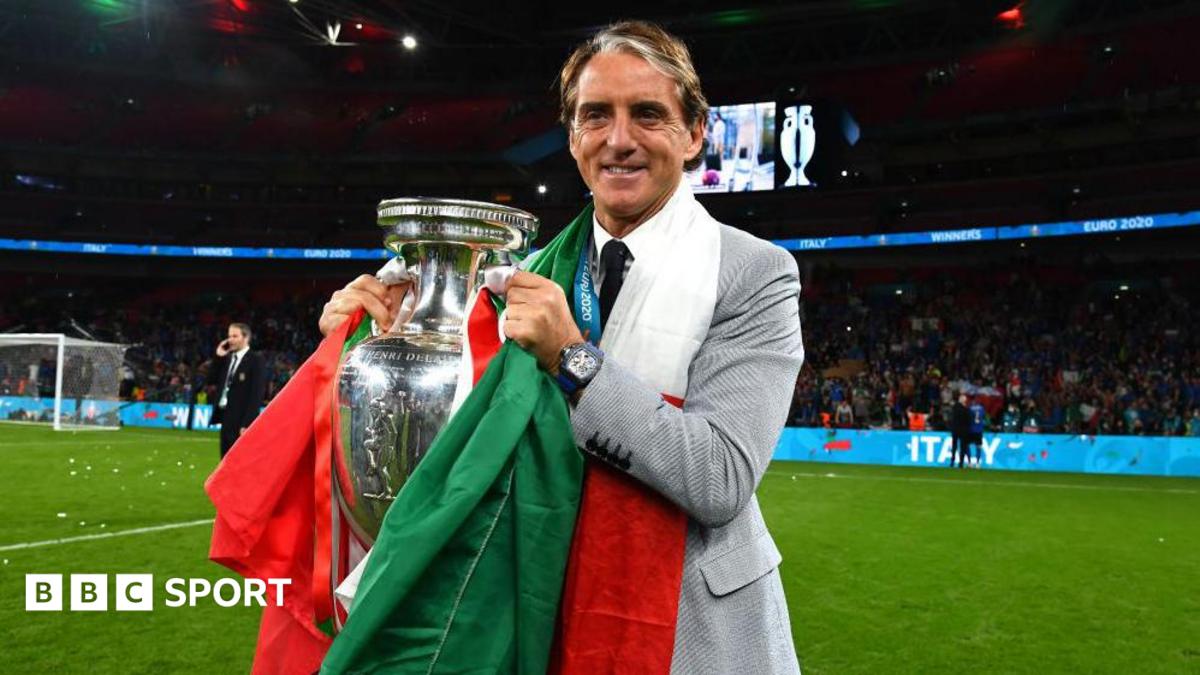
For the 61-year-old Mancini, this return marks a homecoming to a role he already held from 2018 to 2023. During his first tenure leading the Azzurri, he delivered one of Italian football’s most celebrated recent trophies: the UEFA Euro 2020 title, secured with a penalty shootout win over England in the final at Wembley Stadium. He also guided Italy to a world record 37-game unbeaten streak that stands as one of the most impressive extended runs in international men’s football history. That historic run came to an abrupt end, however, when Italy lost a shock 2022 World Cup qualifying play-off to North Macedonia, a result that forced Mancini to resign from his post in August 2023.
Mancini’s resume extends far beyond his international coaching achievements. As a club manager, he led Manchester City to their first-ever Premier League title in 2012, ending the club’s decades-long wait for a top-flight English championship. He also claimed three Serie A titles during his time at Inter Milan, and lifted the Coppa Italia with both Inter and Lazio, proving his ability to deliver domestic silverware across multiple top Italian sides. Before his first Italy appointment in 2018, he also held senior roles at Turkish side Galatasaray and Russia’s Zenit St Petersburg. After leaving the Azzurri in 2023, he spent a short tenure as head coach of the Saudi Arabia national team before taking over Qatari club side Al Sadd. While he led Al Sadd to the Qatar Stars League title during his time in charge, the club exited the AFC Champions League Elite before the semi-final stage and lost the final of the Qatar Cup, prompting Mancini to leave the post in June 2025.
Mancini now faces an immediate test in his second tenure: Italy is set to kick off its 2025-26 UEFA Nations League campaign on September 25, with a home opener against Belgium, followed by an away fixture against Turkey just three days later. All eyes will now be on the returning title-winning coach to steady a federation that has been rocked by weeks of public instability, and end Italy’s painful World Cup qualifying drought ahead of the next cycle of international competition.