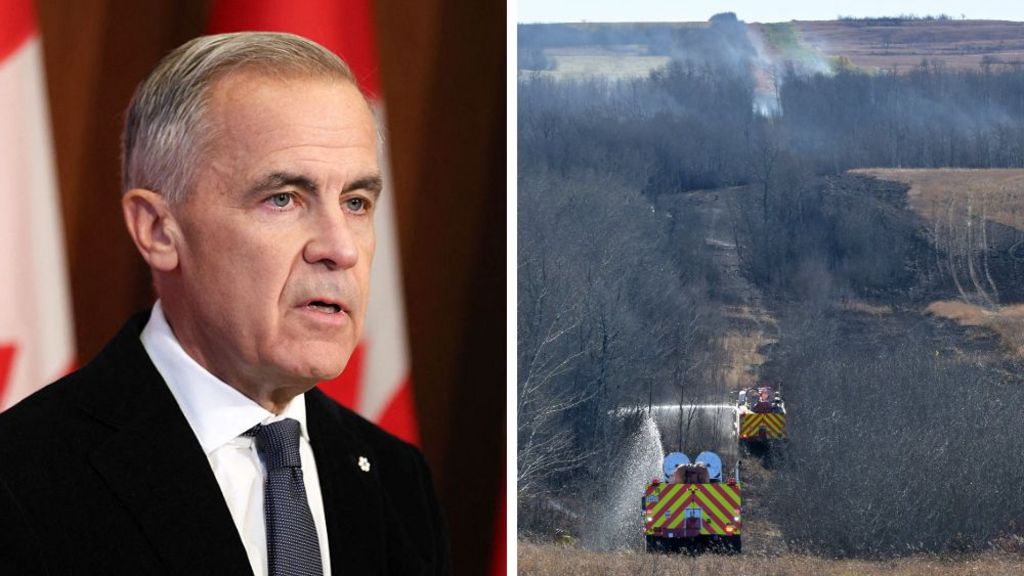
A devastating out-of-control fire at one of Canada’s busiest military training installations in rural Alberta has claimed the lives of four service members and left nearly 40 others injured, in what Prime Minister Mark Carney has called one of the deadliest peacetime military tragedies in Canadian history.
The blaze ignited shortly before 4 p.m. local time Saturday at Canadian Forces Base Wainwright, a sprawling live-fire training hub located roughly 210 kilometers east of Alberta’s capital Edmonton. By the time emergency crews brought the fire under control hours later, it had already left an irreversible mark on the country’s military community.
Canadian Prime Minister Mark Carney addressed the nation from Ottawa Sunday, opening his remarks by extending condolences to the fallen service members’ families and loved ones. “The nation is in mourning for those brave members of our armed forces who we have lost,” Carney said, labeling the incident “one of the worst tragedies for the forces on Canadian soil in peacetime.”
As of Sunday afternoon, the identities of all four fallen troops had been confirmed by BBC sources: Sergeant Morgan Wong, Private Shaun Farrell, Private Aidan Goulding and Private Hayden Lykkemark. Of the 39 injured personnel transported to hospitals across Alberta, at least 19 remain in critical condition, Alberta Premier Danielle Smith confirmed during a Sunday evening press briefing.
At the time the fire broke out, infantry troops were conducting scheduled high-intensity live-fire combat training on the base’s grenade and attack ranges, according to Major-General Wade Rutland. Multiple types of ordnance were in use across the training area, including grenade launchers, hand grenades, small arms and live ammunition. Investigators have confirmed that a grass fire sparked approximately one kilometer from the active training range, and unseasonably strong winds pushed the flames rapidly toward the range’s administrative zone, where personnel were gathered.
Wainwright Mayor Bruce Pugh told the BBC that cannon fire, a routine sound from the base’s training activities, abruptly stopped Saturday afternoon, before local emergency services were called in for an “all hands on deck” response. Fire and rescue teams have remained on site through Sunday to monitor for potential flare-ups of residual hotspots.
Officials have repeatedly ruled out early foul play concerns, confirming that as the investigation into the fire’s origin continues, there is no evidence linking the incident to terrorist activity. Major-General Rutland also added that the blaze was not caused by oil and gas infrastructure operating near the base, nor any form of outside interference.
Canadian Forces Base Wainwright is one of the Canadian military’s primary live-fire training facilities, hosting regular exercises for Canadian troops and allied partner nation personnel. On a standard day, the base hosts roughly 690 active military personnel and 300 civilian employees.
The sheer volume of casualties overwhelmed local medical capacity in Wainwright almost immediately, prompting a mass casualty response across central Alberta. All injured patients were transferred to larger care facilities, primarily Edmonton’s Royal Alexandra Hospital, which initially activated a Code Orange disaster protocol to manage the influx of critical patients. The protocol has since been stood down as care has been stabilized.
Dr. Warren Thirsk, an emergency department physician at Royal Alexandra Hospital, told Canadian broadcaster CBC that the incident completely strained the small local Wainwright healthcare system beyond its capacity. The Alberta provincial health agency deployed 30 emergency response units to Wainwright within hours, including 22 ground ambulances, six fixed-wing aircraft and two helicopter transport units. Regional air ambulance service STARS also sent crews and aircraft from three major centers: Edmonton, Saskatoon and Calgary to assist with patient transfers.
Brandon Simmons, a long-term care resident at Wainwright Health Centre, described the chaotic scene to Reuters. When the Code Orange alert was issued, nursing staff dropped all non-urgent tasks to grab stretchers, gurneys and emergency medical supplies to respond, he said. Ambulances arrived continuously throughout the night, Simmons recalled, adding “I heard people screaming inside of those vehicles that will never end up being out of my mind. It was like a scene from a war movie.”
As of Sunday evening, the investigation into the exact cause of the fire remains ongoing, with Canadian military officials and local law enforcement working to piece together the sequence of events that led to the tragedy.